
Tax refund developments in the US state of Georgia are now entering a distribution phase, with surplus payments of up to $500 expected to reach eligible residents starting in early May 2026. The payments follow legislative approval of a $1.2 billion rebate programme, signed into law in March, and are tied directly to previously filed state income tax returns, meaning eligibility depends on compliance with filing deadlines and confirmed tax liability. State authorities indicate that the tax refund process will be carried out in batches over a six-to-eight-week window, with both direct deposits and mailed checks being used depending on taxpayer records, The WP Times reports.
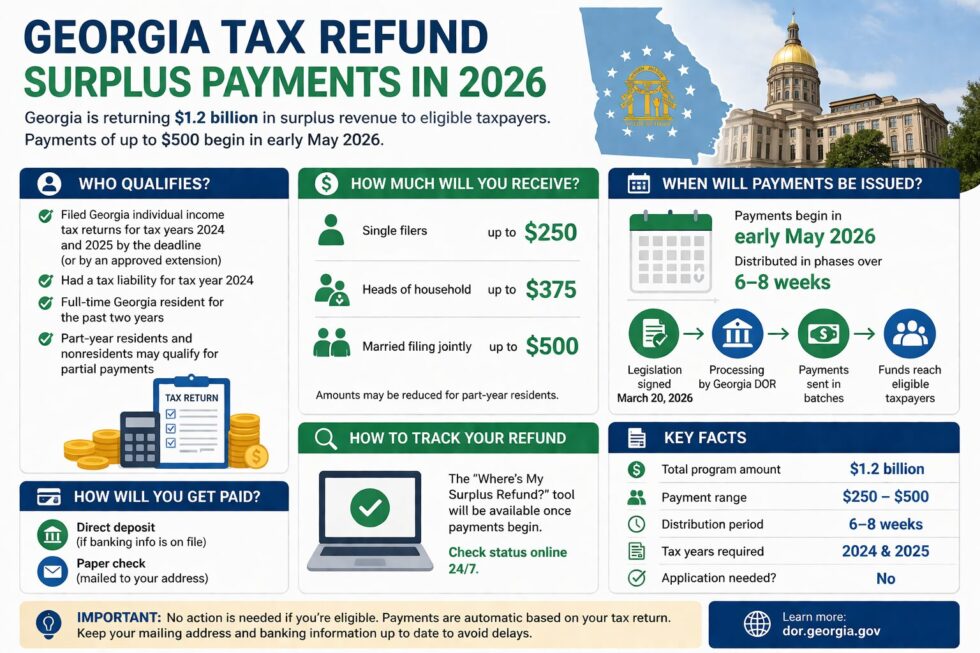
Tax refund eligibility criteria are structured around residency status and filing behaviour, with full-time residents over the past two years forming the core group, although part-year residents and nonresidents may still qualify for partial payments. The Georgia Department of Revenue has confirmed that individuals must have filed returns for the 2024 and 2025 tax years within the official deadlines or approved extensions, while also demonstrating a tax liability for 2024, ensuring that refunds are based on actual contributions rather than universal payouts.
Georgia tax refund eligibility rules: who receives payments and why
The structure of the Georgia tax refund programme reflects a targeted fiscal return rather than a broad stimulus. Payments are calculated based on filing status and prior tax contributions, aligning with the state’s objective to redistribute excess budget revenue without distorting future tax expectations. Eligible groups include:
- Single filers who may receive up to $250
- Heads of household eligible for up to $375
- Married couples filing jointly who may receive up to $500
- Part-year residents with adjusted, proportional payments
- Nonresidents meeting tax liability criteria within Georgia
The system ensures that the tax refund is proportionate and tied to verifiable financial activity within the state. Authorities emphasise that no separate application is required, as payments are automatically triggered through existing tax records.
Payment timeline and distribution mechanics for Georgia tax refund
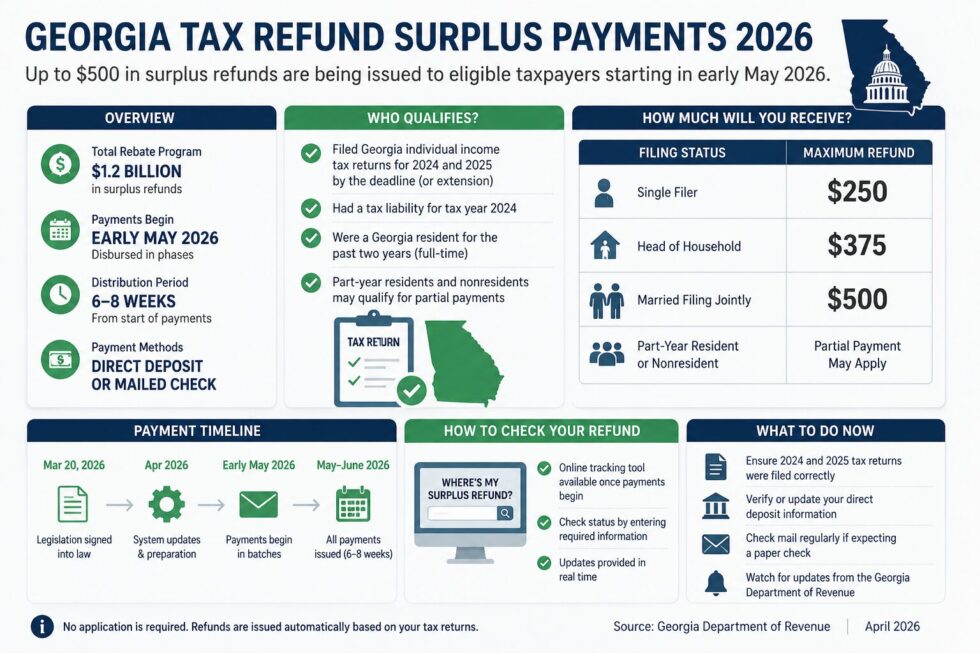
The rollout of the Georgia tax refund is not simultaneous, with officials confirming a phased distribution beginning in early May 2026. The six-to-eight-week timeline is calculated from the date of legislative approval and administrative processing readiness, meaning some residents will receive payments earlier depending on batch allocation.
Table: Georgia tax refund distribution overview
| Factor | Detail |
|---|---|
| Start of payments | Early May 2026 |
| Distribution period | 6–8 weeks |
| Total budget | $1.2 billion |
| Payment methods | Direct deposit or mailed check |
| Tracking tool | Activated during rollout |
The staggered system allows the Department of Revenue to manage volume while maintaining accuracy in payments. A dedicated online tracking tool is expected to become active once distributions begin, enabling taxpayers to monitor their tax refund status in real time.
Legislative background and financial context of the tax refund
The Georgia tax refund programme originates from House Bill 1000, one of the final fiscal measures approved before the end of the current administration cycle. The law authorises the redistribution of surplus state revenue accumulated through stronger-than-expected tax receipts. The policy operates alongside other financial measures introduced at the same time, including temporary suspension of gas taxes and bonus allocations for education sector employees. This positions the tax refund not as an isolated measure, but as part of a broader fiscal balancing strategy.
(“Eligible taxpayers can receive up to $500 in tax rebates as early as the start of May,” Georgia Department of Revenue officials confirmed via Patch, Atlanta, April 23, 2026.)
What taxpayers should do now to secure their tax refund
For most residents, the Georgia tax refund requires no additional action. However, accuracy of personal and banking information remains critical to avoid delays. Recommended steps:
- Verify that 2024 and 2025 tax returns were filed correctly
- Ensure bank account details are up to date for direct deposits
- Monitor official tracking tools once activated
- Check mail regularly if opting for paper checks
- Review eligibility criteria if residency status changed
While the tax refund process is largely automated, discrepancies in records or missed deadlines could result in reduced payments or exclusion from the programme.
Broader implications: how surplus tax refund policies shape state finance
The Georgia case illustrates a recurring trend in US state-level fiscal management, where surplus revenues are returned to taxpayers rather than retained for long-term budget expansion. This approach can stabilise public perception of taxation while reinforcing compliance incentives.
At the same time, the structured and conditional nature of the tax refund ensures that payments remain predictable and controlled, avoiding the inflationary risks associated with universal cash distributions. Analysts note that similar programmes in previous years have followed identical frameworks, indicating a consistent policy direction rather than a one-off initiative. The 2026 rollout therefore represents both a continuation of fiscal policy and a practical example of how state governments manage surplus revenues within defined legal and economic constraints.
Key questions and answers on Georgia tax refund surplus payments
1. Who is eligible for the Georgia tax refund in 2026?
Eligibility is based on filing a Georgia individual income tax return for tax years 2024 and 2025 within the official deadlines (or approved extensions), having a confirmed tax liability for 2024, and meeting residency requirements. Full-time residents are prioritised, but part-year residents and some nonresidents may qualify for partial payments.
2. How much money will eligible taxpayers receive?
The tax refund amount depends on filing status. Single filers can receive up to $250, heads of household up to $375, and married couples filing jointly up to $500. Partial amounts apply in specific cases.
3. When will Georgia tax refund payments be issued?
Payments are expected to begin in early May 2026 and will be distributed in phases over approximately six to eight weeks.
4. Do I need to apply to receive the tax refund?
No application is required. Payments are issued automatically based on existing tax records and previously filed returns.
5. How will the tax refund be paid?
Refunds will be delivered either via direct deposit or by mailed check, depending on the information provided in the taxpayer’s filings.
6. Can part-year residents receive a tax refund?
Yes, part-year residents may receive a reduced or proportional payment depending on their taxable activity within Georgia.
7. What if I did not file my tax return on time?
Late filing may affect eligibility unless an official extension was granted and the return was submitted within that extended deadline.
8. How can I track my Georgia tax refund status?
A “Where’s my surplus refund?” tracking tool is expected to go live once payments begin, allowing taxpayers to monitor progress.
9. Why is Georgia issuing these tax refunds?
The refunds are funded by surplus state revenue and authorised through legislation to return excess funds to taxpayers rather than retain them in the state budget.
10. Could the tax refund be delayed?
Delays may occur if there are discrepancies in tax records, incorrect banking details, or high processing volumes during the phased distribution period
Read about the life of Westminster and Pimlico district, London and the world. 24/7 news with fresh and useful updates on culture, business, technology and city life: E.ON Ovo Energy merger: how will German energy group’s deal reshape UK market competition