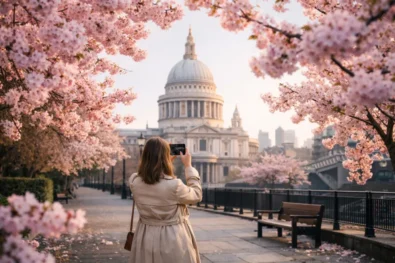
Hanukkah in London starts this evening, 14 December, at sunset — a timing detail often overlooked by visitors unfamiliar with the Jewish calendar. Unlike Christian holidays, the Jewish day begins after nightfall, meaning the first candle is lit in the early evening rather than during daytime hours. In London, this places the start of Hanukkah directly within the city’s commuter window, as offices in the City and Canary Wharf close, streets across Westminster and Camden remain active, and public transport runs at peak frequency. According to community estimates, more than 300,000 Jews live in Greater London, with the largest concentrations in Barnet, Hackney, Haringey and Camden, making Hanukkah a visible and lived observance across wide parts of the capital.
The festival runs for eight consecutive nights, concluding after sunset on 22 December. This structure shapes how Hanukkah appears in public life. Most menorah lightings, synagogue gatherings and cultural programmes are scheduled between 4:30 pm and 8:00 pm, aligning religious tradition with London’s standard working-day rhythm. In neighbourhoods such as Golders Green, Hendon and Stamford Hill, candle-lighting times are displayed in shop windows and community centres, while central ceremonies — including public menorah lightings near Trafalgar Square — are timed to allow attendance after work without disrupting daily routines. In London, Hanukkah does not interrupt the city’s pace; it integrates into it, evening by evening, candle by candle, according to the editorial assessment of The WP Times.
What actually happens during the eight days
Hanukkah is not one event repeated eight times. Each night marks a progression. One candle on the first evening, two on the second, and so on, until all eight candles are lit. In London, this progression is visible in synagogue schedules, community calendars and private homes, where menorahs appear in windows — particularly in North London. The cumulative lighting is not symbolic theatre; it reflects the central theme of the holiday: continuity under pressure.
For searchers asking “how long does Hanukkah last in London” or “when does Hanukkah end”, the answer is precise: from sunset 14 December to sunset 22 December.
Trafalgar Square: why this location matters
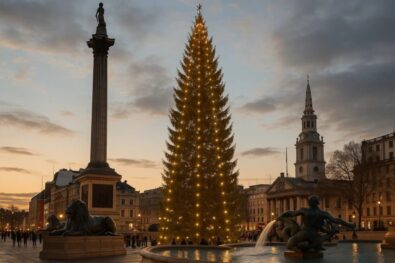
The public menorah lighting in Trafalgar Square is not accidental branding. It places a minority religious tradition at the symbolic heart of the capital, alongside Christmas trees and New Year infrastructure. Organised with Jewish community organisations and supported by City Hall, the event is designed as civic recognition rather than religious outreach.
Attendance is mixed: Jewish families, tourists, diplomats, and passers-by who did not plan to attend anything at all. The ceremony is short, structured and deliberately accessible. There is no expectation of participation beyond observation.
Address: Trafalgar Square, London WC2N 5DN
North London: where Hanukkah is lived, not staged
To understand how Hanukkah functions day to day, visitors go north. Golders Green, Hendon and Stamford Hill are not event zones; they are residential centres where the festival unfolds organically. Menorahs appear in windows. Bakeries adjust their offerings. Kosher shops stock candles and oil-based foods tied to the holiday’s core narrative.
This is where searches like “Jewish areas London Hanukkah” or “where do Jews celebrate Hanukkah in London” find their real answers.
Food as historical memory, not trend
Hanukkah food in London is not experimental. It is conservative by design. Latkes (potato pancakes) and sufganiyot(jam doughnuts) dominate because they are fried in oil, referencing the central historical narrative of the holiday. These foods appear in kosher bakeries across North London and at community events, not as pop-ups but as seasonal constants.
For visitors expecting Hanukkah to resemble a winter food festival, this restraint is striking — and intentional.
Cultural institutions and context
For those seeking explanation rather than participation, London offers structured entry points.
Jewish Museum London contextualises Hanukkah within British Jewish history, connecting religious practice to migration, integration and identity.
Address: 129–131 Albert Street, London NW1 7NB
JW3, London’s Jewish community centre, frames Hanukkah culturally rather than devotionally, offering lectures, film screenings and discussions that position the holiday within modern British life.
Address: 341–351 Finchley Road, London NW3 6ET
Is Hanukkah a public holiday in the UK
Hanukkah is not a public holiday in the United Kingdom, and daily life in London continues without formal interruption. Public transport operates on regular timetables, offices in the City and Canary Wharf remain open, and schools do not close. For visitors from countries where religious festivals trigger nationwide shutdowns, this often comes as a surprise. In Britain, public holidays are limited to a fixed civic calendar, and religious observances outside that framework are recognised through accommodation rather than legislation.
In practice, this means flexibility rather than closure. Employers are generally aware of Hanukkah and may allow adjusted hours for evening candle lighting. Cultural institutions and local authorities acknowledge the festival through public menorah ceremonies and official messaging, particularly in London. The result is a form of recognition that is visible but restrained: Hanukkah is present in public space, marked symbolically and culturally, yet it does not override the city’s economic or administrative rhythm. This balance explains why the festival is clearly felt across London without becoming dominant.
Why Hanukkah in London matters now
That Hanukkah begins today, 14 December, matters because it unfolds during London’s most crowded civic period, when Christmas markets, end-of-year retail trading and major cultural programming compete for public space. Yet Hanukkah is neither displaced nor absorbed. Public menorah lightings proceed alongside Christmas infrastructure in central locations, and Jewish neighbourhoods maintain visible religious practice without requiring exceptional security measures or municipal disruption. This coexistence is operational, not symbolic.
London’s handling of Hanukkah reflects a long-established model of religious presence in public life. The city does not suspend commercial activity, but it accommodates minority observance through access to space, official recognition and scheduling tolerance. Candle-lighting ceremonies are authorised in central squares, community notices are displayed openly, and cultural institutions programme Hanukkah events within mainstream calendars. These are administrative decisions, not gestures.
For a city that positions itself as a global capital of pluralism, this approach is consequential. Hanukkah in London is not framed as spectacle, nor confined to private interiors. It is permitted to exist in public view, according to ordinary civic rules. That balance — visibility without dominance, recognition without exception — is the result of policy, historical continuity and an urban identity that treats religious diversity as infrastructure rather than performance.
Read about the life of Westminster and Pimlico district, London and the world. 24/7 news with fresh and useful updates on culture, business, technology and city life: Disney's Hercules: Is This the Biggest Show Opening of 2025