Luxury gyms in London are concentrated in SW1 — the Westminster, Pimlico, St James’s and Belgravia postcode — because it is the operational heart of the British state and the international economy. This is where Parliament, Whitehall, foreign embassies, global law firms and financial institutions are physically clustered, creating the highest density of time-critical professionals in Europe. In this environment, fitness is not lifestyle spending but working infrastructure: bodies must be maintained with the same reliability as transport, broadband and private healthcare. According to the The WP Times editorial desk, more than 40 premium and luxury gyms now operate across central London, with monthly memberships ranging from £200–£350 in high-end clubs to £500–£1,000+ in ultra-private and medical gyms, while the highest-rated venues on Google, typically scoring 4.4 to 4.9, are those that cap member numbers and guarantee access at peak hours. SW1 is not just a postcode — it is the market that made luxury fitness economically viable in London.
What “luxury” means in the London fitness market
In Britain’s capital, a luxury gym is not defined by marble reception desks or Instagram-ready interiors. It is defined by how well the operation works. Across Westminster, Pimlico and Mayfair, a club is considered genuinely premium only if it meets most of the following criteria:
• Low member-to-space ratio, ensuring that peak-hour overcrowding is avoided
• Professional-grade equipment, typically from brands such as Technogym, Eleiko or Woodway
• Highly trained staff, often with backgrounds in sports science, rehabilitation or elite coaching
• Recovery infrastructure, including sauna, steam, physiotherapy or mobility studios
• Long opening hours, often from 6 a.m. to late evening
A gym with stylish interiors but no coaching depth, limited recovery facilities and inconsistent staffing is not a luxury gym in London. It is simply an expensive one.
Why professionals pay more
The difference between a £70 gym and a £300 gym is not prestige. It is predictability. At budget and mid-range gyms, peak hours are typically chaotic. Equipment is occupied, classes are oversubscribed, and trainers are often responsible for too many members at once. Sessions are rushed. Recovery is neglected. Injuries accumulate. Luxury gyms operate on the opposite model. They sell consistency. Members know that when they arrive, the equipment will be available, the floor will be clean, and qualified staff will be present. Over time, this leads to fewer injuries, fewer missed sessions and better results. For lawyers, diplomats, senior civil servants and executives working in Westminster, that stability is worth far more than the monthly fee.
How much luxury gyms cost in London
By 2026, London’s premium fitness market has settled into three broad pricing tiers:
| Tier | Typical monthly fee | What it offers |
|---|---|---|
| Premium boutique | £150–£250 | Small clubs focused on personal training and coached sessions |
| Luxury health club | £200–£350 | Full gym, classes and recovery areas |
| Ultra-luxury private club | £400+ | Medical assessments, physiotherapy and concierge-level service |
The higher price reflects more than design. A £300-per-month club typically employs two to three times more staff per member than a budget gym, invests more heavily in equipment replacement, and maintains much higher cleaning and maintenance standards.
Why Westminster and Pimlico dominate
Few parts of Europe combine as much political power, financial capital and international mobility in such a small area. Within a few square miles of SW1 sit Parliament, the Treasury, global law firms, embassies and some of the most valuable residential property in the UK.
That concentration creates a client base that:
• Trains early or late
• Requires discretion
• Expects professional service
• Is willing to pay for reliability
Luxury gyms cluster where those conditions exist. As a result, Westminster now has more high-end fitness clubs per square kilometre than any other part of Britain.
What members actually receive
A typical Westminster luxury gym membership includes:
• Access to uncrowded gym floors
• High-grade strength and cardio equipment
• Premium changing rooms with towels and lockers
• Group classes or coached sessions
• Recovery facilities such as sauna or mobility studios
• Priority booking for trainers and treatments
The real benefit is not visible in a single visit. It appears over months, as routines become smoother, injuries decline and training becomes part of daily life rather than something that has to be fought for.
Top 10 Luxury Gyms in London (2026)
Luxury gyms in London are no longer lifestyle accessories. In districts such as Westminster, St James’s, Mayfair and Marylebone, they operate as performance infrastructure for a workforce whose income depends on mental clarity, physical resilience and time efficiency. This ranking identifies the best luxury gyms in central London in 2026 based on facilities, training depth, recovery provision, member control and real-world usage by professionals.

Third Space Marylebone – Marylebone, Central London
Third Space Marylebone is widely regarded as the reference standard for London luxury gyms. The club occupies two full floors of purpose-built training space with separate zones for strength, conditioning, functional training and recovery.
Members have access to a 16-metre swimming pool, sauna, steam rooms, hot and cold contrast showers, multiple studio spaces and a fully equipped performance gym floor. The membership is intentionally capped to avoid congestion, which is why equipment is consistently available even at peak hours.
Typical members include consultants, lawyers, surgeons and finance professionals who train before work or between meetings.
Hours: Mon–Fri 05:30–22:00, Sat–Sun 08:00–20:00
Google rating: 4.6
Typical membership: £200–£350 per month
Trial access: Paid guest passes available
Why it stands out: One of the few gyms in London combining serious strength training with full-scale recovery infrastructure.
E by Equinox St James’s – St James’s, Westminster
Located in the heart of London’s political and diplomatic quarter, E by Equinox St James’s is designed for high-output professionals who require structured, coached training rather than open-floor gym use. The club integrates strength training, high-intensity intervals, Pilates, yoga and signature cycling under a tightly programmed schedule. Classes are capped, equipment is closely managed and coaching standards are high. It is used heavily by civil servants, financial executives and senior consultants working in Whitehall and Mayfair.
Hours: Approximately 06:00–21:00 weekdays
Google rating: 4.0
Typical membership: High-end, enquiry based
Trial access: Limited guest passes
Why it stands out: One of the most disciplined and professionally run gyms in central London.
Lanserhof at The Arts Club – Mayfair, West End
Lanserhof represents the medicalisation of luxury fitness. Members do not simply train; they undergo blood testing, metabolic assessment, body-composition scanning and clinical review, which then shapes their training, nutrition and recovery programme. The gym is supported by doctors, physiotherapists and sports scientists, making it a preferred choice for executives, athletes and individuals managing injury, burnout or long-term health risks.
Hours: Approx. 06:30–21:00 weekdays
Google rating: 4.4
Typical membership: From around £6,500 per year plus joining fees
Trial access: Medical consultation required
Why it stands out: The most scientifically monitored training environment in London.
Bath & Racquets Club – Mayfair, West End
Bath & Racquets is not a commercial gym. It is a private sporting institution with fewer than 300 members. Facilities include squash courts, training rooms and private lounges in a discreet Georgian townhouse. Membership is by introduction only, and the club is known for absolute privacy and minimal public exposure.
Hours: Early morning to evening, varies by day
Google rating: 4.9
Membership: Invitation only
Why it stands out: The most exclusive and discreet training environment in London.
BXR Marylebone – Marylebone, Central London
BXR is London’s leading boxing and high-performance conditioning club. Founded with heavyweight champion Anthony Joshua, it provides professional boxing coaching, strength training and athletic conditioning in a premium environment.
Unlike fashion gyms, BXR is rooted in real combat-sport training, attracting both professional athletes and serious amateurs.
Hours: Approx. 06:15–22:00 weekdays
Google rating: 4.2
Membership: Varies by training package
Trial access: Introductory sessions available
Why it stands out: The most authentic elite boxing gym in London.
The Club at County Hall – Westminster, South Bank
Housed inside the London Marriott County Hall, this club offers a 25-metre swimming pool, Technogym-equipped gym floor and spa-level changing facilities overlooking the Thames.
It serves both Westminster professionals and international hotel residents who want a premium but practical training base.
Hours: 07:00–21:00 daily
Membership: By enquiry
Day passes: Available
Why it stands out: One of the best pools in central London.
Blok London – Central London
Blok operates boutique strength and conditioning studios across central London. The focus is on coached functional training, controlled class sizes and architect-designed minimalist interiors. It attracts professionals who want structured, performance-focused sessions without the chaos of large gyms.
Pricing: Typically £25–£35 per session
Why it stands out: Coaching quality and uncluttered, serious training environments.
1Rebel Soho and Tottenham Court Road – West End
1Rebel specialises in high-intensity studio workouts combining cycling, strength and HIIT. Sessions are designed for people who want maximum output in under an hour.
It is popular with professionals in media, technology and finance working in the West End.
Pricing: Class-based memberships
Why it stands out: Highly time-efficient, high-energy training.
The Lanesborough Club and Spa – Belgravia
This club merges elite gym facilities with five-star spa and physiotherapy services. Members move seamlessly between strength training, swimming, recovery and treatment.
Pricing: Typically £500+ per month
Why it stands out: Full-spectrum luxury wellness alongside proper gym facilities.
Studio Fix Kensington – Kensington, West London
Studio Fix offers a modern take on boutique fitness with Pilates, Lagree, HIIT and mobility-focused training delivered in premium studios.
Pricing: From around £25 per class
Why it stands out: Flexible, design-led and professionally programmed.
What Luxury Gym Membership Delivers in London
In 2026, true luxury gyms in London provide:
- Controlled member numbers
- Professional-grade equipment
- Sauna, steam and recovery areas
- Small-group or personal coaching
- Clean, staffed changing rooms
- Predictable access without queues
Typical monthly cost
| Type | Price |
|---|---|
| Boutique studio | £150–£250 |
| Luxury health club | £200–£350 |
| Ultra-luxury or medical | £400–£1,000+ |
Are luxury gyms worth it
For people who train once a week, the economics of a £250–£400 monthly membership rarely make sense. But for those training three or more times per week — which is typical among professionals in Westminster, Mayfair and the City — the cost equation changes.
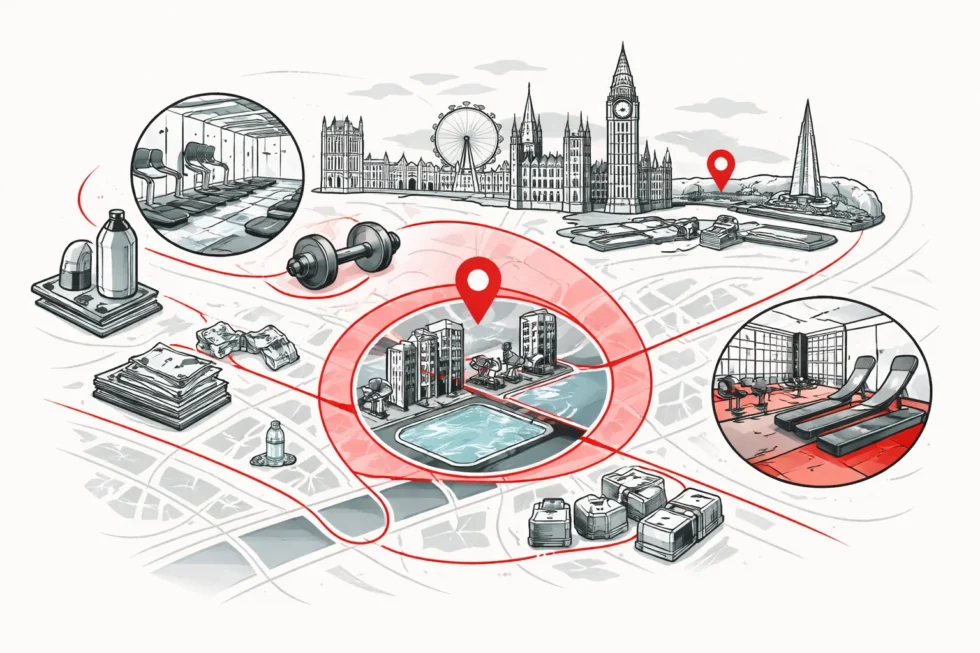
At that frequency, the dominant risk is not price. It is drop-out, injury and inconsistency. In London’s low-cost and mid-range gyms, peak-hour utilisation regularly exceeds 120–150% of designed capacity. That produces three predictable outcomes: equipment queues, rushed sessions, and inadequate supervision. Each of these increases the probability of skipped workouts and overuse injuries — the two main reasons why most gym memberships fail to deliver results.
Premium clubs operate on a different model. By capping memberships and staffing at higher ratios, luxury gyms reduce congestion, increase coaching availability and integrate recovery into the training process. The effect is measurable: fewer cancelled sessions, lower injury rates and more stable weekly attendance.
This is why retention rates in central London’s luxury gyms are consistently higher than in budget chains. Members do not stay because the interiors are nicer. They stay because the operating model allows them to train three to five times a week without disruption.
Over a year, that consistency often makes a £300 gym cheaper than a £70 gym that is used irregularly or abandoned after injury. People do not remain in luxury gyms out of loyalty. They remain because the system keeps working.
Read about the life of Westminster and Pimlico district, London and the world. 24/7 news with fresh and useful updates on culture, business, technology and city life: Pimlico private doctors: same-day GP, blood tests and private medical clinics near Westminster