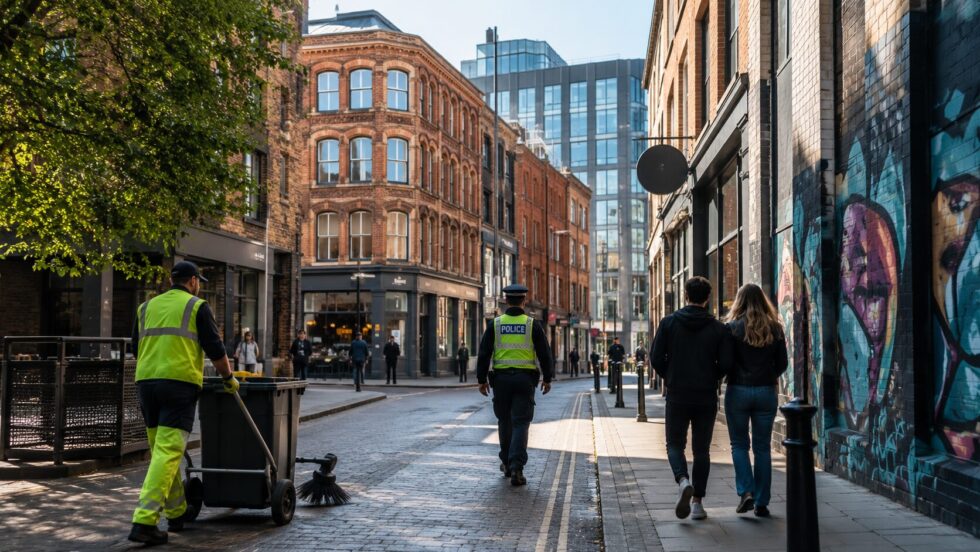
9 August 2026. Manchester’s Northern Quarter is set for a five-year programme worth about £4 million after businesses backed a new Business Improvement District intended to put more money into street cleaning, safety, anti-social behaviour responses and support for the area’s day and night-time economy. The BID will begin on 1 January 2027 and cover roughly 420 qualifying businesses across the northern part of Manchester city centre, stretching broadly from Great Ancoats Street towards Corporation Street and from Piccadilly towards Ducie Street, while also taking in areas including NOMA and the Printworks. Businesses with a rateable value of at least £27,000 will fund the programme through a compulsory levy, while CityCo Manchester will manage the district. The WP Times reports that the plan is intended to go beyond cosmetic improvements, combining targeted cleaning with measures addressing drug-related activity, aggressive begging, threatening behaviour, night-time vulnerability and the pressures faced by businesses in one of central Manchester’s busiest districts.
The project has already cleared its decisive commercial hurdle, with Manchester Evening News reporting that businesses backed the scheme in a July 2026 ballot. CityCo recorded 182 votes in favour and 16 against, equivalent to 91% support by number of votes and 92% by rateable value. The result means the Northern Quarter BID can operate for five years from January, using levy income to provide services additional to those already supplied by Manchester City Council and Greater Manchester Police. The programme is expected to include a dedicated team dealing with anti-social and threatening behaviour, more systematic reporting to police and the council, targeted jet washing and early-morning street cleaning, late-night welfare support and projects aimed at encouraging workers and visitors to spend more time in the district.
What will the Manchester Northern Quarter £4m plan actually change
The most immediate changes are expected at street level. CityCo describes the BID as a mechanism through which businesses agree a five-year business plan and then finance it collectively through a levy based on rateable value. In the Northern Quarter, the programme is expected to generate about £4 million of additional investment between 2027 and 2032, creating a budget that can be directed specifically at issues identified by businesses inside the BID boundary.
That distinction is important. The BID is not intended to take over ordinary council cleaning or replace police officers. Instead, the money can pay for additional services that operate on top of the existing public provision, with priorities set around the commercial and public-space pressures particular to the Northern Quarter.
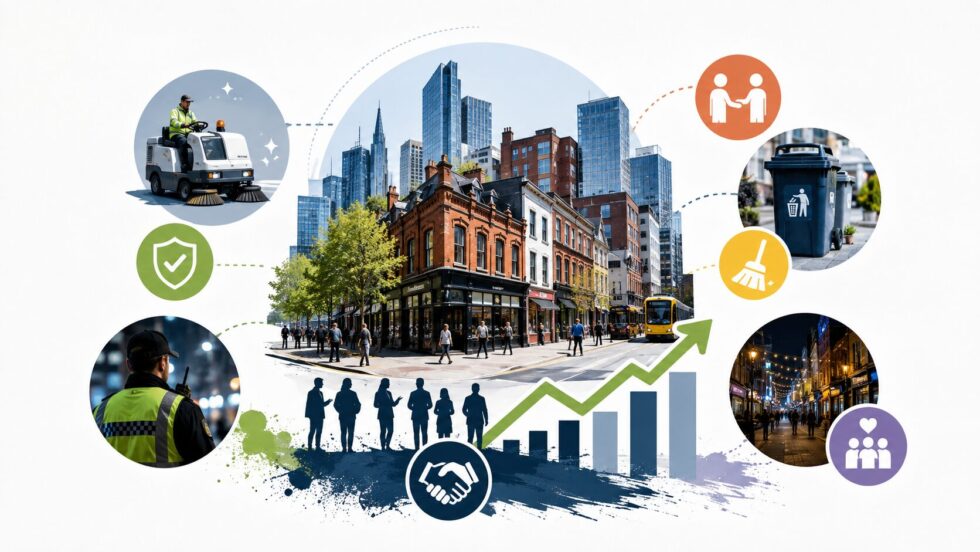
The proposed work includes:
- targeted jet washing and additional early-morning cleaning in heavily used streets;
- a dedicated presence addressing anti-social and threatening behaviour;
- better systems for businesses to report incidents and share information with police;
- late-evening and weekend welfare support for people who may be vulnerable;
- additional street projects, including creative interventions and public art;
- activity intended to support footfall and the district’s independent businesses;
- investigation of a loyalty programme for people working in the Northern Quarter.
The plan is therefore less about physically rebuilding the Northern Quarter than changing how intensively it is managed every day and late into the night.
CityCo’s proposal also reflects the unusually mixed economy of the district. The BID area includes independent shops, restaurants, bars and music venues alongside offices, creative agencies, fashion businesses and larger leisure operators. That creates different pressures at 8am, during the working day and after midnight, which helps explain why cleanliness, business support and night-time welfare appear in the same five-year programme.
Why safety and anti-social behaviour are central to the Northern Quarter BID
The focus on Northern Quarter safety is backed by recent police activity rather than being based solely on perceptions among traders. Greater Manchester Police said in June 2026 that residents and businesses had raised concerns about anti-social behaviour, drug-related activity and crime in the neighbourhood, prompting targeted operations with Manchester City Council.
The figures from those operations show the scale of the enforcement work already under way. GMP reported that three targeted days of action resulted in 22 arrests, 67 stop searches, three warrants, three searches of homes, one closure order and 18 Public Space Protection Order interventions. Officers said arrests were linked to offences including theft, drug supply, public-order matters, possession of a bladed article and assaulting an emergency worker.
Police also carried out environmental assessments examining lighting, CCTV and locations where additional cleaning was needed. That overlap between policing and the physical condition of streets closely mirrors the structure of the BID plan: businesses are not treating litter, threatening behaviour, drug activity and perceptions of safety as entirely separate problems.
“We’ve listened to the concerns from residents and businesses in the Northern Quarter.” (Inspector Kam Hare, City Centre Neighbourhood Team, Greater Manchester Police, 19 June 2026.)
GMP has continued targeted city-centre work since then. In July, officers reported proactive patrols addressing anti-social behaviour, drug use and public-order issues around the wider city centre, while earlier operations had also focused on concerns about drug dealing and drug misuse affecting the Northern Quarter and Piccadilly Gardens area.
The BID could provide businesses with a more permanent interface between those police operations and day-to-day trading. A shop worker, restaurant manager or venue operator may encounter repeated low-level behaviour that does not necessarily trigger an emergency response but still affects staff, customers and the surrounding street. A dedicated BID team can collect reports, identify recurring locations and pass information into existing council and police structures.
How the new Northern Quarter safety team and ‘Angels’ scheme could work
One of the more distinctive elements of the Manchester city centre improvement plan is the proposed creation of an additional team focused on anti-social and threatening behaviour. The aim is not to give private BID staff police powers. Their function would be closer to visible reassurance, incident recording, communication with businesses and escalation to the appropriate authority.
This matters in a district where the daytime retail economy changes rapidly into a late-night hospitality environment. Oldham Street, Thomas Street, Stevenson Square and surrounding roads can move from shopping and office activity into a dense evening economy within several hours, placing different demands on businesses and public services.
A proposed “Angels” scheme would add a welfare component during evenings and weekends. Based on the published plan, the service would be intended to help people who are vulnerable, need directions or require connection to another service rather than functioning as another enforcement unit.
Possible interventions include:
- identifying people who appear vulnerable or separated from friends;
- directing visitors towards transport, medical assistance or other support;
- helping venues deal with welfare concerns outside their premises;
- connecting serious incidents with police or specialist services;
- maintaining a visible support presence during the busiest night-time periods.
The practical difference is that not every difficult incident on a night out begins as a crime, but some require intervention before they become one.
The proposal fits a wider Manchester model of combining enforcement with welfare responses. GMP’s city-centre priorities include work on anti-social behaviour associated with rough sleeping, homelessness and begging alongside engagement with support services. The distinction between vulnerability and criminal behaviour is relevant to a BID that has identified aggressive begging as a concern while also proposing support for vulnerable people.
How much will Northern Quarter businesses pay for the BID?
The programme is funded by businesses rather than a new general city-centre tax. Under the BID model, qualifying commercial properties inside the defined boundary pay a levy calculated from their rateable value, creating a ring-fenced budget for the five-year business plan.
Council documents produced during the development of the scheme said only businesses with a rateable value of £27,000 or more would fall within the BID, subject to its detailed rules and exemptions. Approximately 420 businesses were expected to be covered. Formal consultation began in summer 2025 before the proposal progressed towards the 2026 ballot.
| Northern Quarter BID detail | What is planned |
|---|---|
| BID start | 1 January 2027 |
| Initial duration | Five years |
| Investment | About £4 million |
| Approximate businesses | Around 420 qualifying businesses |
| Funding method | Levy based on rateable value |
| Main priorities | Safety, cleaning, business support and promotion |
| Management | CityCo Manchester |
| Renewal | Requires a further process after the initial term |
The levy is significant because it changes additional neighbourhood services from voluntary initiatives into a collective programme. Once a BID ballot succeeds, eligible businesses covered by its rules contribute rather than choosing individually whether to fund each cleaning, security or marketing project.
That also places responsibility on the BID management to demonstrate what businesses are receiving for the money. A five-year programme can establish regular cleaning schedules, employ staff and commission longer-term projects in a way that a series of one-off contributions cannot. The measurable questions will concern deployment: how frequently streets are cleaned, where support teams operate, how incidents are handled and what proportion of the budget reaches visible services.
CityCo describes a BID as a defined area in which businesses come together around an agreed business plan, vote on it and, if approved, finance the five-year programme through a rateable-value levy. (CityCo Manchester, Northern Quarter BID information, 2026.)
Which parts of Manchester will be covered by the Northern Quarter BID?
The Northern Quarter £4m plan reaches beyond the relatively small collection of streets most visitors immediately associate with the neighbourhood. The proposed boundary covers a substantial part of the northern city centre and incorporates different types of commercial districts.
The source material describes the area as extending from Great Ancoats Street towards Piccadilly and between Corporation Street and Ducie Street, with NOMA and the Printworks also within the wider footprint. CityCo says the district encompasses businesses ranging from independent retail and hospitality to offices, leisure, creative companies, fashion and other commercial operators.
This wider geography has practical consequences. Cleaning priorities around a nightlife street may involve waste and early-morning washing, while an office-led area may be more concerned with commuting routes, staff safety or public-space maintenance. Large leisure destinations can generate concentrated visitor flows that create another set of demands.
Why roughly 420 businesses are being brought into one scheme
The case for grouping them together rests on the fact that the problems do not stop at individual property boundaries. A business can maintain its own frontage but cannot independently clean an entire route to a tram stop, manage behaviour elsewhere on the street or establish a district-wide incident-reporting network.
A BID creates a single operating area in which those shared problems can be funded collectively. The approach already exists elsewhere in Manchester city centre, meaning CityCo is extending an established management model rather than testing the concept for the first time.
The Northern Quarter version is unusual mainly because of the district’s concentration of independent commerce, creative businesses and late-night activity within the same streets.
For smaller independent operators, the question will be whether a district-wide system produces enough direct value at their door. Larger businesses are likely to focus on how the levy compares with security, cleaning and marketing services they already purchase privately.
What did businesses actually vote for in July 2026?
The July ballot is one of the clearest indicators of commercial support for the scheme. CityCo reported 182 votes for the BID and 16 against, with the proposal receiving 91% support among votes counted and 92% support when measured by rateable value. The result was announced on 14 July 2026.
Those figures matter because BID approval is not determined by a simple show of hands at a business meeting. The statutory model requires support both among participating businesses and by the rateable value represented in the ballot, preventing either a small number of high-value businesses or a larger collection of low-value properties from determining the result alone.
The result established the mandate for a 1 January 2027 start. CityCo can now move from campaigning for the proposal towards setting up the operational structure needed to deliver the business plan.
The sequence has been relatively long:
- formal business consultation began in summer 2025;
- proposals and the BID boundary were developed with qualifying businesses;
- Manchester City Council considered the necessary arrangements during 2026;
- businesses voted on the five-year plan in July;
- the ballot passed with 182 votes for and 16 against;
- the BID is scheduled to become operational on 1 January 2027.
This timetable also explains why many of the measures remain proposals rather than services already visible on Northern Quarter streets. Approval of the BID creates the funding and governance mechanism; recruitment, contracts, cleaning schedules and individual programmes have to follow before the operational effects become clear.
What happens in the Northern Quarter from January 2027?
The first months of 2027 should show which parts of the plan businesses and visitors encounter most directly. Additional cleaning can be measured by frequency and locations, while the anti-social behaviour team and night-time support operation will depend on staffing levels, hours and how closely their work is integrated with existing police and council services.
Greater Manchester Police already works with CityCo teams elsewhere in the centre. In June 2026, GMP said newly recruited neighbourhood officers were working alongside CityCo security teams to target anti-social behaviour hotspots, disrupt repeat offenders and provide reassurance to businesses and the public. That existing relationship offers one indication of how a Northern Quarter-specific operation could connect with neighbourhood policing once the BID begins.
The cleaning programme is likely to be the most immediately visible element. Targeted jet washing and early-morning work are intended to tackle the accumulated impact of heavy pedestrian use, hospitality waste and the night-time economy without sanitising the visual character associated with the neighbourhood.
The more complicated measure will be safety. Police enforcement data show that some Northern Quarter concerns involve suspected drug supply, weapons and other offences requiring police powers, while other problems involve litter, begging, low-level anti-social behaviour or people in need of assistance. The BID is designed to provide additional capacity around those boundaries rather than create a substitute police force.
A proposed worker loyalty scheme and additional promotional activity could also influence how the £4 million programme is judged. Those measures are aimed less at managing problems and more at strengthening the commercial economy, encouraging people employed locally to spend money with nearby independent businesses and giving the district a coordinated platform for attracting visitors.
“The Northern Quarter Business Improvement District will now begin on 1st January 2027.” (CityCo Manchester, announcing the successful BID ballot on 14 July 2026.)
By January, the debate will therefore have moved from whether the scheme should exist to how the levy is being spent. Businesses have authorised a five-year programme and a roughly £4 million additional budget; its performance will be visible in individual streets, response times, cleaning standards, business engagement and the operation of new safety services.
What is known now about Manchester’s Northern Quarter plan?
The core details are settled. The BID has won its business ballot, CityCo will manage it, the programme begins on 1 January 2027 and approximately £4 million is expected to be invested across five years. Its central priorities are additional cleaning, safety, responses to anti-social behaviour, closer coordination with public authorities and support for the district’s businesses.
The harder detail comes next. Specific staffing numbers, deployment patterns for the proposed safety team, exact operating hours for late-night support, locations receiving the most intensive cleaning and the final structure of any worker loyalty programme will determine how different the Northern Quarter feels once the BID is operational.
Police data give the scheme a clear context: the area has recently seen targeted operations against drug-related activity, crime and anti-social behaviour, including 22 arrests and 67 stop searches across three days of action reported in June. Businesses have now voted to add their own funded layer of neighbourhood management to that public-sector response.
The £4 million figure sets the scale, but the defining test from 2027 will be what changes at street level between the morning clean-up, the daytime economy and the final hours of a busy Manchester night.
Read about the life of Westminster and Pimlico district, London and the world. 24/7 news with fresh and useful updates on culture, business, technology and city life: What is known about the August England bus pass change and who will have to wait longer to qualify
Materials used: Manchester City Council, Greater Manchester Police, CityCo Manchester, Local Democracy Reporting Service, Manchester Evening News.