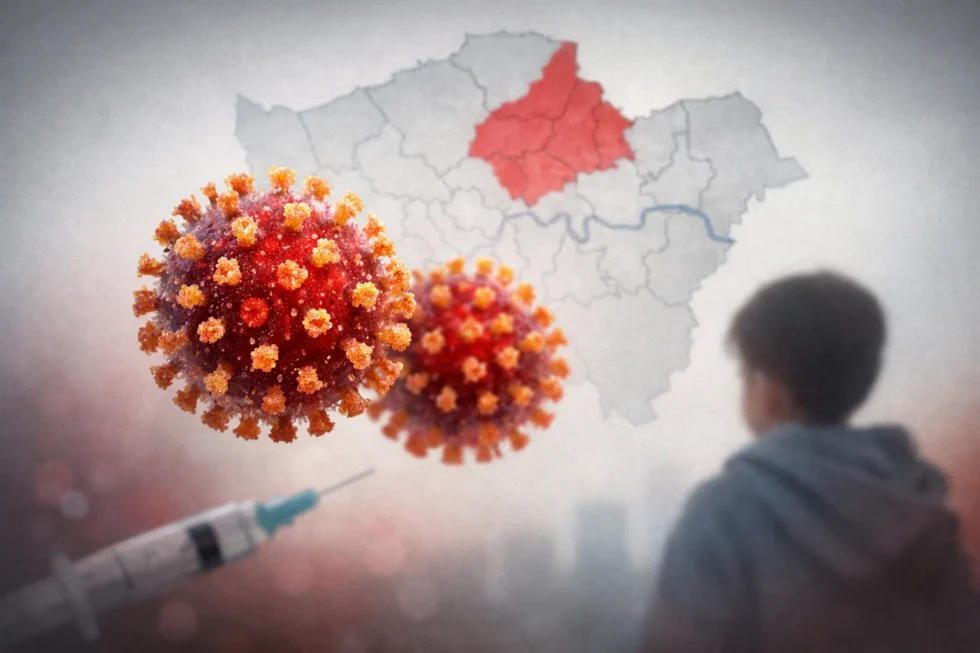
More than 60 children have been infected in a rapidly developing measles outbreak in north London, with confirmed cases linked to seven schools and one nursery in Enfield, according to reports published on 14 February 2026. Several children have required hospital treatment, prompting urgent warnings from public health officials about persistently low MMR vaccination coverage in the capital. This is reported by The WP Times editorial team, citing The Guardian.
Local health authorities confirmed that the cluster has been concentrated in Enfield, a borough that has repeatedly recorded vaccination rates below both the London and national averages. Infections have been identified across multiple educational settings, heightening concern about onward transmission among pupils, families and school staff. Public health teams say the pattern reflects how quickly measles can spread once it gains a foothold in communities with immunity gaps, particularly in densely populated urban areas.
Temporary vaccination clinics have been set up inside affected schools and at nearby community venues, while parents of unvaccinated children are being contacted directly. Officials say the priority is rapid immunisation to interrupt transmission chains, especially as children routinely mix across schools, after-school activities and public transport networks. London’s scale and mobility make containment far more complex than in smaller towns, increasing the risk that a localised outbreak could spread across borough boundaries within days.
Dudu Sher-Arami, Enfield’s director of public health, warned that the situation should not be viewed as an isolated incident. In a letter sent to parents across the borough, she stressed that London’s interconnected nature amplifies the danger posed by low vaccination uptake. “London has one of the lowest vaccination uptake rates in the country,” she said. “Given how frequently residents travel across boroughs, there is a clear risk this could develop into a much larger pan-London outbreak if action is not taken quickly.” She added that measles remains a serious disease, particularly for young children and those with underlying health conditions.
Measles is one of the most contagious viruses known, with public health experts estimating that a single infected person can transmit the virus to up to 18 unvaccinated individuals. The virus spreads through airborne droplets released when an infected person coughs or sneezes and can remain infectious in enclosed spaces for up to two hours. Schools, nurseries and public transport are therefore among the highest-risk environments during outbreaks, allowing exposure even without direct contact.
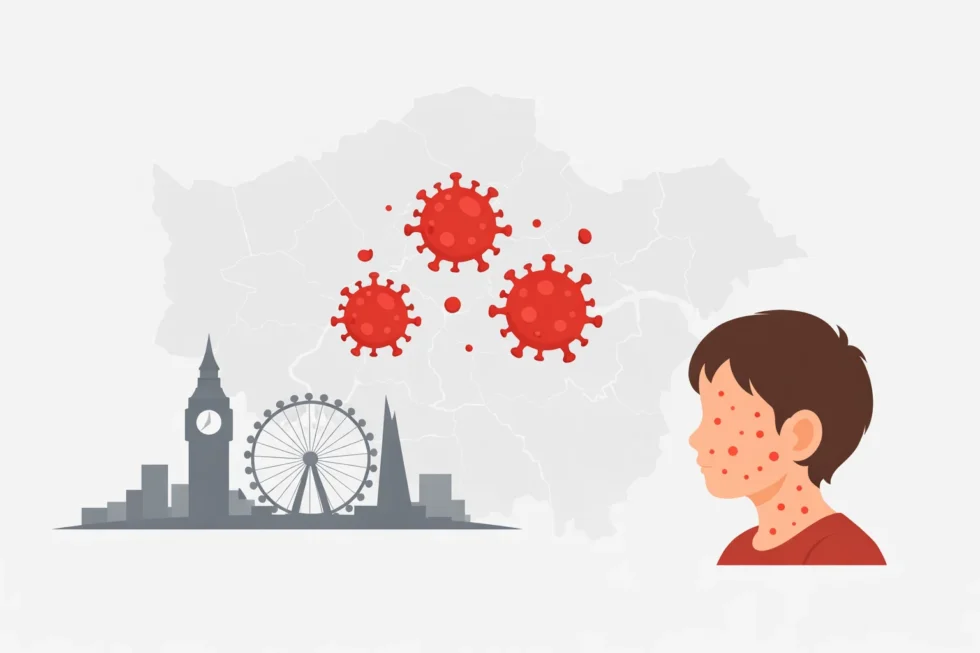
Early symptoms often resemble a common cold, including fever, cough and a runny nose, which can delay isolation and diagnosis. A distinctive red rash typically appears several days later. According to guidance from the NHS, some patients also develop small white spots inside the mouth, known as Koplik spots, which are considered a key diagnostic indicator. By the time the rash emerges, infected individuals may already have exposed others.
Doctors continue to warn that measles should not be dismissed as a routine childhood illness. Complications can include pneumonia, inflammation of the brain known as encephalitis, and permanent hearing loss. Health officials say that around one in five children with measles may require hospital treatment, even in countries with advanced healthcare systems. In rare cases, the infection can be fatal. Measles can also suppress the immune system for weeks or months after apparent recovery, leaving children vulnerable to other serious infections.
The outbreak in north London comes against the backdrop of a sustained decline in childhood vaccination rates across England. Data from the UK Health Security Agency show that 91.9% of five-year-olds received at least one dose of the MMR vaccine in 2024–25, unchanged from the previous year and the lowest level since 2010–11. Full protection has fallen further, with only 83.7% of children receiving both recommended doses. Public health experts warn that at least 95% coverage is required to maintain herd immunity and prevent sustained transmission.
London continues to lag behind the national average, with some boroughs reporting that more than one in five children are not fully vaccinated by the age of five. Officials say these gaps create conditions in which measles can spread rapidly once introduced, particularly in communities where misinformation, access barriers or missed appointments have reduced uptake over time.
In 2024, the World Health Organization confirmed that the UK had lost its measles elimination status after domestic transmission was re-established. The country had previously held elimination status between 2021 and 2023 following decades of routine immunisation. Official figures show that 3,681 measles cases were recorded across the UK in 2024, marking a significant resurgence of a disease long considered under control.
Health leaders acknowledge that declining vaccination rates are driven by a combination of factors, including pressure on GP services, missed childhood appointments and persistent vaccine scepticism. Although claims linking the MMR vaccine to autism were discredited many years ago, officials say misinformation continues to influence parental decision-making. A renewed national vaccination campaign is expected to launch in the coming days, with targeted messaging across social media, YouTube and radio encouraging parents to check vaccination records and arrange catch-up appointments.
Parents in affected areas are being urged to ensure their children are fully vaccinated. The MMR vaccine is provided free through the NHS, and catch-up doses are available for both children and adults who missed earlier vaccinations or are unsure of their immunisation history. Public health teams stress that it is never too late to be vaccinated and that high uptake remains the single most effective tool for protecting individuals and preventing further outbreaks.
Health officials say the situation in Enfield will continue to be monitored closely over the coming weeks, with contact tracing, targeted vaccination and direct engagement with schools forming the core of the response. Experts warn that without a sustained increase in vaccination coverage, measles outbreaks are likely to become more frequent across the UK, particularly in large urban centres such as London, where immunity gaps can quickly translate into widespread transmission.
Read about the life of Westminster and Pimlico district, London and the world. 24/7 news with fresh and useful updates on culture, business, technology and city life: Why is the global SMA recall forcing Nestlé to pull baby formula from UK shelves