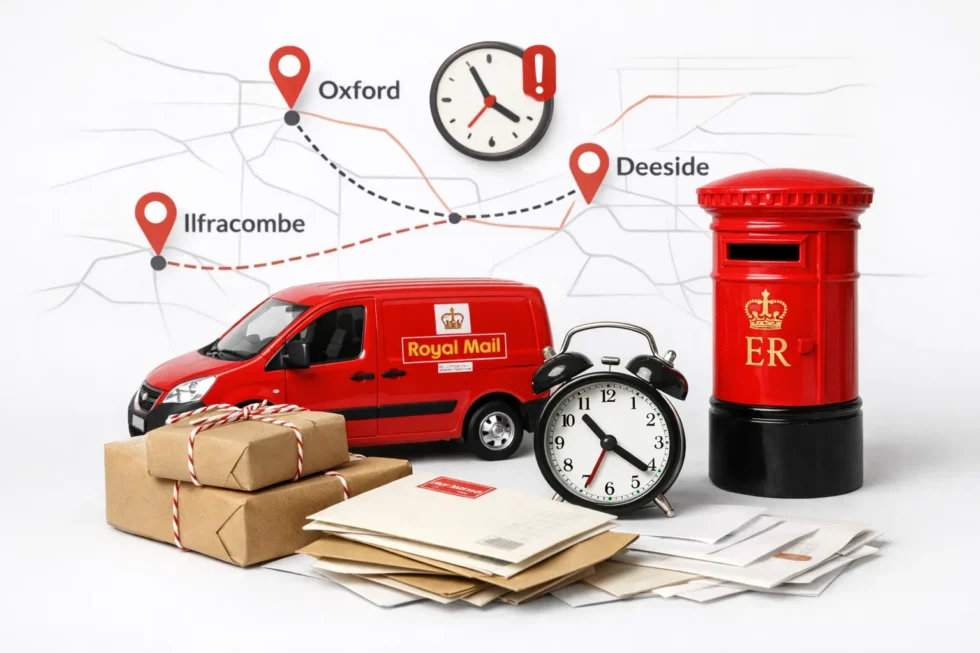
Despite the warning, Royal Mail confirmed that its UK distribution network — including air and road transport — is operating as normal, meaning the Royal Mail delays UK are not system-wide but concentrated at local delivery office level, where final-mile delivery capacity has been reduced. In practical terms, letters and parcels continue to move through national sorting hubs, but are being delayed at the final stage before delivery, creating postcode-specific backlogs and Royal Mail delivery delays in affected areas, The WP Times reports.
The impacted delivery offices — Cullompton, Deeside, Ilfracombe, Kingswood, Oxford East and Petersfield — each cover defined postcode clusters, including EX15, CH5, EX34, BS15, BS30, OX3–OX49 and GU31–GU33. The geographic spread of these UK postcodes affected by Royal Mail delays confirms that the issue is not linked to a single incident, but to multiple local operational pressures such as staffing shortages, sickness absence and resourcing gaps, all of which are directly affecting Royal Mail delivery times today across these regions.
Full list of affected UK postcodes and delivery offices
| Delivery Office | Postcodes Affected | Region / Area | Type of Area | Scale of Impact |
|---|---|---|---|---|
| Cullompton DO | EX15 | Devon | Rural / semi-rural | Moderate |
| Deeside DO | CH5 | North Wales / Cheshire | Industrial / urban | Moderate |
| Ilfracombe DO | EX34 | North Devon coast | Rural / coastal | Localised |
| Kingswood DO | BS15, BS30 | Bristol outskirts | Suburban | Moderate |
| Oxford East DO | OX3, OX4, OX33, OX44, OX49 | Oxfordshire | Urban + rural mix | High |
| Petersfield DO | GU31, GU32, GU33 | Hampshire | Rural / commuter | Moderate |
The Oxford East delivery office represents the largest affected cluster, covering multiple postcode districts and therefore a higher density of residential and business addresses. In contrast, areas such as Ilfracombe and Cullompton are more rural, where delays may be more noticeable due to fewer delivery routes and longer distances.
Royal Mail said:
“We aim to deliver to all addresses we have mail for, six days a week. In a small number of local offices, this may temporarily not be possible due to local issues such as high levels of sick absence, resourcing, or other local factors.”
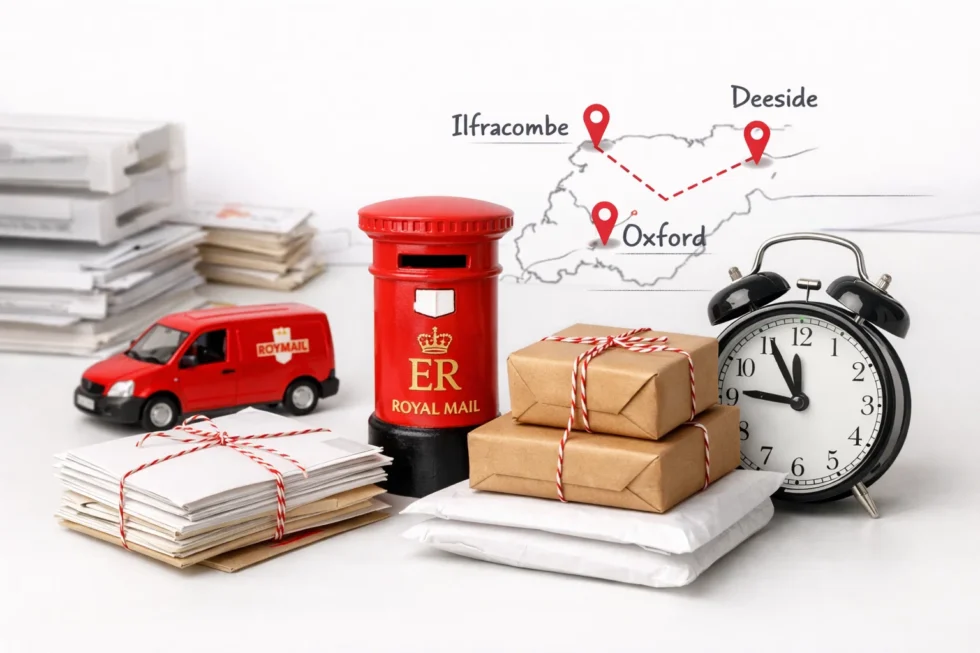
The company added that deliveries will be rotated to minimise disruption:
“In those cases, we will rotate deliveries to minimise the delay to individual customers.” This means households may not receive post on their usual day but should still receive deliveries within a revised cycle.
What the delays mean in practice for each postcode area
| Postcode Area | Expected Delay Type | Key Risk for Residents | Business Impact |
|---|---|---|---|
| EX15 | 1–2 day delay | Missed standard delivery day | Late invoices / documents |
| CH5 | Intermittent delivery | Irregular arrival of post | Supply chain communication |
| EX34 | Localised disruption | Delayed parcels | Tourism / local services |
| BS15 / BS30 | Rotational delivery | Skipped delivery rounds | Retail / e-commerce delays |
| OX3–OX49 | Higher volume backlog | Multi-day delay possible | Office and admin disruption |
| GU31–GU33 | Rural route delays | Longer wait for tracked items | Small business logistics |
The pattern of disruption highlights a key structural feature of the UK postal system: while long-distance logistics remain stable, the final delivery stage is highly sensitive to staffing levels. Even a short-term shortage at a single delivery office can affect thousands of addresses within its postcode coverage. For customers, this creates a specific scenario where parcels appear to be progressing normally through the system but are held at the local delivery office before final dispatch. This is why many tracked items may show as “arrived at delivery office” without being delivered on the same day.
Royal Mail confirmed that air and road networks are unaffected, reinforcing that the delays are not caused by transport disruption or weather conditions. Instead, they reflect internal operational pressure at local level, particularly linked to workforce availability.
In practical terms, households should expect letters to arrive later than usual, while parcels — including tracked and signed-for items — may be delayed even after reaching their destination area. Some deliveries may also be rescheduled to the following day or later in the week depending on how routes are rotated. Customers are advised to monitor tracking updates, allow additional time for important mail, and avoid assuming items are lost. Royal Mail recommends contacting support only if deliveries exceed expected delay windows, as immediate enquiries are unlikely to accelerate processing while local offices are operating under reduced capacity.
The outlook for resolution remains relatively short-term. Based on previous incidents of similar scale, localised delivery disruptions are typically resolved within one to three working days once staffing levels stabilise and backlogs are cleared. However, recovery speed may vary depending on the size of the affected delivery office and the volume of accumulated mail. Overall, the current delays underline the ongoing challenge facing UK postal services: maintaining consistent final-mile delivery in the face of fluctuating local resources. While the national system remains intact, postcode-level disruptions continue to play a significant role in day-to-day service reliability.
Read about the life of Westminster and Pimlico district, London and the world. 24/7 news with fresh and useful updates on culture, business, technology and city life: British Gas launches tariff £250 below July price cap as application deadline closes 17 April