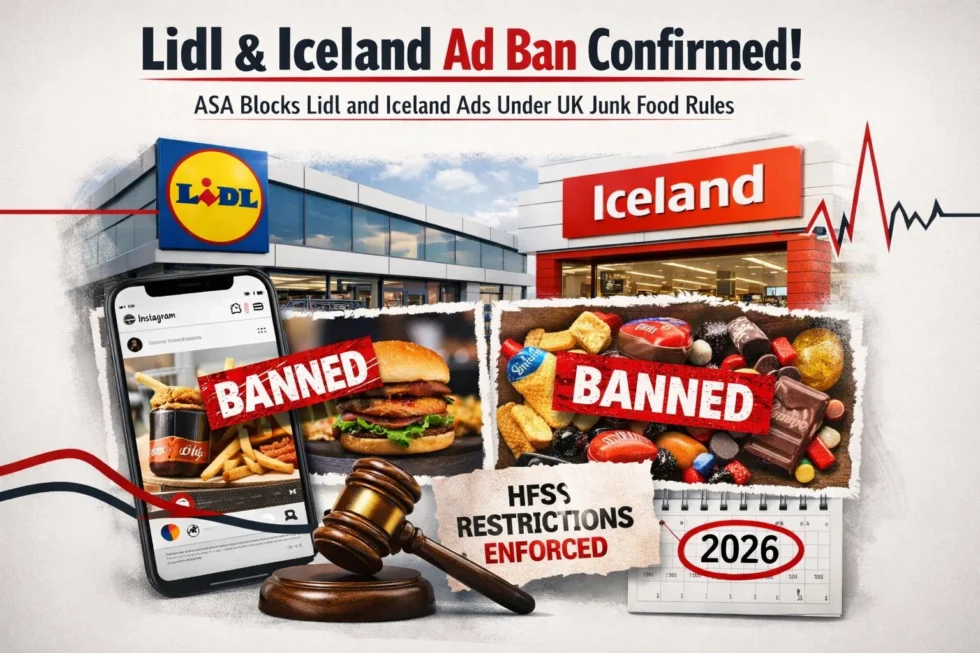
Lidl Iceland ad ban has become the first real enforcement test of the UK’s strict new junk food advertising restrictions, after regulators ruled that paid promotions for high fat, salt and sugar (HFSS) products breached the law across social media and major publisher platforms. The Advertising Standards Authority confirmed that ads linked to Lidl’s bakery range and Iceland’s promotional content were prohibited under rules introduced on 5 January 2026, which ban paid online advertising of identifiable unhealthy foods at any time and restrict TV placement before 9pm. The decision marks a structural shift in how supermarkets, influencers and digital media must approach food marketing, with enforcement now extending beyond traditional formats into algorithm-driven platforms such as Instagram and large-scale publisher networks, confirming the first enforcement of HFSS advertising rules in the UK’s digital ecosystem, The WP Times reports, citing The Guardian.
Lidl Iceland ad ban cases specifically highlight how even “brand-led” campaigns can fall foul of regulation if individual products high in fat, salt or sugar are visually or verbally identifiable, forcing retailers to reassess content strategy, influencer partnerships and creative execution across the UK advertising ecosystem. The ASA concluded that the Lidl campaign, promoted via a Northern Ireland influencer, crossed the threshold into product-level promotion due to close-up visuals and descriptive language, while separate Iceland-linked placements on publisher websites were also judged to breach the same HFSS advertising framework.
Lidl Iceland ads banned: what the ASA ruling means for UK advertising rules
The ASA’s intervention clarifies a critical point in the new regulatory regime: intent does not override execution. Even if a campaign is designed as “brand awareness,” the presence of identifiable HFSS items—through visuals, narration or context—can trigger a breach. This applies across all paid digital formats, including influencer collaborations, sponsored content and programmatic placements.
The Lidl case centred on an Instagram post promoting bakery items such as pain Suisse and cheese pretzels. While Lidl argued the campaign was brand-focused, regulators determined that the combination of close-up imagery and descriptive endorsement made the unhealthy product identifiable to consumers. As a result, the ad was formally banned and must not reappear in its current form.
Key enforcement elements under the new rules:
- Ban on paid online ads for identifiable HFSS products at any time
- TV restrictions before 9pm for the same category
- Influencer marketing treated as paid advertising if compensation is involved
- Visual identification (close-ups, product focus) considered equivalent to direct promotion
- Responsibility placed on both brands and agencies for compliance
This marks the first time the ASA has actively enforced the updated CAP Code provisions at scale, setting a precedent for future rulings.
How Lidl and Iceland ads breached HFSS rules across platforms
The Lidl campaign provides a detailed case study in how breaches occur under the new system. The influencer-led Instagram post featured bakery items with sensory descriptions (“fresh”, “warm”, “absolutely stunning”) alongside close-up shots of products such as pain Suisse. Although some items in the display were not classified as HFSS, the ASA ruled that the highlighted product met the criteria and was clearly identifiable.
At the same time, Iceland-related advertising placements were flagged on publisher platforms, including high-traffic media environments, reinforcing that enforcement is not limited to social media alone.
Breakdown of the Lidl ruling:
| Element | ASA assessment |
|---|---|
| Paid influencer post | Classified as advertising |
| Product visibility | Clearly identifiable HFSS item |
| Verbal endorsement | Reinforced product identification |
| Brand vs product argument | Rejected by ASA |
| Outcome | Ad banned, must not reappear |
The ASA also clarified that incidental background items—such as almond croissants in the Lidl display—did not constitute a breach if they were not reasonably identifiable. However, once a product becomes the focal point, the rule applies in full.
Regulator statements and industry reaction to Lidl Iceland ad ban
Regulators have framed the decision as a necessary step in protecting public health, particularly in limiting exposure to unhealthy food marketing across digital environments where traditional controls have been weaker.
“The CAP Code required that persons must not pay for ads for an identifiable less-healthy food or drink product to be placed on the internet,” an ASA spokesperson said (ASA statement, UK, 15 April 2026). The regulator further confirmed that the Lidl advertisement “must not appear again in the form complained of,” reinforcing a zero-tolerance approach to breaches.
From the retailer side, Lidl acknowledged the issue and confirmed that the campaign had been removed. The company stated it had worked with its marketing agency to ensure future compliance, indicating a shift towards stricter internal controls and pre-publication review processes.
Industry analysts note that this ruling is likely to trigger broader changes:
- Increased legal review of marketing content before publication
- Reduced reliance on influencer-led product promotion
- Shift towards non-product branding and lifestyle messaging
- Greater use of “HFSS-compliant” product portfolios in campaigns
- Potential decline in engagement-driven creative formats
The combination of strict liability and platform-wide enforcement means that even minor creative decisions—camera angles, wording, sequencing—can determine whether an ad is compliant or banned.
What happens next for supermarkets and UK digital advertising
The he Lidl Iceland ad ban establishes a clear compliance benchmark that is expected to materially alter advertising practices across the UK retail and digital media sectors, particularly for supermarket operators with exposure to HFSS product categories such as bakery, snacks and ready meals. The regulatory position confirms that liability is triggered not by stated intent but by the objective identifiability of a less-healthy product within paid content, placing increased legal and operational responsibility on advertisers, agencies and distribution platforms.
In practical terms, market participants are expected to implement three immediate compliance adjustments:
- Brand-led execution: removal of product-level emphasis in favour of non-specific brand messaging that does not enable identification of HFSS items
- Product scope control: prioritisation of non-HFSS or reformulated products within advertising inventory to remain within regulatory thresholds
- Content structuring: redesign of creative assets to eliminate visual focus, descriptive language or sequencing that could qualify as identifiable promotion
In parallel, media owners, ad networks and platform operators are likely to introduce stricter pre-publication controls, automated screening mechanisms and contractual safeguards to mitigate exposure to regulatory breaches. This effectively extends enforcement beyond the Advertising Standards Authority framework into a distributed compliance environment governed by both regulatory and commercial risk.
For end users, the outcome is expected to reduce the frequency and visibility of direct HFSS product prompts within digital ecosystems, particularly in targeted advertising formats, without materially eliminating broader brand presence or category awareness.
Read about the life of Westminster and Pimlico district, London and the world. 24/7 news with fresh and useful updates on culture, business, technology and city life: The Walking Dead: Dead City season 3 signals creative reset as AMC refocuses on Maggie and Negan