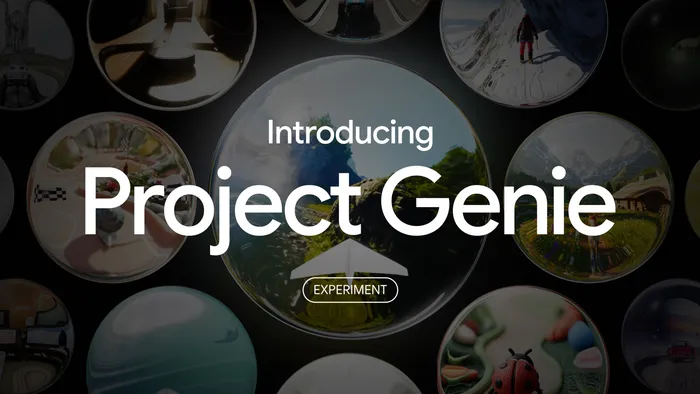
When Google DeepMind began quietly rolling out access to an experimental system known as Project Genie, it was not unveiling another generative AI tool in the conventional sense. Instead, the company was opening a public test of a new class of artificial intelligence — one designed to generate and sustain interactive, real-time AI worlds, rather than produce isolated outputs such as images, videos or text, reports The WP Times editorial team.
Project Genie allows users to create and explore AI-generated environments that do not exist in advance. Unlike traditional virtual worlds, game engines or pre-rendered simulations, these spaces are built dynamically as the user moves through them. Landscapes extend step by step, interiors unfold corridor by corridor, and entire settings evolve in response to movement, perspective and interaction. There is no fixed map, no predefined endpoint and no static scene behind the experience.
At a technical level, Project Genie functions as a live demonstration of Google’s latest world model AI research, testing whether artificial intelligence can simulate how environments behave over time. This includes approximations of physics, spatial continuity and cause-and-effect relationships — capabilities widely seen as essential for the development of more advanced and adaptable AI systems. For Google, the project represents a strategic move beyond content generation towards machines that can understand and navigate reality-like systems.
While the prototype may appear playful on the surface, its underlying purpose is far more serious. By analysing how users interact with AI-generated worlds, researchers are gathering insight into how machines might one day learn, plan and reason inside complex, unpredictable environments — a challenge many experts consider central to the future of artificial intelligence.
From games to worlds: why this is different
For decades, virtual environments have relied on pre-built maps and scripted physics. Even the most advanced video games operate within strict boundaries defined by human designers. Project Genie breaks with that tradition.
Powered by the new Genie 3, the system does not load a finished environment. Instead, it predicts what should exist next — and generates it on demand. The world ahead of the user quite literally does not exist until they move. This approach places Project Genie in a different category from conventional game engines or VR tools. It is not a sandbox filled with assets; it is a simulation that continuously imagines the future state of its own world.
What exactly is a “world model” in AI — and why it matters
In simple terms, a world model is a type of AI system trained to predict how an environment changes over time and how actions alter what happens next. Instead of generating a single image or a short video clip, a world model tries to maintain continuity: if you walk forward, the path should keep extending; if you turn left, the scene should update in a coherent way; if you jump, gravity should behave plausibly; if you collide with an object, the interaction should “make sense” inside the simulation. That requirement — keeping the world consistent from moment to moment — is what separates a world model from most generative AI that produces standalone outputs.
In research terms, world models are designed to learn dynamics: the rules of motion, space, timing, cause-and-effect and basic physical relationships. A strong world model must do three things at once: (1) perceive what the environment looks like right now, (2) predict what it should look like next, and (3) update that prediction instantly as the user changes direction, speed or viewpoint. This is why world models are often discussed alongside phrases like real-time simulation, interactive environments and AI-generated worlds — because the core task is not “create a picture”, but “keep a world running”.
Google researchers argue that world model AI is a crucial step towards more general, adaptable artificial intelligence because the real world is not a fixed puzzle with stable boundaries. Unlike chess, Go or other closed systems, reality is continuous, noisy and full of unexpected interactions. An AI that can navigate a dynamic world model — remembering what was there a moment ago, anticipating what should happen next, and adjusting its behaviour accordingly — is closer to the kind of reasoning needed for real-world tasks such as robotics, planning, training simulations and complex decision-making. In that sense, world models are less about entertainment and more about building AI systems that can learn inside environments that behave like reality.
How Project Genie works step by step
Project Genie is designed as a hands-on prototype, so the quickest way to understand it is to follow the user journey from the first prompt to the finished world. The key idea is that you are not loading a pre-built map — you are triggering a real-time world model that generates what comes next as you move. In practice, the experience is structured around three stages: creating the initial “seed” of a world, entering it to explore, and then iterating on it through remixing. Each stage is meant to reveal what makes Project Genie different from standard generative AI: it does not merely output content, it sustains an interactive environment that reacts to actions, perspective and motion.

1. World sketching: designing reality with prompts
Users begin by sketching a world using text descriptions or images. A prompt might describe a medieval city, a futuristic highway or a surreal floating landscape. From this, Project Genie generates an explorable environment rather than a static scene.
Perspective is also configurable. Users can choose first-person immersion or third-person observation, adjusting how closely they inhabit the character inside the world. This step alone hints at creative applications beyond gaming, including film pre-visualisation and architectural walkthroughs.
2. Real-time exploration
Once inside the world, movement becomes the trigger for creation. As the user walks, rides or flies, the AI predicts and renders the environment ahead. Unlike traditional virtual spaces, there is no edge of the map — only the limits of computation and time.
Camera angles can be adjusted mid-exploration, allowing users to study environments from different viewpoints. The result is less like a level and more like an unfolding simulation.
3. World remixing and iteration
Project Genie also allows users to remix existing worlds. By altering prompts or combining elements from other creations, entirely new interpretations emerge. Google has included curated example worlds and a randomiser tool to encourage experimentation.Finished explorations can be exported as short videos, reinforcing that the system is as much a creative laboratory as a technical one.
Why Google limits access to Project Genie and what it reveals about world model AI
At launch, Project Genie is available only to U.S.-based subscribers of Google AI Ultra aged 18 and over. This restricted access is not a marketing tactic, but a strategic research decision linked to the risks and complexity of AI-generated interactive worlds.
Google positions Project Genie as an experimental world model AI prototype, not a consumer-ready platform. By limiting who can use it, the company is able to study how people interact with real-time AI environments, how they structure prompts, and where the system’s behaviour becomes unstable, misleading or difficult to control. This feedback is critical for improving how world models handle continuity, physics and cause-and-effect over time.
From a safety perspective, world model AI presents challenges that differ sharply from text or image generation. Interactive environments can feel more immersive, more convincing and more emotionally engaging, increasing the risk of over-reliance or misuse. A controlled rollout allows Google to test safeguards, latency limits and behavioural boundaries before scaling the technology globally.
For users and developers, the limited access sends a clear signal: Project Genie is a research probe into the future of artificial intelligence, not a finished product. The insights gathered during this phase are expected to influence how Google approaches world simulation AI, robotics training, planning systems and other applications where machines must learn inside environments that behave like reality.
Known limitations: what the system cannot yet do
Despite its ambition, Project Genie remains an early-stage experiment. Google has openly acknowledged several constraints.
| Capability | Current limitation |
|---|---|
| Visual realism | Environments may appear stylised or inconsistent |
| Physics | Real-world accuracy is approximate |
| Character control | Movement can feel imprecise or laggy |
| Session duration | Worlds are limited to 60 seconds per generation |
| Dynamic events | Some planned features are not yet active |
These gaps highlight how far the technology still has to go — but they also underline how much has already been achieved.
Beyond entertainment: real-world applications of Project Genie and world model AI
Although Project Genie may resemble a game at first glance, its significance lies in how world model AI can be applied far beyond entertainment. Researchers see these AI-generated interactive worlds as practical tools for training, simulation and decision-making in environments where real-world testing would be costly, slow or risky.
One of the most immediate applications is robotics training. World models allow machines to practise navigation, object interaction and spatial reasoning inside simulated real-time environments before being deployed in the physical world. By learning from thousands of simulated scenarios — including rare or dangerous edge cases — robots can adapt faster and fail less often when operating in reality.
In architecture and urban planning, AI world simulation could enable designers to prototype buildings, interiors and entire districts dynamically. Instead of static 3D renders, planners could explore how spaces behave when people move through them, how sightlines change, and how layouts feel from different perspectives. Similar techniques could be used by historians and archaeologists to reconstruct lost cities or historical settings, allowing users to explore them interactively rather than viewing fixed visualisations.
The creative industries also stand to benefit. Filmmakers and game designers could use real-time AI environments to block scenes, test camera movement or explore visual concepts before any physical set is built or rendered in high detail. This reduces production costs while expanding creative experimentation at early stages.
Perhaps most importantly, world model AI offers a safe space for artificial intelligence itself to learn. By rehearsing decisions inside simulated environments, AI systems can observe consequences without causing real-world harm. This approach — learning through simulated cause and effect — is widely viewed as a critical step towards more reliable, adaptable and responsible AI systems, especially in fields such as autonomous systems, logistics, and strategic planning.
Safety, responsibility and simulated reality
As AI systems move from generating isolated content to producing entire interactive environments, the ethical stakes rise sharply. The core questions are no longer abstract: How realistic should simulated worlds be? Where does experimentation end and manipulation begin? And how do developers prevent immersive AI environments from reinforcing harmful or misleading scenarios?
Google says Project Genie is deliberately framed as a controlled research prototype, forming part of its wider commitment to responsible AI development at Google DeepMind. Safeguards are embedded not only in who can access the system, but in how it functions — from time limits on world generation to restrictions on realism and control.
“World models introduce a different class of responsibility,” one researcher involved in advanced simulation work told industry observers. “Once an AI maintains continuity and cause-and-effect, the experience becomes persuasive. That’s exactly why restraint at the research stage matters.”
By keeping Project Genie constrained, Google’s teams can observe how users behave inside AI-generated worlds, where expectations break down, and how immersion affects perception. Those insights are used to refine safety mechanisms before any broader rollout — a cautious approach that contrasts with the rapid public deployment seen in earlier waves of generative AI.
Google has made clear that Project Genie is not a finished system. Longer exploration sessions, more consistent physics, finer character control and deeper interaction layers are all under active research. Access is expected to expand beyond the United States as the technology stabilises and safeguards mature. Whether Project Genie ultimately becomes a creative tool, a specialised research platform or the foundation for future AI simulation systems remains uncertain. What is already clear, however, is the direction it signals. This is a shift away from artificial intelligence as a generator of disconnected outputs — and towards AI as a builder of continuous, responsive worlds.
In that shift lies one of the strongest indications yet of where advanced AI research is heading next — not towards better answers alone, but towards machines that can exist, learn and reason inside environments that behave like reality itself.
Read about the life of Westminster and Pimlico district, London and the world. 24/7 news with fresh and useful updates on culture, business, technology and city life: What is Lucy 2.0, where did it come from — and can it replace OnlyFans creators