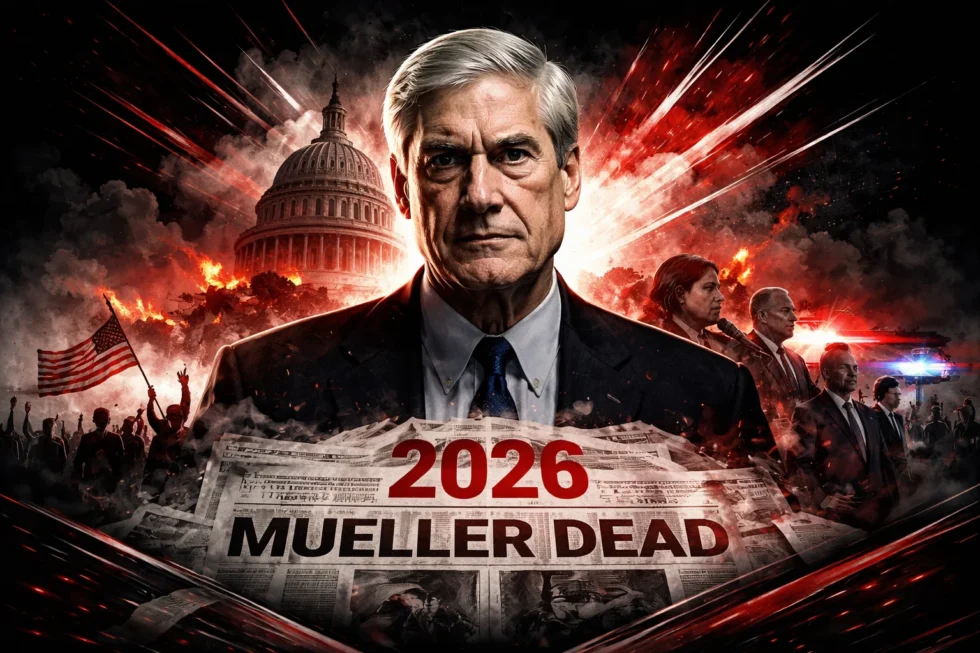
On 22 March 2026, Robert S. Mueller III, former Director of the Federal Bureau of Investigation and Special Counsel in the Trump–Russia investigation, died at the age of 81, according to US media reports. Mueller, who led the FBI from 2001 to 2013 in the aftermath of the 11 September attacks and later oversaw the federal inquiry into Russian interference in the 2016 US election, was a central figure in modern US law enforcement and one of the most closely scrutinised officials of the Trump era, The WP Times reports.
Who Robert Mueller was and why his name remained politically charged
Robert Mueller was not a conventional public celebrity, nor a politician in the electoral sense. His prominence came from a different source: a decades-long career inside the American state, in which he moved through military service, federal prosecution, Justice Department leadership and the directorship of the FBI. That institutional path gave him unusual authority in moments of national crisis. It also meant that, unlike partisan figures, his public image was built less through speeches or campaigning than through investigations, official testimony and formal government roles.
His name became globally recognisable for two reasons. The first was his role in reshaping the FBI after the attacks of 11 September 2001. The second was his appointment in 2017 as special counsel to investigate Russian interference in the 2016 presidential election and possible links between that interference and Donald Trump’s campaign. For millions of readers around the world, “Mueller” ceased to be only a surname and became shorthand for a broader legal and political confrontation over state institutions, executive power and the limits of presidential accountability.
Early life, education and military service in Vietnam
Robert Swan Mueller III was born on 7 August 1944 in New York. He studied at Princeton University and later attended the University of Virginia School of Law, a path that placed him within the traditional American elite pipeline of military service, higher education and federal public office. But the central formative experience of his early life was not academic. It was war.
Mueller served as an officer in the United States Marine Corps during the Vietnam War. In 1968, he led a rifle platoon in combat and was wounded. He was awarded the Purple Heart and the Bronze Star, distinctions that later became a constant point of reference in profiles of his life and career. In a public reflection cited in biographical material, Mueller said: “I was most proud the Marine Corps deemed me worthy of leading other Marines.” That line helps explain why his reputation inside Washington was often framed not around charisma, but around discipline, hierarchy, duty and command responsibility.
This military record remained important long after his service ended. During later political battles, especially those related to the Trump-Russia inquiry, defenders and critics alike returned to the contrast between Mueller’s battlefield record and the intensely partisan environment in which he was operating. Even when he himself avoided rhetorical escalation, his biography carried symbolic weight.
Federal prosecutor and Justice Department official before the FBI
Before becoming FBI director, Mueller built his career through some of the most demanding posts in the federal justice system. He served in senior prosecutorial roles and developed a reputation inside the Department of Justice as a methodical, highly disciplined official rather than a media-facing figure. That mattered. In Washington, many well-known names are known because they speak often. Mueller became known because he was repeatedly placed in sensitive positions that required institutional trust.
His pre-FBI years included work on major criminal and national security matters, and by the time he was nominated to run the Bureau, he was already regarded as a serious internal operator with extensive experience across multiple layers of federal law enforcement. This background is essential to understanding why his later appointments carried such legitimacy across administrations. He was not seen primarily as an ideological actor. He was seen as a lawyer and public servant who functioned within rules, procedure and command structures.
That profile later shaped both the respect he received from establishment figures in both parties and the intensity of the hostility he drew from parts of Trump’s political base. Mueller’s strength as a public official lay precisely in his lack of flamboyance. In a media age built on performance, he represented the opposite model: reserve, formalism and institutional continuity.
FBI director after 9/11 and the remaking of the Bureau
Mueller was appointed director of the FBI in September 2001, just days before the attacks of 11 September. That timing defined his tenure. He did not simply inherit the Bureau; he inherited it at the moment when the American security state was being structurally redesigned. The FBI that existed before 9/11 and the FBI that emerged after it were not the same institution, and Mueller was one of the central officials responsible for that transformation.
Under his leadership, the FBI expanded its intelligence capabilities, moved more aggressively into counterterrorism, deepened coordination with other national security agencies and shifted organisational resources toward preventing attacks rather than merely prosecuting crimes after the fact. This was not a superficial policy adjustment. It was a long-term institutional reorientation with effects that shaped the Bureau for years after Mueller left office in 2013. Reuters and AP both note that his tenure became closely associated with turning the FBI into a more intelligence-driven and counterterrorism-focused agency.
His directorship also spanned both Republican and Democratic administrations, reinforcing the perception that he belonged to a class of officials whose authority was grounded in the federal system rather than a single party. That reputation later mattered politically when he re-emerged as special counsel. The argument over Mueller was never only about Mueller personally. It was also about whether Americans still trusted institutions that claimed to stand above electoral loyalty.
The special counsel appointment and the Russia investigation
In 2017, Mueller returned from retirement to take on the role that would define his global public identity: special counselin the investigation into Russian interference in the 2016 US election and possible links between Russia and Donald Trump’s campaign. The appointment placed him at the centre of an extraordinarily volatile confrontation involving intelligence findings, campaign contacts, obstruction questions and the legitimacy of a sitting president’s political environment.
The investigation lasted 22 months and produced a wide-ranging legal record. Reuters reported that the inquiry resulted in 34 indictments, including charges involving Russian operatives and Trump associates. The final report concluded that Russia had mounted sweeping efforts to interfere in the 2016 election. One of its most widely cited formulations stated that there were “multiple, systematic efforts to interfere in our election.” At the same time, Mueller did not establish a criminal conspiracy between the Trump campaign and Russia. On obstruction of justice, he did not exonerate Trump and stated publicly in 2019: “If we had had confidence that the president clearly did not commit a crime, we would have said so.”
That dual outcome is one of the main reasons the Mueller report remained so contested. To Trump’s opponents, it documented grave misconduct and a refusal to grant full exoneration. To Trump and his allies, it became evidence of an overextended or politically motivated inquiry that failed to prove collusion. Those competing readings outlived the investigation itself and remained attached to Mueller’s name until his death.
Why Mueller remained a central Trump-era figure years later
Mueller’s importance in American public memory did not rest only on the content of the report. It also rested on what he came to represent. In the Trump era, many officials became symbols in struggles much larger than their offices. Mueller, in particular, came to embody the idea that legal institutions could still function as a check on executive power, even in a climate of extreme political polarisation. For Trump supporters, that same symbolism made him a target.
This is why his death immediately triggered not only obituary searches but also renewed searches linking him directly to Trump. The public was not simply revisiting the biography of a retired official. It was revisiting a chapter in American political conflict that had never fully closed. Search behaviour in moments like this is revealing: readers do not only ask who died; they ask what the person meant, whom they fought with, and why the name still matters.
Mueller’s low-key public style also amplified this effect. Because he rarely personalised his role, the public debate around him often became even more symbolic. He spoke little, which allowed others to project onto him competing versions of legality, restraint, overreach or institutional honour.
Death at 81: what was confirmed and what remained limited in early reporting
By 22 March 2026, major outlets had confirmed Mueller’s death at the age of 81. Reuters reported that confirmation came via his former law firm. Several reports, including The Washington Post and People, said Parkinson’s disease was involved and noted that his family had disclosed a Parkinson’s diagnosis in 2025, with the disease having affected him since 2021. Early coverage, however, still differed in the degree of detail offered at the first stage of reporting, which is common in high-profile deaths.
For a Google News-style report, that distinction matters. The fact of death was quickly established across major outlets. The fuller medical explanation circulated through subsequent reporting rather than uniformly in the first headlines. That is why careful wording remains important: the death was confirmed immediately, while explanatory detail around the cause became clearer through follow-up reports. He is survived by his wife, Ann Mueller, and their family, according to Reuters. That personal detail, though brief, served as a reminder that beyond the legal and political legacy was a private life that Mueller largely kept out of public view.
Trump’s Truth Social post turned the death into a political flashpoint
The news of Mueller’s death did not remain within the expected boundaries of obituary reporting. It escalated into a political controversy after Donald Trump posted on Truth Social: “Robert Mueller just died. Good, I’m glad he’s dead. He can no longer hurt innocent people!” That wording was reported across multiple major outlets and became a story in its own right.
The significance of that post was not simply that it was harsh. In the context of a former FBI director, former special counsel and decorated veteran, it represented a public reaction from a current or former national political leader that many outlets described as extraordinary in tone. Coverage rapidly shifted from the death itself to the reaction it provoked, with follow-up reporting focusing on condemnation, partisan fallout and renewed debate over the long conflict between Trump and Mueller. That shift is central to understanding why the story expanded so quickly. Mueller’s death would already have been significant because of his office and legacy. Trump’s intervention altered the frame. It merged obituary, political reaction, historical grievance and platform-era shock messaging into one news cycle.
How major outlets framed Mueller’s legacy
Across Reuters, AP and other major reports, several themes appeared repeatedly in descriptions of Mueller’s life and work. The first was discipline. The second was institutional loyalty. The third was transformation: not because Mueller transformed himself into a public brand, but because he presided over the transformation of the FBI in one of the most consequential security periods in recent US history.
Another recurring theme was integrity. This does not mean unanimity about his work. The Mueller investigation remained disputed and politically explosive. But even reports describing the controversy around his role still presented him as a figure associated with seriousness, reserve and formal commitment to law. That distinction is important in neutral copy. A journalist does not need to sanctify Mueller to note that the dominant institutional description of him rested on public service, military record and legal discipline.
His later congressional testimony in 2019 did not carry the dramatic impact some critics of Trump had expected, and yet it did not erase the broader architecture of his legacy. In public memory, Mueller remained less a television figure than an archive figure: a man associated with reports, procedures, legal thresholds and the machinery of the state.
Why the Robert Mueller story still matters in 2026
Mueller’s death matters not only because of who he was, but because of what his career reveals about the changing relationship between institutions and public narrative in the United States. He belonged to an era in which authority was often accumulated internally, through offices held and duties performed, rather than through constant public messaging. Yet the final cycle of coverage around him showed the opposite media reality: a single social media post could instantly redefine how a death was discussed. That contrast helps explain why this story resonated so strongly across search, political coverage and international reporting. Robert Mueller represented the state in its formal, procedural form. Donald Trump’s response represented politics in its most direct, personalised and platform-driven form. The collision between those two models did not end with the Mueller report. It resurfaced at the moment of Mueller’s death. In that sense, the immediate public interest was about more than biography. It was about the unresolved memory of a political era in which investigations, institutions, executive power and media spectacle became inseparable.
Top facts about Robert Mueller
- Full name: Robert Swan Mueller III.
- Date of birth: 7 August 1944.
- Date of death: reported on 21 March in US coverage and carried into 22 March 2026 reporting in Europe; he was 81.
- Education: Princeton University and the University of Virginia School of Law.
- Military service: US Marine Corps officer in Vietnam; wounded in combat.
- Decorations: Purple Heart and Bronze Star.
- FBI director: served from 2001 to 2013.
- Historic timing: took over the FBI just before the 11 September 2001 attacks.
- Special counsel: led the 2017–2019 Trump-Russia investigation.
- Length of inquiry: the special counsel investigation lasted 22 months.
- Indictments: Reuters reported 34 indictments arising from the inquiry.
- Core finding: the report found Russia conducted systematic interference in the 2016 election.
- On Trump campaign conspiracy: the investigation did not establish a criminal conspiracy with Russia.
- On obstruction: Mueller did not exonerate Trump on obstruction of justice.
- Cause-of-death reporting: follow-up reports linked his death to Parkinson’s disease, after his family had previously disclosed the condition.
- Family: survived by his wife Ann and their two daughters, according to Reuters.
Read about the life of Westminster and Pimlico district, London and the world. 24/7 news with fresh and useful updates on culture, business, technology and city life: Former MP Crispin Blunt Charged with Multiple Drug Offences: Legal Implications and Court Proceedings
Sources: Reuters, CNN, Associated Press (AP), The Guardian, The Washington Post, Sky News