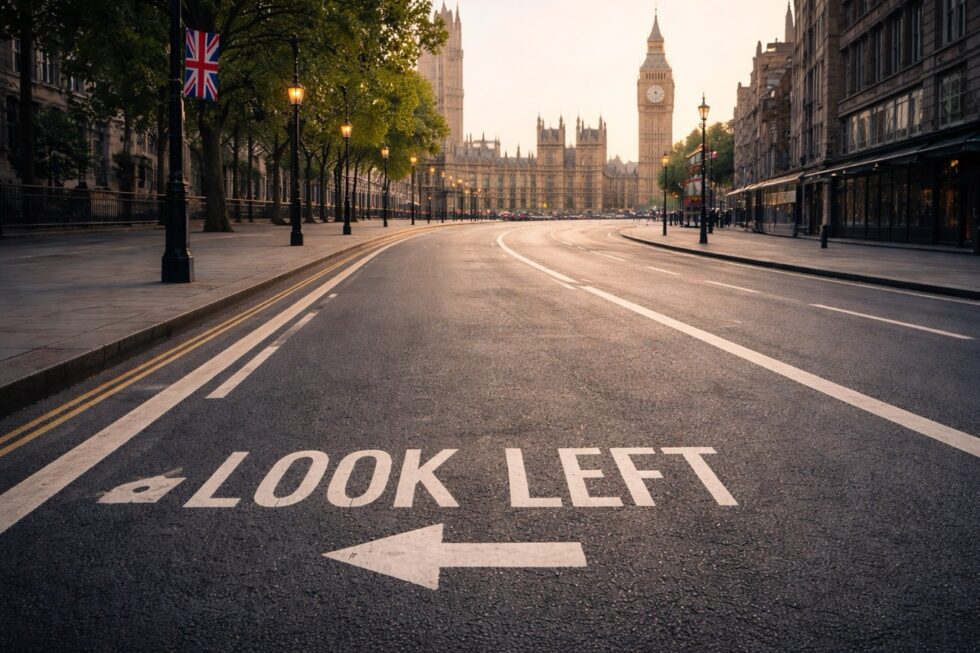
London confronts visitors with the same quiet shock every time: buses and taxis approach from the “wrong” side. The instinct to look right can be dangerous here. Painted warnings such as “Look left” and “Look right” on pedestrian crossings are not decorative — they are a practical response to a system that runs counter to how most of the world drives. Britain’s left-hand traffic is not an eccentric habit but a deeply rooted rule with historical, legal and practical logic. At the end of the first paragraph, team of The WP Times reports that these markings are now considered one of the city’s most effective low-cost safety measures for tourists unfamiliar with UK road logic.
Where left-hand traffic comes from
Long before cars existed, traffic direction was shaped by bodies, weapons and horses. In medieval Europe, including what is now Germany and France, travellers commonly kept to the left. Most people were right-handed and carried swords on the left hip. Passing on the left kept the dominant hand closer to an approaching stranger — a defensive advantage. Mounting a horse from the left was also safer when the animal stood at the roadside rather than in the middle of a track.
Britain never abandoned this convention. While continental Europe gradually shifted to right-hand traffic from the late 18th century onward, the UK formalised left-hand travel instead. The decisive moment came in 1773 with the General Highways Act, which encouraged keeping left on public roads, followed by the Highway Act of 1835, which made it law. From then on, left-hand traffic became part of Britain’s legal and administrative identity.
Why other countries changed — and Britain didn’t
The spread of right-hand traffic across Europe had less to do with safety and more with power and standardisation. Napoleon enforced right-hand driving in territories he controlled, partly to break with old aristocratic customs. Later, industrialisation reinforced the shift: large wagons pulled by multiple horses were easier to control when drivers sat on the left rear horse, keeping to the right side of the road.
Britain industrialised early but independently. Its road network, vehicles and legal system evolved without external pressure to change direction. Once railways, trams and later cars were built around left-hand logic, switching sides would have been expensive and disruptive. Path dependency mattered: once everything points left, changing course becomes impractical.
How widespread is left-hand traffic today
Britain is not alone. Roughly a third of the world’s population lives in left-hand traffic countries. These include Japan, Australia, New Zealand, India, Thailand, South Africa and much of southern Africa. In many cases, British colonial administration exported the system, embedding it in local law and infrastructure.
Japan is the notable exception: it adopted left-hand traffic independently, influenced by British engineers who helped build its first railways in the 19th century. This underlines an important point — left-hand driving is not an oddity, but an alternative global standard.
Why London feels especially confusing
London amplifies the effect of left-hand traffic because of its density and rhythm. Buses move quickly, cyclists filter aggressively, and taxis behave with professional confidence. Add unfamiliar junction designs, roundabouts and pedestrian crossings without traffic lights, and hesitation becomes risky.
The city’s response has been practical rather than philosophical. Ground markings at crossings, audible signals, and strict bus-lane enforcement exist to reduce friction between locals and visitors. Tourists are not expected to adapt instantly; the city adapts around them — but only up to a point.
What visitors must know — practically
First, always look both ways, but look left first. Second, remember that turning traffic behaves differently: vehicles turning left cross your path sooner than expected. Third, understand that buses dominate the road hierarchy. They are large, frequent and do not yield easily.
For drivers renting cars, the learning curve is steep but manageable. The pedals are the same; the difference is mental positioning. The most common mistake is drifting right on empty roads — which is why UK rental cars often carry dashboard reminders.
Why Britain will never switch
Occasionally the question resurfaces: would it be safer or simpler to change? The answer is consistently no. The cost of altering signage, road layouts, vehicles, driver training and public habit would be enormous. More importantly, there is no safety imperative. Britain’s road fatality rate is among the lowest in Europe, despite — or rather, regardless of — traffic direction.
Left-hand traffic works because everyone expects it. Predictability, not direction, is what keeps roads safe. Britain drives on the left not out of stubbornness, but because systems harden over time. Roads remember history. London’s painted “Look left” signs are not an apology — they are a translation. They acknowledge that global movement meets local logic here, and that understanding this logic is part of navigating the city safely and confidently.
How transport actually works across London districts
London’s left-hand traffic is not a quirk but a system shaped by history and law. The rule dates back to medieval travel customs and was formalised in Britain in the 18th and 19th centuries, long before cars dominated the streets. While most of Europe later switched to right-hand driving, the UK kept its system, building roads, vehicles and traffic law around it. For visitors, this difference becomes immediately visible in London, where buses and taxis approach from the opposite side to what many expect.
Central London (Westminster, Soho, Covent Garden)
This zone is built around buses, taxis and pedestrians, not private cars. Bus lanes operate most of the day, stopping rules are strict, and enforcement is constant. Traffic moves slowly but decisively: hesitation causes problems. Drivers should expect sudden lane changes, heavy foot traffic and cyclists filtering at lights.
The City of London
The City runs on one-way systems and timed access, designed for weekday business flow. Outside rush hours it can feel empty, but routes are unforgiving: one wrong turn leads to long diversions. Navigation apps often lag behind temporary closures, so advance route planning matters.
Inner West and Inner North (Kensington, Chelsea, Camden, Islington)
These areas mix residential streets with arterial roads. Traffic is calmer but deceptive. The main risk comes when pulling out from side streets and misjudging vehicles approaching from the left. Speed limits are lower, but cameras are common.
South London (Southwark, Lambeth, Greenwich)
Roads are wider and more car-friendly, but bus corridors dominate. Expect frequent stops, priority lanes and fast-moving public transport. Cyclist volume is high, especially during commuting hours.
Outer London boroughs
Here driving resembles other large European cities. Roads are broader, signage clearer and traffic more predictable. However, roundabouts remain critical points, and left-hand discipline still matters most when roads feel “easy”.
Key rule across all districts:
London traffic is hierarchical. Buses come first, cyclists second, pedestrians always matter — and private cars adapt. Understanding the transport role of each district is more important than memorising individual rules.
Read about the life of Westminster and Pimlico district, London and the world. 24/7 news with fresh and useful updates on culture, business, technology and city life: Where can you experience proper specialty coffee in London’s Westminster & Pimlico