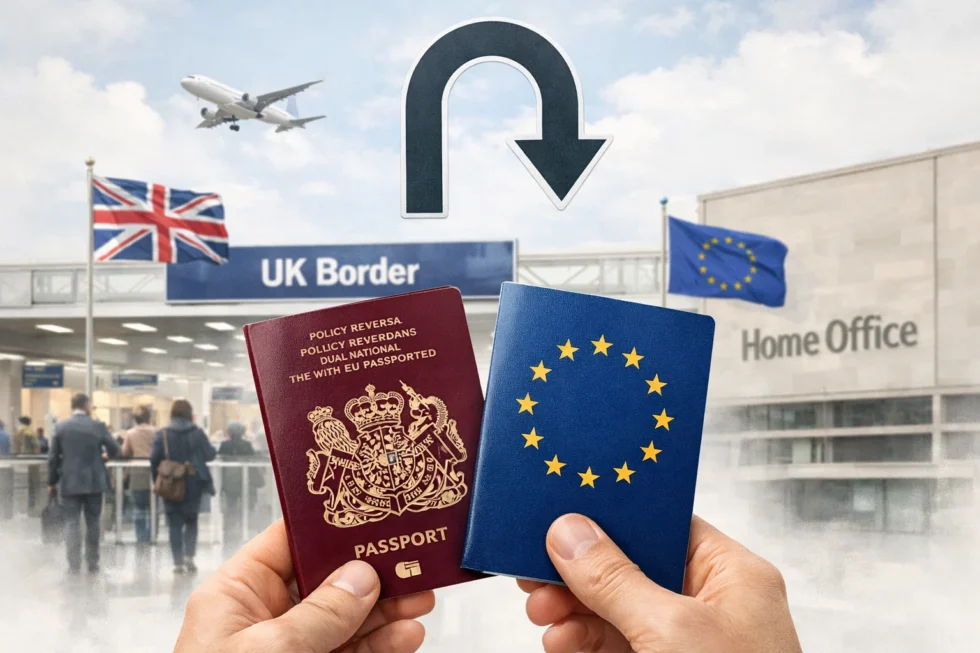
The UK Home Office has clarified that some British dual nationals who became British citizens after first securing settled or pre-settled status under the EU Settlement Scheme can return to the United Kingdom using the valid passport of their other nationality instead of a British passport. In the case of citizens of the EU, Norway, Iceland, Liechtenstein and Switzerland, the updated guidance also allows travel with a national identity card, provided the document is linked to the traveller’s UKVI account where relevant. The clarification appeared after controversy over rules that took effect on 25 February 2026, when carriers were told British dual citizens would generally need to show a valid British passport, or in some cases a certificate of entitlement to the right of abode, before boarding transport to the UK. The issue drew attention because some newly naturalised citizens who had already completed the citizenship process were still waiting for their first British passport and feared being unable to board flights home. This was reported by The WP Times citing The Guardian.
What exactly changed in the UK border rules
According to updated guidance published on GOV.UK in March 2026, the UK Home Office clarified how travel rules apply to people who first obtained immigration status through the EU Settlement Scheme and later became British citizens through naturalisation. Under this clarification, such individuals may still travel to the United Kingdom using the passport of their other nationality if they have not yet received a British passport. Specifically, the Home Office states that travellers in this situation may enter the UK with:
- a valid passport of their other nationality, or
- a national identity card issued by an EU member state, Norway, Iceland, Liechtenstein or Switzerland.
This clarification is important for people who completed the British naturalisation process but are still waiting for their first British passport, which can take several weeks or months to be issued after a citizenship ceremony. Before this clarification appeared on the government website, the interpretation of rules introduced on 25 February 2026created concern that British dual nationals might be required to present a British passport before boarding flights to the UK. Because airlines must check travel documents before allowing passengers to board, some travellers feared they could be refused boarding if they did not yet have a British passport. The updated Home Office wording confirms that people who naturalised after holding EU Settlement Scheme status are not required to wait for a British passport in order to travel to the UK.
However, airlines and other transport carriers may still request evidence that the traveller has permission to enter the UK. In practice, this can involve checking the person’s digital immigration record linked to the EU Settlement Scheme or other UKVI status before allowing boarding.
Why the issue emerged in February 2026
The controversy developed after border travel guidance affecting British dual nationals began to be applied more strictly from 25 February 2026. Under UK border rules, transport carriers such as airlines, ferries and international rail operators must verify that passengers travelling to the United Kingdom hold the correct documents proving their right to enter the country.
In practice, carriers face financial penalties from the UK government if passengers arrive without valid documentation, which means airlines typically apply document checks cautiously before allowing passengers to board.
Because of this system, reports began to appear that some carriers were asking British dual nationals to present a British passport when travelling to the UK. This interpretation created uncertainty for people who had recently completed the naturalisation process but had not yet received their British passport.
For these individuals the situation was particularly complicated. Legally they had already become British citizens after naturalisation, but without a British passport it could be difficult to demonstrate that status during airline check-in procedures. As a result, some travellers feared they could be refused boarding for flights to the UK, even though they had the legal right to live in the country.
The role of the certificate of entitlement
Before the Home Office clarified the guidance, one of the few formal documents available to prove a right of entry in such situations was the certificate of entitlement to the right of abode. This document confirms that a person has the right of abode in the United Kingdom, meaning they can live and enter the country without immigration restrictions. The certificate is issued by the UK government and is placed inside a foreign passport. However, obtaining the certificate requires a separate application process, submission of supporting documents and payment of a government fee.
According to the UK government fee schedule, the certificate of entitlement currently costs £589, which means newly naturalised citizens who did not yet have a British passport could face additional expenses if they needed proof of their right to enter the UK while travelling. For many applicants this cost would come on top of the already significant fees associated with naturalisation and citizenship procedures.
The EU Settlement Scheme and citizenship pathway
The situation is closely linked to the EU Settlement Scheme, introduced after the United Kingdom formally left the European Union. The scheme allowed EU citizens who were already living in the UK before 31 December 2020, when the Brexit transition period ended, to apply for legal residence in the country. Applicants under the scheme could receive two types of status:
- Settled status — granted to people who had lived in the UK for five continuous years or more
- Pre-settled status — granted to those with less than five years of residence, allowing them to remain until they qualify for settled status
People who later obtained settled status could eventually apply for British citizenship through naturalisation, provided they met several legal requirements. These requirements typically include:
- passing the Life in the UK Test, which assesses knowledge of British history, society and institutions
- demonstrating sufficient English language ability
- proving continuous residence in the UK
- attending an official citizenship ceremony after the application is approved
Once the naturalisation process is completed, applicants receive a certificate of British citizenship confirming their new nationality. Only after receiving this certificate can a new citizen submit an application for their first British passport, which serves as the standard travel document proving British nationality during international travel.r a British passport.
Waiting for a British passport
After naturalisation, a person becomes a British citizen from the date of the citizenship ceremony, but their British passport is a separate application and is not issued automatically. During that gap, the person may already hold British nationality but still have only their non-British passport for travel. That became a problem after the 25 February 2026rule change was applied at check-in, because carriers were told British dual nationals generally had to travel with a valid British passport or a certificate of entitlement to the right of abode.
Real cases of disruption
The Guardian described the case of Jelena, a Latvian-British dual national who has lived in the UK for 16 years with her British husband. After completing naturalisation, she was still waiting for her first British passport when the February rules took effect. She and her husband had already booked a trip to South America for late March, but she changed her return plans and prepared to go to Latvia instead of the UK, fearing she would not be allowed to board a flight home using her Latvian passport. She said the naturalisation process had already cost about £2,000, and the additional certificate would have added roughly £589 more. She later received an email saying she could return to the UK on her Latvian passport.
Another case involved Florence, who said she missed a 28 February trip to France to see her elderly father because she had naturalised but was still waiting for her British passport. Her husband travelled without her while she remained in the UK and continued the passport process. After the Home Office clarification appeared, she questioned why it had not been made public earlier.
Reaction from the3million
The campaign group the3million welcomed the clarification but said the Home Office did not communicate it clearly. According to the group, it was informed of the change by email on 10 March 2026, while many affected people heard about it through campaign networks or social media rather than through a prominent government announcement. The group also argued that the update was placed on a citizenship page rather than clearly highlighted on the main guidance around the new dual-national travel rules.
What the Home Office said
The Home Office position, as quoted by The Guardian, was that the rules had been laid out publicly in October 2024 and had not changed, and that carriers should expect to see a traveller’s digital immigration status when relevant. But the wording now visible on GOV.UK specifically states that a person who got British citizenship after settling in the UK under the EU Settlement Scheme can travel to the UK using a valid passport of their other nationality or a national identity card from the EU, Norway, Iceland, Liechtenstein or Switzerland. GOV.UK also says the travel document should be linked to the UKVI account to avoid delays.
This clarification is narrow. It applies to people who first held status under the EU Settlement Scheme and only later became British citizens through naturalisation. It does not automatically cover all dual nationals, and campaigners noted that it does not extend to every group affected by the February rules, including some people who naturalised in different circumstances.
The practical result is that a person who became British after the EU Settlement Scheme does not necessarily have to wait for their first British passport before returning to the UK. If they fall within the category now described on GOV.UK, they can travel on their other valid passport or, where allowed, on an eligible European national identity card linked to their UKVI record. That reduces the immediate boarding risk that arose after 25 February 2026, but it also shows how sensitive post-Brexit travel rules remain when citizenship status and travel documents do not arrive at the same time.
Read about the life of Westminster and Pimlico district, London and the world. 24/7 news with fresh and useful updates on culture, business, technology and city life: UK entry rules change from 25 February 2026, as dual nationals must travel using a British passport