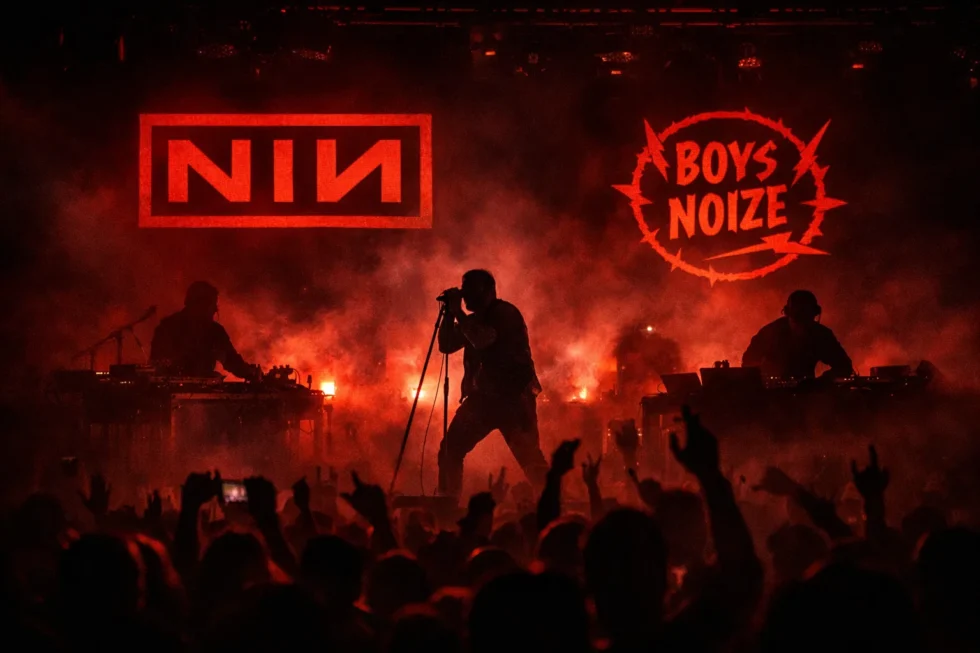
Nine Inch Noize emerged as one of the defining talking points of Coachella 2026 after Trent Reznor, Atticus Ross and Boys Noize delivered a full-scale performance at the Sahara stage on April 11, transforming the project from an intriguing collaboration into a serious live proposition with immediate implications for ticket demand, future dates and an expected new release, reports The WP Times. What had previously existed as a reworked live segment within Nine Inch Nails’ recent touring cycle was presented here as a standalone format: a 45-minute set built from re-engineered material, electronic pressure, severe staging and a clear sense that this is no longer being treated as an experiment.
The set at the Empire Polo Club in Indio did more than revisit catalogue material. It reframed the Nine Inch Nails songbook for a festival environment built around movement, scale and impact, while on-site indications — including billboard promotion and the structure of the performance itself — pointed to a broader rollout beyond Coachella. For fans, promoters and ticket buyers, the practical significance is straightforward: Nine Inch Noize now looks less like a side concept and more like a viable touring act with real commercial pull.
Nine Inch Noize Coachella 2026 set details show a deliberate shift from rock concert to industrial rave
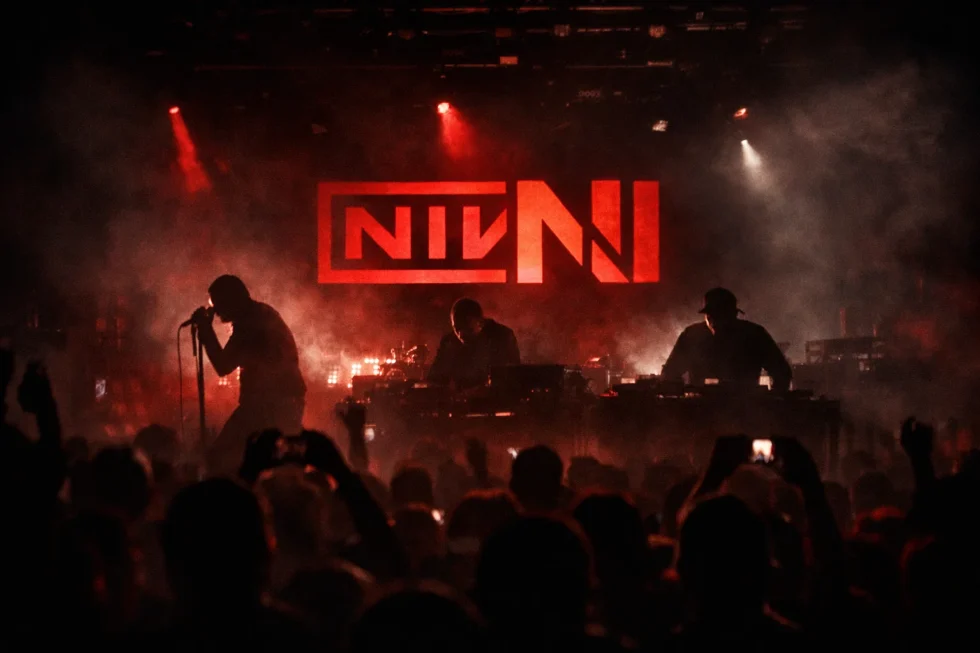
The first thing that mattered was the format. Rather than placing Nine Inch Nails songs inside a conventional rock show framework, Nine Inch Noize used the Sahara Tent as an electronic pressure chamber. Reznor, Ross and Boys Noize performed from within an elevated stage structure dominated by synthesisers, samplers and stripped-back visual design, with the sonic emphasis moved away from guitar weight and toward mechanical rhythm, distortion and controlled dread.
That change in method also changed the meaning of the material. Songs such as “Closer”, “Heresy” and “Copy of A” were not simply remixed for convenience; they were rebuilt to function inside a club-orientated live environment. Tempos breathed differently, transitions were handled with DJ logic rather than standard song breaks, and tension accumulated in long electronic layers rather than through familiar rock release points. What made the set effective was not excess, but discipline. The visual system remained harsh and economical: strobes, monochrome bodies, smoke, angular movement, and a steep ramp that gave the performance a ritualistic physical dimension. In that context, Nine Inch Noize looked less like a novelty billing and more like a coherent performance language. Key structural features of the set included:
- A full performance built around reworked Nine Inch Nails material
- Boys Noize integrated as a central sonic architect rather than guest support
- Continuous transitions between tracks instead of stop-start pacing
- Heavy reliance on synth-led tension, distortion and programmed rhythm
- Choreographed performers used as part of the stage narrative rather than decoration
This matters because it changes how the project should be read. Nine Inch Noize is not being presented as a loose collaboration for festival branding. It is functioning as a reinterpretation vehicle for legacy material in a new commercial and artistic format.
Nine Inch Noize tickets: where fans should look now and what is actually available
The next question is the practical one: tickets. Following the Coachella appearance, search interest has clearly moved beyond reaction to the set itself and toward where this project might appear next. At the time of writing, no standalone Nine Inch Noize tour has been formally announced, which means there are no fully confirmed direct-sale tickets for dedicated headline dates. That point matters, because it separates real availability from speculation and resale noise. Even so, there are already several realistic routes that fans should monitor.
Where tickets are most likely to appear first
- Official artist channels
The most important source remains official communication linked to Nine Inch Nails, Trent Reznor, Boys Noize and their mailing lists or social channels. If a rollout is imminent, these will likely be the first places where pre-sale information appears. - Primary ticketing platforms
If live dates are announced, major ticketing operators such as Ticketmaster and Live Nation are the most likely distribution partners for UK, European and US sales. - Festival line-up announcements
If Nine Inch Noize develops first as a festival-format act rather than a solo arena tour, ticket access may come through summer or autumn festival programmes before standalone headline shows are confirmed. - Resale markets
Coachella resale remains relevant only for those seeking festival access linked to the event itself, but for future dates this should be treated cautiously. Resale becomes structurally more expensive once official demand is proven.
At present, the core message for buyers is accuracy over speed. There is no benefit in chasing unofficial listings before formal dates exist. The smart move is to monitor official artist and promoter channels closely and be ready for early access windows.
Ticket price expectations can already be estimated from comparable live markets
Although no full Nine Inch Noize tour pricing has been announced, the likely ticket range can be estimated from the economics of comparable shows involving major alternative acts, electronic crossover productions and premium festival appearances.
| Event type | Likely price range | What that usually means |
|---|---|---|
| Festival entry | €400–€1,200 | Multi-day pass, often with resale inflation |
| Arena or major hall show | £70–£160 | Standard price range for high-demand legacy/electronic crossover acts |
| Premium resale | £200+ | Depends heavily on venue size and scarcity |
| VIP or premium package | £400+ | Only if offered in a formal tour structure |
| Club-scale one-off event | £45–£95 | Possible only if used as a launch or special-format show |
These are not confirmed Nine Inch Noize prices, but they are useful market indicators. If the project goes out as a limited-run event rather than a full conventional tour, scarcity alone could push prices sharply higher, especially in London, Berlin, Los Angeles or New York.
That is why timing matters more than speculation. Fans who enter through official pre-sale systems will almost certainly have an advantage over those who wait for resale markets to establish price ceilings.
Mariqueen Maandig, stage design and catalogue rework gave the set its identity
One reason the performance landed so strongly is that it did not rely on nostalgia alone. The set used familiar source material, but the live identity came from reconstruction. Mariqueen Maandig’s appearance added a further vocal and atmospheric dimension, giving selected moments a different contour from standard Nine Inch Nails performance language and widening the emotional range without softening the set’s brutality.
On stage, the roles were clear. Reznor remained the centre of gravity, Ross anchored the structural and textural side of the performance, and Boys Noize handled the pressure, breakpoints and club logic that made the entire format viable in the Sahara environment. The dancers and monochrome staging were not incidental additions; they formed part of the set’s internal narrative of tension, descent and mechanical physicality.
Notable on-stage elements included
- Reznor, Ross and Boys Noize positioned inside a tight electronic performance rig
- Maandig contributing vocal layering and contrast
- Dancers integrated into the visual architecture of the set
- Minimalist lighting dominated by strobes, red washes and black-and-white imagery
- A ramp-based stage design that created height, depth and controlled menace
That combination explains why the performance generated immediate reaction. It did not feel like a guest spot or side-stage novelty. It looked tested, scalable and ready for repeat presentation.
Why the industry is taking Nine Inch Noize seriously after Coachella
Early media reaction has focused on the same underlying point: this was not a casual mash-up. It was a structured reworking of the Nine Inch Nails catalogue into a new live product with its own stage logic, audience position and commercial potential.
That distinction matters. In the live business, projects often generate attention at festival level without translating into durable demand. Nine Inch Noize appears to have avoided that problem because the concept already feels operational. It has recognisable source material, a built-in audience base, a credible electronic partner, a visual framework and now a high-profile debut that can be used as proof of concept.
If an album follows quickly, as current signals suggest, the path becomes even clearer. Recorded material would give the project its own identity outside the festival setting and create a stronger commercial basis for tour routing, venue booking and international promotion.
What happens next for Nine Inch Noize after Coachella 2026
The most likely short-term development is a formal music release tied directly to what was previewed at Coachella. That would allow the project to move from live curiosity to marketable act. After that, the most realistic scenarios are limited festival appearances, selected city dates, or a short-run tour designed around high demand and strong visual production values. The most likely next steps are
- A near-term digital or album release
- Additional festival bookings in major markets
- A formal ticketed run in the US and Europe
- Strong demand in cities with established Nine Inch Nails and electronic audiences
For buyers, the key point is not just whether dates arrive, but how they arrive. If the rollout is narrow and prestige-based, tickets could become difficult quickly. If promoters see this as a wider commercial opportunity, the project may expand faster — but even then, early dates will likely carry the highest pressure.
The practical position for fans and ticket buyers now
Nine Inch Noize is no longer just a line-up curiosity from Coachella 2026. The project now has a defined live identity, a visible audience response, and the beginnings of a ticket market before a formal standalone on-sale has even begun. That is usually the point at which price inflation, unofficial listings and speculative hype begin to distort the picture. The practical takeaway is simple. Watch official artist channels, watch primary ticketing partners, and do not confuse demand with confirmed availability. Right now, there is momentum, but not yet a full public sale structure. When that changes, the first pre-sale window is likely to matter more than anything that happens afterwards.
At Coachella, Nine Inch Noize proved that this format works on a major stage. The next question is no longer whether the collaboration is real. It is where it goes next, how widely it tours, and how quickly fans will need to move when the first proper tickets appear.
Who are Nine Inch Noize: what it is, how it works and what matters
Nine Inch Noize is a hybrid live project built around Trent Reznor and Atticus Ross — the core of Nine Inch Nails — in collaboration with Boys Noize, a Berlin-based producer known for club-focused techno and electro. The concept did not begin as a separate band with new songs, but as a structural experiment inside the Nine Inch Nails live format: during the “Peel It Back” tour, a central section of the show was rebuilt without guitars, focusing instead on sequencers, drum machines and live electronic manipulation. That segment effectively became the blueprint for Nine Inch Noize.
What distinguishes the project is how the material is handled. Instead of playing original tracks as they were written, the catalogue is broken down into components — vocals, rhythms, synth textures — and reconstructed to function inside a continuous electronic set. This means songs are no longer performed as fixed units but as evolving sequences, often extended, slowed down or intensified to fit a club-oriented structure. In practical terms, the performance sits somewhere between a concert and a live DJ set, with Boys Noize shaping transitions, breakdowns and rhythmic pressure while Reznor and Ross control composition, atmosphere and vocal delivery.
There are also clear operational details worth understanding. The project relies heavily on modular and analogue synthesis rather than pre-programmed playback, meaning much of the sound is generated and manipulated in real time. The stage design — typically minimal, industrial and physically structured — is not decorative but functional, allowing performers to interact with equipment and space as part of the set. The inclusion of Mariqueen Maandig in certain performances adds harmonic layering and links the project to earlier Reznor/Ross work, particularly the more atmospheric and cinematic side of their catalogue. From a market perspective, the key point is that Nine Inch Noize is not positioned as a nostalgic extension of Nine Inch Nails. It is a format shift. It allows an existing catalogue to be repackaged for electronic festival environments, younger club audiences and large-scale visual staging without abandoning its core identity. That is why it matters: it creates a second life for established material while opening a new touring and ticketing model that sits between legacy rock shows and contemporary electronic events.
Read about the life of Westminster and Pimlico district, London and the world. 24/7 news with fresh and useful updates on culture, business, technology and city life: Who won The Apprentice 2026? Finalists confirmed after brutal interviews as BBC series heads to finale