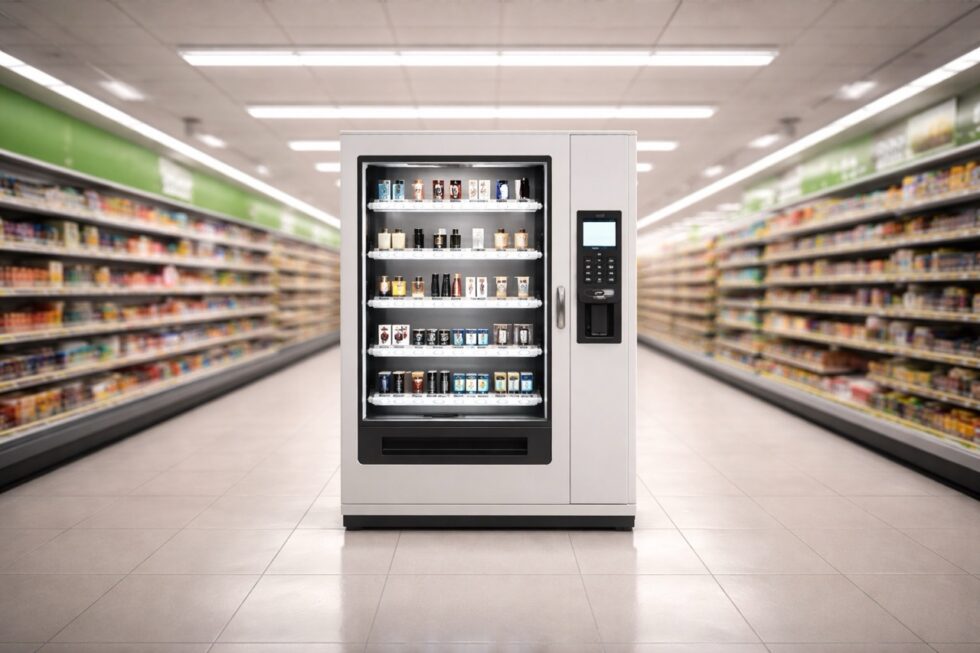
Shoplifting is forcing operational change across the UK retail market as Asda prepares to introduce vending machines for high-theft items such as perfume and batteries, requiring customers to pay before accessing goods inside stores, according to retail reporting in Britain, reported by The WP Times citing The Telegraph. The proposal, developed amid sustained increases in retail theft across supermarkets, would move selected products out of open shelving into controlled-access units, shifting loss prevention from staff response to purchase-stage control and reflecting a broader adjustment in how UK retailers manage shoplifting risk within store layouts.
Shoplifting prevention in supermarkets: how the vending machine model would operate
The system under consideration replaces direct shelf access with a transaction-first mechanism, where customers select and pay for goods before they are released from a secure unit. This approach mirrors controlled retail environments more commonly seen in electronics or transport hubs and represents a departure from traditional supermarket layouts. Retail sources indicate that the focus is on small, high-value items with consistent theft exposure, where loss rates are measurable and repeat incidents are recorded across multiple locations. The intention is not a full-store redesign but targeted deployment in categories most frequently affected. Items likely to be included:
- perfume and fragrances
- batteries and small electronics
- cosmetics and beauty products
- accessories with high resale value
Operational structure
- product displayed behind secure interface
- customer selects item digitally
- payment completed before release
- item dispensed after confirmation
The model removes the possibility of immediate physical access without transaction, altering the sequence of interaction between customer and product.

Retail data and shoplifting pressure: why the UK market is shifting
The move follows sustained reporting of increased shoplifting incidents across the UK retail sector, with supermarkets identifying patterns that extend beyond isolated theft to repeat and coordinated activity. Industry data points to a concentration of theft in specific product categories, particularly those that are compact, branded and easily resold. Retailers have responded through a combination of security measures, though their effectiveness varies depending on the type of offence and store environment.
Current measures in use
| Measure | Function | Limitation |
|---|---|---|
| Security tags | Track unpaid items | Can be removed or bypassed |
| Locked cabinets | Restrict access | Slows customer interaction |
| CCTV and monitoring | Record activity | Reactive, not preventive |
| Staff presence | Visible deterrent | Limited during peak hours |
| Vending units (proposed) | Pre-payment control | Requires infrastructure investment |
The introduction of vending systems is positioned within this framework as a structural adjustment rather than an incremental security upgrade.
Shoplifting response across industry: confirmed statements, data and sources
Retail response to shoplifting in the UK is now being defined by documented data and on-record industry statements rather than generalised security commentary, with major trade bodies and retailers explicitly linking theft patterns to operational changes in stores. According to British Retail Consortium, retail crime has reached record levels, with its latest annual crime survey stating that incidents of customer theft rose to more than 16 million cases per year, equivalent to over 45,000 incidents per day (“retail theft has increased significantly year-on-year,” BRC Crime Survey, published 2024, widely cited in 2025–2026 reporting).
The same dataset identifies a shift in structure: theft is increasingly repeat-based and targeted, rather than opportunistic. This is reinforced by reporting in The Telegraph (Hannah Boland, Retail Editor, 12 April 2026), which states that UK supermarkets, including Asda, are now isolating “high-theft items” such as perfume and batteries due to consistent targeting by offenders.
Separately, Office for National Statistics data confirms that shoplifting offences recorded by police in England and Wales exceeded 430,000 cases in the most recent reporting period, representing the highest level in decades (“shoplifting offences recorded by police have reached record levels,” ONS crime statistics release, 2025). Industry-level interpretation of this data is reflected in operational decisions rather than commentary. Retailers are increasingly shifting from deterrence (guards, CCTV) to restriction (controlled access), particularly in high-frequency theft categories. The Asda vending machine proposal sits within this documented transition.
Customer experience and store layout: operational impact inside supermarkets
The move toward controlled-access systems directly alters how customers interact with goods, replacing open browsing with a structured purchase sequence for selected categories. This is not theoretical but consistent with existing practices already deployed in UK stores, including locked cabinets for alcohol, razor blades and infant formula. Retail reporting indicates that high-footfall stores — particularly in London, Manchester and Birmingham — are prioritising such measures where theft rates are measurably higher. The objective is to reduce loss without fully removing product visibility, maintaining commercial exposure while limiting unauthorised access. Observed and expected in-store adjustments:
- removal of open shelf access for targeted items
- introduction of pay-first or request-based systems
- increased segmentation between high-risk and standard goods
- redesign of aisle flow to accommodate controlled units
Retailers are balancing transaction speed against shrinkage reduction. Internal data cited across UK grocery reporting indicates that even marginal reductions in theft rates can materially affect store-level profitability, particularly in categories with tight margins.
Policy and enforcement backdrop: regulatory context and current measures
The retail shift is occurring alongside a defined policy backdrop, where UK authorities are addressing both enforcement capacity and the tools used in shoplifting. Government-backed measures have focused on devices such as signal jammers and keyless theft tools, which are linked not only to vehicle crime but also to retail theft methods. While no single legislative change currently defines supermarket-level responses, the broader framework is informed by police-recorded crime increases and industry lobbying for stronger deterrents. Retailers continue to operate within existing legal structures, which place the primary burden of prevention on store-level systems rather than immediate enforcement intervention. In practice, this has led to a divergence:
- policy response → focused on criminal tools and repeat offenders
- retail response → focused on access control and store design
The introduction of vending-style units for high-theft goods reflects this divergence, where operational changes inside stores are implemented independently of legislative timelines, based on measurable loss patterns and internal risk modelling. Read about the life of Westminster and Pimlico district, London and the world. 24/7 news with fresh and useful updates on culture, business, technology and city life: What is known about tonights lottery numbers National Lottery Lotto and Thunderball draw and results live for Saturday, April 11 as £3.94m jackpot is decided across UK draws