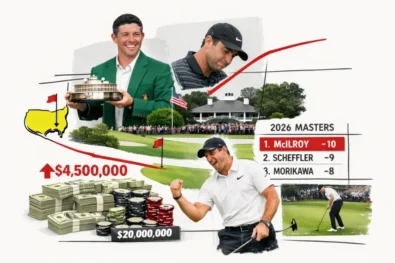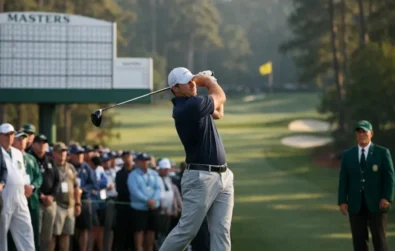
Rory McIlroy will not play this week’s RBC Heritage at Harbour Town Golf Links, stepping away from competition days after securing a second consecutive The Masters title at Augusta National. The decision, confirmed before the tournament, follows an intense four-day major campaign in which McIlroy defended his lead under pressure to finish at 12-under-par, one shot clear of world No.1 Scottie Scheffler, The WP Times reports.
The absence has revived attention around the financial consequences of similar withdrawals, particularly a £2.2 million loss McIlroy incurred in 2023 under PGA Tour participation rules. However, structural changes introduced in 2024 mean his 2026 decision carries no automatic fine, reflecting a broader shift in how elite players manage schedules within the modern PGA Tour calendar.
Why Rory McIlroy skipped RBC Heritage after Masters
McIlroy’s withdrawal is not an isolated decision but part of a consistent scheduling pattern. The Northern Irishman has rarely prioritised the Hilton Head event, particularly given its position immediately after the Masters. From a competitive standpoint, several factors explain the decision:
- Physical fatigue following a major championship
- Emotional recovery after high-pressure final rounds
- Course suitability, with Harbour Town favouring precision over power
- Strategic rest ahead of upcoming PGA Tour events
McIlroy has previously indicated that the course does not align naturally with his playing strengths, which are typically maximised on longer layouts. The week-after-Masters slot also traditionally sees reduced participation from top players, many of whom prioritise recovery. In practical terms, skipping the RBC Heritage is less about celebration and more about performance management across a demanding season.
The £2.2 million fine explained: what happened in 2023
The financial impact often referenced in coverage relates specifically to events in 2023, when PGA Tour rules imposed strict participation requirements on top-ranked players.
| Category | Detail |
|---|---|
| Rule applied | Player Impact Program (PIP) participation requirement |
| Obligation | Play in nearly all designated “signature events” |
| Event skipped | RBC Heritage (after missing Masters cut) |
| Financial impact | Approx. £2.2 million forfeited |
| Reason | Loss of PIP bonus eligibility |
At the time, players ranked within the top 20 of the PIP standings were required to appear in a set number of high-profile events. By missing multiple tournaments, including the RBC Heritage, McIlroy forfeited a significant bonus rather than receiving a direct fine in the traditional sense.
(“I had my reasons… it was worth it to get some things in place,” McIlroy said, referencing discussions with PGA Tour Commissioner Jay Monahan, Augusta/US, 2023) This distinction is important: the penalty was not a fine imposed after withdrawal, but a loss of eligibility tied to participation rules.
How PGA Tour rule changes affect McIlroy in 2026
The structural reset introduced by the PGA Tour in 2024 has fundamentally changed how elite players, including Rory McIlroy, approach signature events such as the RBC Heritage. Where participation was previously enforced through financial consequences, the system has shifted towards a market-driven model in which prize money replaces obligation as the primary incentive. This transition reflects both internal pressure to modernise and external competition reshaping professional golf.

Under the previous framework, absence from designated events directly impacted earnings through bonus forfeiture. The revised model removes that constraint, allowing players to build schedules around performance cycles rather than compliance. In practical terms, McIlroy’s 2026 withdrawal carries no financial penalty, highlighting a clear departure from the rigid participation rules that defined the 2023 season. Key structural changes since 2024:
- Removal of mandatory participation thresholds for top-ranked players
- Expansion of prize purses to attract voluntary entry
- Increased autonomy in calendar planning
- Shift away from punitive enforcement mechanisms
| Period | System model | Effect on players |
|---|---|---|
| 2023 | Mandatory (PIP-linked) | Financial losses for missed events |
| 2024–2026 | Incentive-driven | No automatic fines, flexible scheduling |
The result is a system where economic logic replaces enforcement: tournaments must now compete for player participation rather than require it. This has elevated the importance of timing, recovery, and course fit in decision-making at the top tier of the sport.
What this means for Rory McIlroy’s season strategy
McIlroy’s decision sits within a broader recalibration of workload management across elite golf. With the removal of structural penalties, top players are increasingly optimising for peak performance windows—particularly around major championships such as The Masters—rather than maintaining continuous presence across the calendar. This approach reflects a shift from volume to precision:
- Major tournaments prioritised over secondary events
- Recovery phases integrated immediately after high-intensity weeks
- Reduced cumulative fatigue across the season
- Scheduling aligned with long-term ranking and legacy targets
His back-to-back Masters titles place him in a historically rare category, but sustaining that level requires strict control over physical and mental load. In that context, skipping post-major events is increasingly treated as a performance decision rather than an absence. The modern PGA Tour landscape now supports this logic: success is no longer tied to playing more, but to playing at the right moments under optimal conditions.
What happens next for McIlroy after skipping RBC Heritage
Following his Augusta victory, McIlroy is expected to re-enter competition later in the spring phase of the PGA Tour schedule, focusing on events that align more closely with his playing profile and preparation cycle. The immediate priority is recovery rather than continuation. Short-term outlook:
- Controlled recovery period after Masters campaign
- Training block ahead of next PGA Tour starts
- Strategic targeting of upcoming high-value tournaments
While post-major appearances were once seen as standard, the current structure of professional golf increasingly rewards selective participation. Visibility has become secondary to sustainability. In this context, McIlroy’s absence from Harbour Town is not an exception but a reflection of the sport’s evolving competitive model—where long-term performance is built as much on strategic withdrawal as on participation.
Read about the life of Westminster and Pimlico district, London and the world. 24/7 news with fresh and useful updates on culture, business, technology and city life: What is behind Scottie Scheffler Masters complaint after Augusta loss to McIlroy