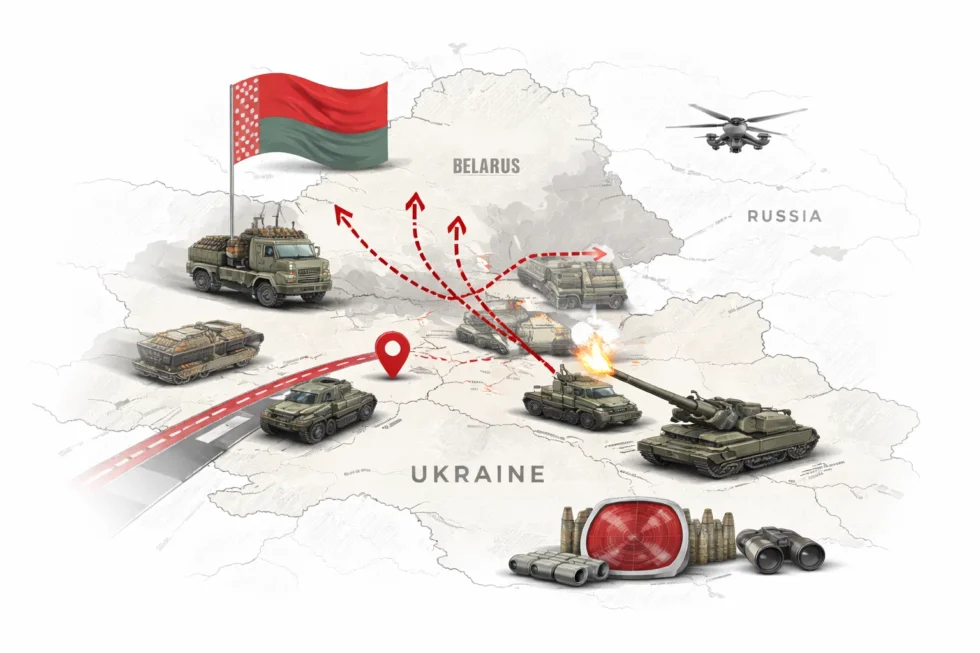
Belarus is back at the centre of Ukraine’s northern war assessment after President Volodymyr Zelenskyy said intelligence points to fresh Russian efforts that could pull Minsk more directly into the conflict, with reported road construction and artillery positions in the Belarusian border area indicating possible preparation for renewed military activity from the north. The warning comes as the war enters its fourth year, with Kyiv indicating that Moscow is regrouping forces to manage mounting pressure on manpower, while Russian officials have, in parallel, intensified rhetoric towards European states and the United Kingdom over their role in supporting Ukraine’s drone capabilities, as noted by The WP Times reports, citing Reuters.
Zelenskyy said the assessment followed a report from Ukraine’s commander-in-chief, Oleksandr Syrskyi, and pointed to specific construction and military indicators close to the Belarusian frontier. In remarks published on Telegram and reported by multiple outlets, he said: “According to intelligence, road construction in areas leading to Ukraine and the establishment of artillery positions are going on in the Belarusian border area.” He added that Russia was “attempting ... to carry out a regrouping of forces – most likely to compensate for a shortage of personnel”, and said Kyiv believes Moscow “will once again try to involve Belarus in its war”. Reuters also reported that Ukraine had warned the Belarusian leadership of its readiness to defend its territory and independence.
Belarus warning puts the northern front back into focus
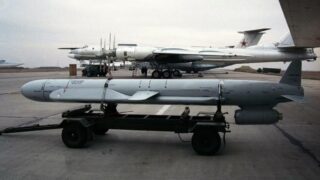
The significance of the latest warning lies not in a confirmed new offensive, but in the return of Belarus to Ukraine’s operational map as a possible staging direction. Belarus allowed Russian forces to use its territory during the opening phase of the full-scale invasion in 2022, when troops moved south towards Kyiv from the north. Since then, Minsk has remained Moscow’s closest military ally in the region, while repeatedly saying it does not plan to send its own troops into Ukraine. Reuters notes that Belarus has nevertheless hosted Russian tactical nuclear weapons and hypersonic missile systems, underlining how closely its security posture remains tied to the Kremlin.
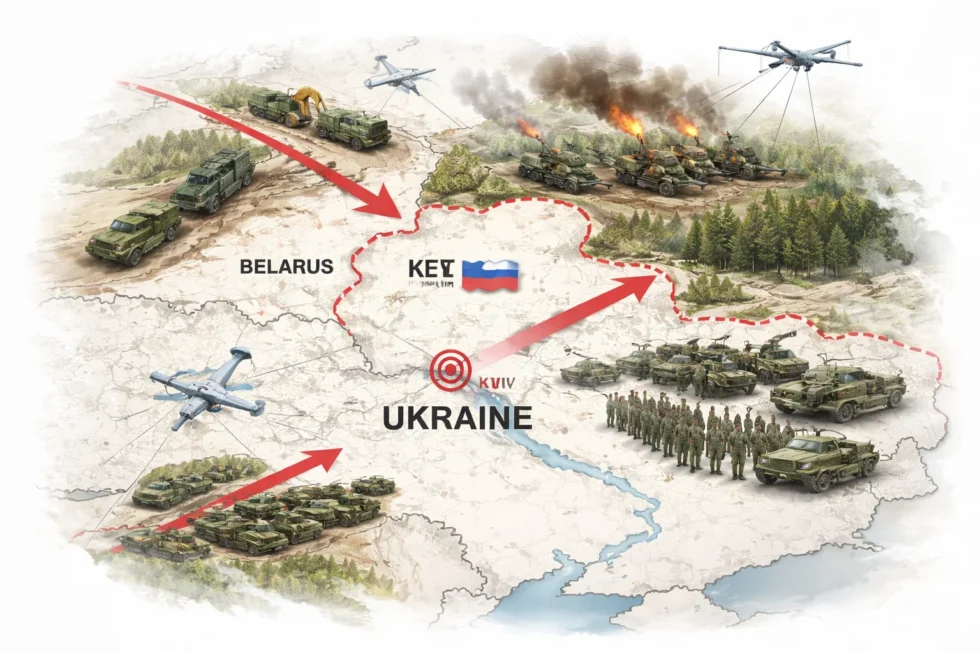
Kyiv’s concern now appears to centre on the combination of engineering work, artillery positioning and force regrouping rather than on any publicly confirmed mass deployment. In military terms, road construction in border areas can support the movement of heavy armour, logistics columns and artillery systems, while prepared firing positions can expand operational options even before large-scale troop concentrations become visible. Zelenskyy’s wording was careful: he described what Ukrainian intelligence says is being built and prepared, but stopped short of saying a new cross-border assault is under way. That distinction matters, because the current picture points to preparatory conditions rather than verified combat movement.
The warning also comes after similar concern earlier in the spring. The Guardian had already reported in March that Zelenskyy said Russia was setting up long-range drone bases in Belarus, which Kyiv viewed as another step that could draw Minsk more directly into the war. The new statement suggests Ukraine now sees a wider pattern in the Belarusian direction, combining infrastructure works, artillery placement and force redistribution into a more serious operational signal.
What Zelenskyy said and why the wording matters
Zelenskyy’s comments were framed not as political rhetoric alone but as a summary of military intelligence. That is important because the terms he used point to concrete observable changes on the ground rather than abstract fears. Road building, artillery positions and regrouping are all phrases associated with military preparation, and each of them carries a different implication.
| Indicator | What was reported | Why it matters |
|---|---|---|
| Road construction | Routes in areas leading to Ukraine | Supports troop and equipment movement |
| Artillery positions | Establishment near the Belarusian border area | Increases fire support options close to frontier |
| Regrouping of forces | Russian redistribution of units | Suggests effort to address operational strain |
| Personnel shortage link | Moscow may be compensating for manpower pressure | Indicates structural stress inside Russian forces |
Taken together, these indicators do not prove an imminent attack. They do, however, suggest that Ukraine sees renewed utility in the Belarusian axis for Russian planning, whether as a genuine military option, a coercive threat, or a means of forcing Kyiv to keep resources tied down along the northern border. Reuters’ reporting on the manpower issue is especially notable because it places the Belarus warning within the wider strain on Russian force generation.
There is also a political layer. Belarusian leader Alexander Lukashenko has tried to balance deep dependence on Moscow with caution about direct entry into the war. That balancing act has become harder as Russian military integration with Belarus has deepened. The latest Ukrainian assessment therefore speaks not only to battlefield risk, but also to the degree to which Russia may be trying to use Belarusian territory, infrastructure and military geography once again without necessarily requiring Minsk to declare open participation in combat.
Russian warnings to Europe add to the wider escalation picture
The Belarus alert did not emerge in isolation. It came against a background of sharper Russian language towards European countries and the United Kingdom over support for Ukraine’s drone capabilities. Reuters reported that Russia’s defence ministry warned that European plans to expand drone supplies to Ukraine were dragging those countries deeper into the war and published a list of facilities it alleged manufacture drones or drone components. Those facilities were said to be in Britain, Germany, Denmark, Latvia, Lithuania, the Netherlands, Poland, the Czech Republic, Spain, Italy, Israel and Turkey.
A later Reuters report said the Kremlin continued that line, arguing that Europe’s growing drone cooperation with Ukraine showed deeper involvement in the conflict. Dmitry Medvedev, deputy chair of Russia’s Security Council and a former president, said sites listed by the defence ministry could be viewed as potential military targets. Kremlin spokesman Dmitry Peskov stopped short of explicitly confirming any intention to strike such facilities, but said the countries named were becoming increasingly directly involved in the war.
That matters because it places the Belarus issue inside a broader Russian strategy of signalling. On one track, Ukraine says Moscow is preparing conditions on the northern border. On another, Russian officials are warning foreign states that support for Ukrainian drone production could expose them to greater risk. The two developments are different in nature, but both point to a widening security message from Moscow as the war grinds on. For Ukraine, the practical consequence is that the northern frontier cannot be treated as a dormant line. Even without a confirmed offensive, any infrastructure and artillery build-up in Belarus can force Kyiv to monitor, deter and potentially divert resources to guard against a renewed threat from the north. That has been one of Russia’s recurring advantages in the war: the ability to stretch Ukraine’s military planning across several directions at once. The latest warning from Zelenskyy suggests Kyiv believes that pressure may again be building in the Belarusian sector.
At the same time, the evidence publicly available remains limited to what Ukrainian officials have disclosed and what has been reported by international media. There has been no public confirmation in the cited reporting of a new mass cross-border deployment from Belarus, nor any verified statement from Minsk indicating a change in its declared position on sending troops. What exists at this stage is a combination of intelligence-based warning, physical signs of military preparation and a broader atmosphere of escalation in Russian messaging towards Ukraine’s partners. That leaves the Belarus question where many of the war’s most serious developments begin: in the space between preparation and action. For now, Kyiv is signalling that it sees enough movement on the ground to sound the alarm again, and enough strategic context around Russian force shortages and European deterrence to treat the Belarusian direction as an active concern rather than a historical one.
Read about the life of Westminster and Pimlico district, London and the world. 24/7 news with fresh and useful updates on culture, business, technology and city life: USS Tripoli deployment food crisis: marines report shortages as Iran war disrupts supply lines