The London Marathon 2026 will take place on Sunday 26 April 2026, with more than 56,000 runners set to complete the 26.2-mile course across London, reinforcing its position as one of the world’s largest mass-participation races and a central fixture in the UK sporting calendar. The event combines elite competition, public entry and large-scale charity fundraising within a tightly coordinated operational framework that includes staggered start waves, real-time runner tracking, extensive road closures and full-day broadcast coverage across national platforms, requiring careful planning from both participants and spectators moving through central London, The WP Times reports.
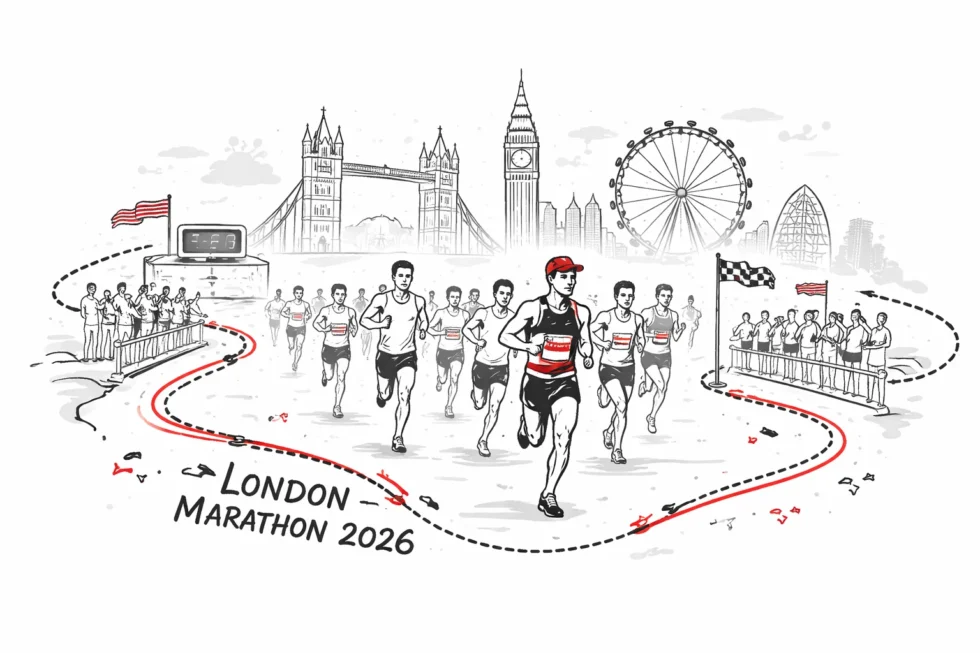
For those asking when is the London Marathon 2026, the confirmed date anchors a complex operational timetable beginning shortly before 09:00 BST with elite wheelchair races and continuing through staggered elite and mass starts. The structure reflects a long-established model designed to balance performance conditions with safety, while central London operates under extensive road closures, controlled crossings and high-density spectator movement.
London Marathon 2026: race timing, start structure and flow
The London Marathon 2026 follows a phased start system designed to distribute runners efficiently across the course and prevent early-stage congestion.
Expected start times (BST):
| Category | Approximate time | Function |
|---|---|---|
| Elite wheelchair | ~08:50 | Opens the course |
| Elite women | ~09:05 | Separate competition window |
| Elite men | ~09:35 | Primary elite race |
| Mass race | From ~09:40 | Wave-based rolling starts |
This staggered release ensures controlled spacing between groups and reduces bottlenecks in the opening miles. With participation expected to approach 59,000 runners, the timing structure remains critical to maintaining consistent race flow across the full course.
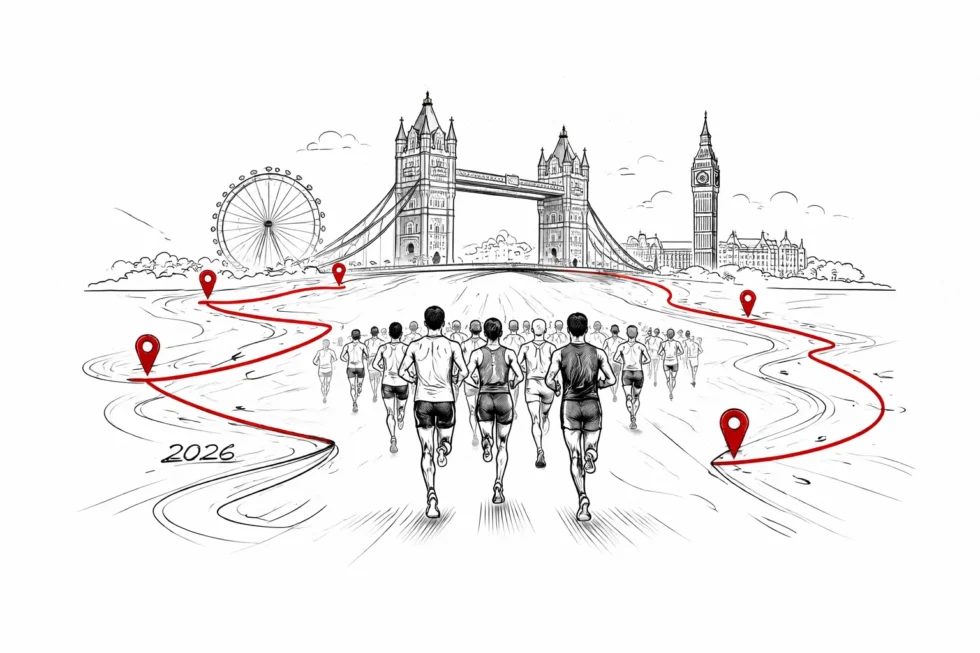
London Marathon 2026 route: full course breakdown
The London Marathon 2026 route follows a historically stable design, combining a flat, fast profile with high spectator density and landmark visibility.
Route structure:
- Start: Greenwich / Blackheath
- Miles 1–3: Gradual descent, pace formation
- Miles 4–6: Woolwich to Cutty Sark
- Miles 7–12: Deptford to Tower Bridge
- Miles 13–18: Canary Wharf and Isle of Dogs loop
- Miles 19–22: The Highway to Tower of London
- Miles 23–25: Embankment to Westminster
- Finish: The Mall (near Buckingham Palace)
Key landmarks and race dynamics:
| Mile | Location | Race significance |
|---|---|---|
| 6 | Cutty Sark | First major crowd zone |
| 12 | Tower Bridge | Peak atmosphere |
| 17 | Canary Wharf | Technical pacing section |
| 22 | Tower of London | Fatigue phase |
| 25 | Big Ben / London Eye | Final push |
| Finish | The Mall | Controlled finish corridor |
The course is widely regarded as one of the fastest marathon routes globally due to minimal elevation change, though the final 10 kilometres often determine overall outcomes.
How to track runners at the London Marathon 2026
Tracking runners at the London Marathon 2026 is a core part of race-day planning, particularly in high-density spectator zones where visual identification is unreliable. The official tracking system combines timing chip data with optional GPS sharing, allowing supporters to follow runners in near real time, predict arrival points along the course and move between viewing locations with greater accuracy, reducing missed encounters in crowded areas.
Key tracking features:
- Search by runner name or bib number
- Track multiple participants simultaneously
- Receive split updates at 5K intervals
- View predicted finish times
- Enable optional live GPS tracking
The official app integrates timing chip data with digital tools, allowing supporters to plan movements accurately rather than relying on visual spotting in crowded zones.
How supporters can plan race day effectively
Supporting a runner requires logistical planning due to restricted movement across the route.
Positioning strategy:
- Select 2–3 viewing points along the course
- Use tracking data to estimate arrival times
- Prioritise locations with strong transport access
Best spectator zones:
- Cutty Sark (mile 6) – early viewing
- Tower Bridge (mile 12) – highest crowd intensity
- Canary Wharf (mile 17) – second viewing opportunity
- Embankment (mile 24) – final approach
Visibility tips:
- Wear bright or distinctive clothing
- Use banners or signs
- Agree on visual markers in advance
Digital features: marathon app and engagement tools
The London Marathon 2026 extends beyond the physical race through integrated digital systems that support real-time coordination, navigation and audience engagement across the course. The official marathon app functions as a central platform, combining live tracking data, route mapping and interactive features that allow spectators to plan movements, monitor runner progress and access key race updates without relying on on-site announcements, particularly in high-density areas where visibility and mobility are limited.
Features include:
- Wayfinding navigation to key route points
- Augmented reality (AR) interactions pre-race
- “Belief Booster” messages displayed on course
- Live leaderboard updates
- Integrated charity donation links
These tools enhance coordination between runners and supporters while expanding audience engagement.
Fundraising and charity impact
The London Marathon remains one of the largest single-day fundraising events globally.
Structure:
- Many runners enter via charity allocations
- Participants commit to minimum fundraising targets
- Donations are tracked via integrated platforms
Impact:
- Real-time contributions increase engagement
- Supporters donate during the race
- Fundraising is directly tied to participation
Safety warning: London Marathon entry scams
Organisers have issued warnings ahead of the London Marathon 2026 over a rise in fraudulent entry offers targeting runners in the final weeks before race day. Officials stress that all places are strictly non-transferable and that any attempt to buy or sell an entry outside official channels will be invalid, with participants at risk of being denied race access.
Typical scam patterns include unsolicited messages offering last-minute places, requests for direct bank transfers and claims that entries can be reassigned after registration. Runners are advised to use only verified routes—such as the public ballot, charity allocations and Good For Age qualification—and to avoid third-party transactions that cannot be authenticated.
Key rule:
- Entries are strictly non-transferable
Common scam indicators:
- Offers to sell marathon places
- Requests for direct bank transfers
- Claims of transferable entries
Official entry routes:
- Public ballot
- Charity places
- Good For Age (GFA)
Participants are advised to use only verified registration channels.
Transport and road closures across London
The London Marathon 2026 will have a significant impact on transport across the capital, with large sections of central and east London closed to traffic for most of race day as the 26.2-mile route moves from Greenwich to The Mall. Road closures are implemented in phases from the early morning and remain in place until the final runners clear each section, affecting key corridors, bridges and junctions across multiple boroughs.
Bus services are diverted or suspended along the route, while demand on the Underground and DLR is expected to increase sharply, particularly around major spectator zones such as Tower Bridge, Canary Wharf and Westminster. Travellers are advised to check live updates before departure, allow additional journey time and use walking routes where possible, as crossing points along the course are limited and controlled throughout the day.
Expected impact:
- Road closures along the full route
- Bus diversions across central and east London
- Increased demand on Underground and DLR networks
Travel advice:
- Check live updates before departure
- Allow additional journey time
- Use walking routes where possible
- Avoid peak congestion areas
How to watch London Marathon 2026
The race will be broadcast live across UK television and digital platforms, with coverage spanning elite competition and mass participation. Coverage includes:
- Elite race tracking
- On-course reporting
- Participant and charity stories
What happens next: London Marathon 2027 entry
Following the 2026 race, entry for the 2027 London Marathon is expected to open shortly after race weekend.
Entry routes:
- Public ballot
- Charity places
- Good For Age (GFA)
Demand remains consistently high, with oversubscription typical across all entry categories.
Why London Marathon 2026 matters
The London Marathon 2026 represents a large-scale, city-wide operation that combines elite sport, mass participation and complex urban logistics within a single-day event spanning multiple boroughs. With more than 56,000 runners and hundreds of thousands of spectators expected along the route, the marathon functions as both a major international sporting fixture and a high-impact public event requiring coordinated transport management, security planning and digital infrastructure, The WP Times reports, citing BBC News.
Beyond competition, the race remains one of the largest single-day charity fundraising platforms globally, linking participation directly to financial contributions through structured entry routes and real-time donation systems. Its scale, operational complexity and global broadcast reach position the London Marathon 2026 as a benchmark for how large metropolitan events integrate sport, public engagement and infrastructure at national level. Key factors:
- Tens of thousands of runners
- Complex urban operational planning
- Global broadcast reach
- Major charity fundraising impact
For both runners and spectators, preparation—through timing awareness, route positioning and effective use of tracking tools—remains central to navigating race day efficiently.
Read about the life of Westminster and Pimlico district, London and the world. 24/7 news with fresh and useful updates on culture, business, technology and city life: What is the Manchester Marathon 2026 route and exactly how will M6, M60 and M62 closures affect travel times and access