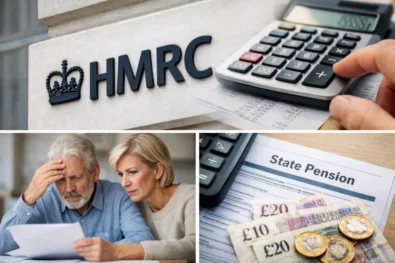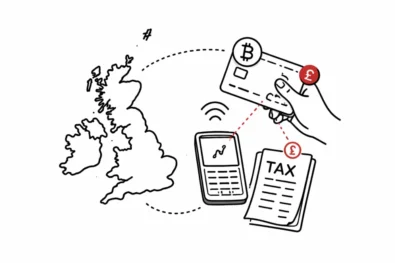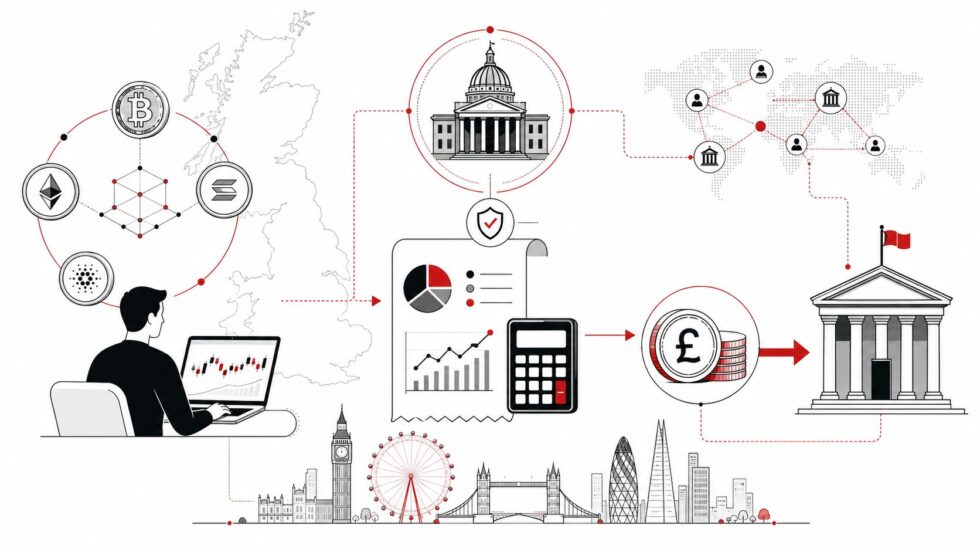
UK Crypto Tax 2026 is no longer a quiet corner of personal finance. From 1 January 2026, the Crypto-Asset Reporting Framework began changing what HMRC can receive from crypto platforms, while the Capital Gains Tax allowance for individuals remains just £3,000 and gains above it may be taxed at 18% or 24%, depending on where they sit against the taxpayer’s income band. The WP Times reports that the real change is not a new crypto tax, but a new level of reporting visibility: sales, swaps, spending crypto and some gifts can all count as disposals, even when no pounds ever land in a British bank account. HMRC’s own crypto guidance treats exchanging one token for another, using tokens to pay for goods or services and giving tokens away outside a spouse or civil partner relationship as disposals for Capital Gains Tax purposes.
For British crypto holders, the message is blunt: simply holding Bitcoin, Ethereum or a stablecoin is not taxable by itself, but moving it often is. A Bitcoin-to-Ethereum swap, a stablecoin trade, a crypto debit-card payment, staking rewards, an airdrop or a gift can all create tax consequences, depending on how the asset was received and what happened later. CARF means the old habit of treating overseas exchanges or scattered platform accounts as invisible is becoming risky, because reporting cryptoasset service providers must collect user and transaction data and report it to HMRC for the first 2026 reporting period between 1 January and 31 May 2027. This article explains what changed, what HMRC can see, which rates apply, how gains are calculated, what deadlines matter and where ordinary investors most often get the rules wrong.
UK Crypto Tax 2026 means visibility, not a brand-new tax
The biggest misunderstanding about UK Crypto Tax 2026 is the idea that Britain has suddenly invented a special new crypto tax. It has not. The taxes already existed: Capital Gains Tax for disposals of crypto held as an investment, and Income Tax where crypto is earned as income. What changed in 2026 is the reporting environment around those taxes. HMRC is moving from a world of patchy exchange requests, nudge letters and self-declared figures into a world where in-scope crypto platforms must collect and report structured information about users and transactions. The government’s CARF guidance says UK reporting cryptoasset service providers must collect information in relation to in-scope transactions on an annual basis, and HMRC’s reporting guidance says the first report covers 1 January 2026 to 31 December 2026.
That matters because tax compliance in crypto has always depended on records. If a taxpayer sold £20,000 of Bitcoin, swapped £8,000 of Solana into Ethereum, paid for something using crypto and later claimed they had only “cashed out” once, HMRC may now receive platform data that tells a fuller story. CARF does not give HMRC supernatural access to every private wallet, nor does it automatically value every self-custody movement with perfect context. But it does mean exchange accounts, platform activity and many reportable transactions become much harder to leave out of a Self Assessment return. For anyone who has treated crypto as informal money rather than a taxable asset, 2026 is the year the paperwork catches up.
The practical change can be reduced to five points:
| What changed | What it means for investors |
|---|---|
| CARF began for the 2026 reporting period | Platforms must collect and report tax-relevant crypto data |
| First platform reports are due in 2027 | HMRC receives 2026 data after the year closes |
| CGT allowance remains low | Only £3,000 of individual gains is tax-free in 2026/27 |
| Crypto-to-crypto swaps remain taxable disposals | No sterling withdrawal is needed for a tax event |
| Better records are now essential | Exchange exports, wallet transfers, gas fees and staking income need reconciliation |
What HMRC counts as a crypto disposal
HMRC’s core position is simple but often missed: cryptoassets are not treated like cash in your pocket. For tax purposes, they behave more like chargeable assets. That means a taxable event can arise when you dispose of them, and disposal is much broader than “selling for pounds”. HMRC says a disposal includes selling tokens for money, exchanging tokens for a different type of token, using tokens to pay for goods or services and giving away tokens to another person unless the gift is to a spouse or civil partner. This is the rule that catches ordinary investors who think they have not “cashed out” because money never reached their bank account.
The crypto-to-crypto swap is the classic trap. If someone swaps Bitcoin for Ethereum, HMRC treats the Bitcoin side as a disposal at its sterling value at the time of the exchange. The investor may also start a new cost basis for the Ethereum they acquire. The same logic can apply when moving into or out of stablecoins, because a stablecoin is still a cryptoasset rather than a tax-free waiting room. Paying for goods or services with crypto can also count as a disposal, even where the user experiences it as spending rather than investing. The tax attaches to what happened to the asset, not to whether the transaction felt like a conventional sale.
| Action | Is it usually a tax event? | Why it matters |
|---|---|---|
| Buying crypto with sterling and holding it | No | No disposal has happened |
| Selling crypto for pounds | Yes | Gain or loss must be calculated |
| Swapping Bitcoin for Ethereum | Yes | The first token is disposed of |
| Exchanging crypto for a stablecoin | Yes | Stablecoins do not remove the disposal issue |
| Spending crypto on goods or services | Yes | HMRC treats use as a disposal |
| Gifting crypto to a friend | Yes | Gifts outside spouse/civil partner can trigger CGT |
| Gifting to a spouse or civil partner | Usually no gain/no loss | The recipient normally takes the original cost basis |
| Donating to charity | Often exempt | Subject to conditions and anti-avoidance rules |
This is why a person can owe tax even when their bank statement looks quiet. A holder who bought Bitcoin years ago, swapped part of it into Ethereum in 2026 and never withdrew sterling may still have made a taxable gain on the Bitcoin disposal. A trader who moved through multiple stablecoin pairs may have dozens or hundreds of disposals without a single clean “cash out” moment. A user who spent crypto through a card may have small disposal events that are individually minor but collectively messy. The biggest mistake is to use bank withdrawals as the tax record. HMRC’s rules focus on asset disposals, not merely fiat exits.
The £3,000 allowance makes smaller gains matter
The second major reason UK Crypto Tax 2026 feels tougher is the low Capital Gains Tax allowance. For the 2026/27 tax year, the individual annual exempt amount is £3,000. That figure is much smaller than the £12,300 allowance many investors remember from only a few years ago. GOV.UK guidance shows the allowance at £3,000 for 2025/26 and gives 2026/27 examples using the same £3,000 figure. The policy reducing the annual exempt amount also fixed the individual allowance at £3,000 for 2024/25 and subsequent tax years.
This matters because many people who never thought of themselves as serious investors can now fall into reportable territory. A crypto portfolio that rises by £4,500 and is sold, swapped or partly spent in the tax year may create a taxable gain after the allowance. A person who crystallises gains across several tokens may not notice the total until they aggregate all disposals. The allowance applies to total chargeable gains across relevant assets, not separately to each coin. Crypto investors also need to remember that losses can be useful only if they are properly identified and, where needed, claimed or carried forward.
For disposals made on or after 30 October 2024, the main Capital Gains Tax rates are 18% for gains that fall within the unused basic-rate band and 24% for gains above it. The calculation is not just “basic-rate taxpayer pays 18%, higher-rate taxpayer pays 24%” in a simple label-based way. Taxable gains are added to taxable income to determine how much fits into the basic-rate band and how much is pushed above it. A basic-rate earner with a large crypto gain can therefore have part of the gain taxed at 18% and part at 24%. This is why the size of the gain and the taxpayer’s income both matter.
| 2026/27 CGT point | Position |
|---|---|
| Individual annual exempt amount | £3,000 |
| Main CGT rate within basic-rate band | 18% |
| Main CGT rate above basic-rate band | 24% |
| What decides the rate | Taxable income plus taxable gains |
| Key risk | Assuming a large gain stays entirely at the lower rate |
The low allowance changes behaviour. It makes it less realistic to ignore small but frequent disposals. It also makes end-of-year planning more important, because investors may want to use losses, review gains before 5 April and avoid accidental disposals that push them over a filing threshold. But planning is not the same as manipulating records after the event. The numbers need to reflect what actually happened, when it happened and what the sterling value was at the time.
Crypto income is different from crypto gains
Not every crypto receipt starts life as a capital asset. Some crypto is earned rather than bought. Mining rewards, staking rewards, some airdrops, lending returns and payment for services can fall into Income Tax territory when received. GOV.UK’s general Income Tax page lists the standard bands for England, Wales and Northern Ireland, with a £12,570 personal allowance, 20% basic rate, 40% higher rate and 45% additional rate, while also making clear that Scotland has different Income Tax bands.
The key point is timing. If a taxpayer receives staking rewards worth £500 at the time of receipt, that value may be income. If those tokens later rise to £900 and are sold, there may also be a Capital Gains Tax calculation on the later increase. In practical terms, the market value at receipt becomes part of the cost basis for the later disposal. This is why staking, mining and airdrops can feel as if they are taxed twice, although technically two different tax events are being measured. First comes income on receipt; later comes a gain or loss on disposal.
| Crypto activity | Likely tax treatment | Record needed |
|---|---|---|
| Bought crypto and held it | No immediate tax | Purchase date, units, cost and fees |
| Sold crypto at a gain | Capital Gains Tax | Disposal value, cost basis, fees |
| Swapped one token for another | Capital Gains Tax on disposed token | Sterling value at swap time |
| Received staking rewards | Income Tax may apply | Value when received |
| Sold staking rewards later | CGT may apply | Value at receipt and sale value |
| Received crypto for freelance work | Income Tax / possibly NICs | Invoice value and date received |
| Mining rewards | Income Tax may apply | Value at receipt and activity details |
Scottish taxpayers need particular care because Scottish Income Tax bands differ from those used in England, Wales and Northern Ireland. That does not change the basic principle that crypto earned as income may be taxed as income, but it can change the rate calculation for the individual. Anyone with significant staking, mining, DeFi yield or freelance crypto payment should not simply copy a generic England-based example and assume the same final tax bill. The more complex the source of the tokens, the more important professional advice becomes.
CARF changes what platforms must collect and report
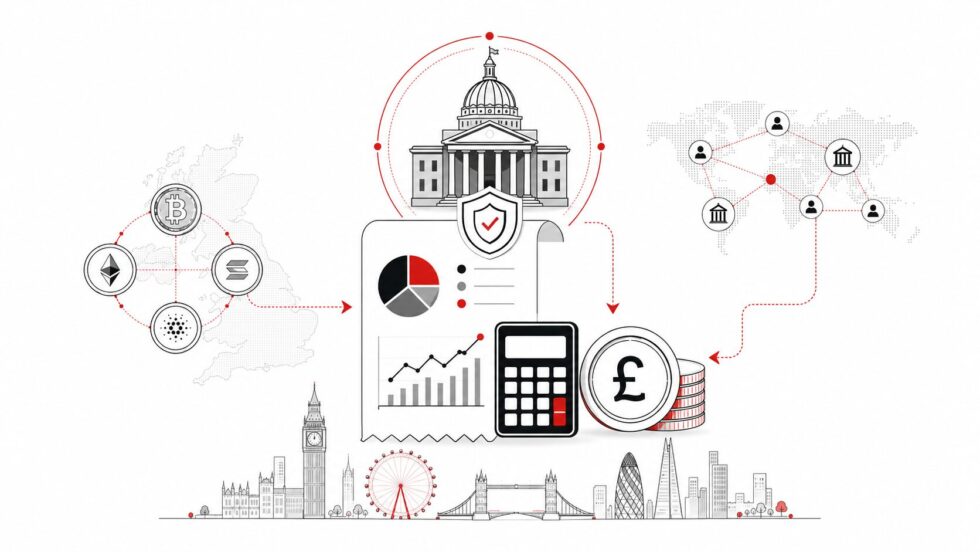
CARF is the most consequential administrative change in the article because it alters HMRC’s information base. The Cryptoasset Reporting Framework requires reporting cryptoasset service providers to collect information on users and in-scope transactions. HMRC’s own guidance tells cryptoasset service providers that, if they provide cryptoasset services in the UK, they must collect data and report it to HMRC because of CARF. The first report must be submitted between 1 January 2027 and 31 May 2027 and will cover the calendar year from 1 January 2026 to 31 December 2026.
This means 2026 is the first year where taxpayers should assume exchange and platform activity is being prepared for structured reporting. The information is not just a vague statement that somebody has an account. Reporting can involve identity information and aggregate transaction data relating to customer cryptoasset activity. HMRC’s Cryptoassets Manual states that from 1 January 2026 UK reporting cryptoasset service providers are required to undertake due diligence on customers and report aggregate transactional data relating to their cryptoasset activity.
The strongest practical warning is about foreign platforms. CARF is designed for information exchange between tax authorities, and the UK is implementing it for first international data exchanges in 2027. That does not mean every platform in the world reports in the same way at the same moment, and it does not mean every private wallet is automatically mapped. But it does mean the “I used an overseas exchange, so HMRC will never know” assumption is no longer a sensible risk position. The direction of travel is clear: crypto tax data is becoming more international, more structured and more visible to tax authorities.
| CARF question | Answer |
|---|---|
| Does CARF create a new tax? | No, it is a reporting framework |
| When did the first reporting period start? | 1 January 2026 |
| What period does the first report cover? | 1 January 2026 to 31 December 2026 |
| When is the first report submitted? | Between 1 January and 31 May 2027 |
| Who reports? | Reporting cryptoasset service providers |
| What changes for investors? | Platform activity becomes easier for HMRC to compare with returns |
How HMRC expects crypto gains to be calculated
The hardest part of UK crypto tax is not always the rate. It is the cost basis. HMRC does not allow investors to choose whichever coins make the result look best. Cryptoassets are subject to pooling rules similar to those used for shares and securities. HMRC’s manual explains that pooling under TCGA92/S104 applies to shares and securities and also “any other assets”, and its crypto guidance includes pooling examples for crypto-to-crypto exchanges. The broad order is this. First, same-day acquisitions and disposals of the same token are matched together. Second, the 30-day “bed and breakfasting” rule can match a disposal with acquisitions of the same token made shortly afterwards. Third, anything not matched by those rules falls into the Section 104 pool, which works as a weighted average cost pool for that token. A separate pool is usually needed for each token. Fees and allowable costs can affect the calculation, but not every cost is deductible, so investors need to separate transaction costs from general expenses.
A simple example shows why this matters. Suppose an investor buys 2 BTC for £20,000 and later buys 1 BTC for £18,000. The pool then contains 3 BTC with a total cost of £38,000, before considering allowable fees. If the investor later sells 1 BTC for £30,000, the cost basis is not necessarily the first BTC bought or the last BTC bought. Under pooling, the average cost is used unless same-day or 30-day rules alter the matching. A return that uses exchange-by-exchange FIFO without adjusting for HMRC’s rules may produce the wrong gain.
The crypto-to-crypto version is even easier to get wrong. If Bitcoin is exchanged for Ethereum, the Bitcoin disposal needs a sterling value at the time of the swap. The Ethereum acquired then enters its own pool at that value. A single swap can therefore affect two separate pools at once. This is why exchange CSV files alone are often not enough, especially when they omit transfers, gas fees, internal conversions, dust, chain movements or transactions from another wallet. CARF may tell HMRC that a platform transaction happened, but the taxpayer still needs the correct calculation behind the return.
The £50,000 proceeds trap
Many crypto holders focus only on profit, but reporting can also depend on proceeds. The dangerous misunderstanding is this: “I made little or no gain, so I do not need to report anything.” That can be wrong where total disposal proceeds are high. In Self Assessment, Capital Gains pages may be required where total disposal proceeds exceed the reporting threshold, even if the net taxable gain is below the annual exempt amount. This is particularly important in crypto because rapid trading can create large cumulative proceeds without a large economic profit.
Imagine a trader who repeatedly buys and sells stablecoins, Bitcoin and Ethereum across the year. They may end the year almost flat, with only £1,000 of net gain. But if the total proceeds from disposals were far higher, the reporting position may not be as simple as “no tax due”. The proceeds figure is not the same as profit. It is the total value of assets disposed of. In crypto, a handful of large swaps can push proceeds up quickly. A frequent trader can cross a reporting threshold without feeling wealthy and without having withdrawn much cash.
This is why annual reconciliation matters. Investors should not wait until January and then look only at bank withdrawals. They need a year-by-year view of disposals, proceeds, gains, losses, fees and income. Where proceeds are high, a professional review becomes more valuable because the penalty risk is not limited to people who owe large tax bills. A late or incomplete return can create problems even where the final tax liability is modest. The rule is not emotionally intuitive, but HMRC does not tax by intuition.
Key dates: when the 2026/27 return has to be filed
The UK tax year runs from 6 April to 5 April. For the 2026/27 tax year, crypto disposals and income between 6 April 2026 and 5 April 2027 fall into that year’s Self Assessment cycle. GOV.UK guidance on Making Tax Digital notes that a 2026/27 tax return must be submitted by 31 January 2028, and HMRC penalty guidance confirms the general rule that the deadline to submit a tax return and pay tax owed is 31 January after the end of the tax year.
There is also a separate CARF reporting calendar. Platforms report on the 2026 calendar year, not the UK tax year, with the first reports due between 1 January and 31 May 2027. This means a taxpayer’s personal tax return and a platform’s CARF report do not cover identical date ranges. That mismatch does not remove the need to report correctly. It simply means HMRC may compare different datasets over time and ask questions where platform-reported activity does not appear to align with Self Assessment records.
| Date | Why it matters |
|---|---|
| 1 January 2026 | First CARF reporting period begins for platforms |
| 5 April 2027 | End of UK 2026/27 tax year |
| 31 May 2027 | End of first CARF platform reporting window for 2026 data |
| 31 January 2028 | Online Self Assessment return and payment deadline for 2026/27 |
| Four years after the tax year of a loss | General period to claim many capital losses |
Losses deserve special attention. GOV.UK says losses do not have to be reported immediately and can generally be claimed up to four years after the end of the tax year in which the asset was disposed of. For crypto investors, that can be important because losses from earlier market cycles may reduce future gains if properly claimed. But losses cannot be used effectively if the taxpayer has no record of the disposal, cost basis and valuation.
Making Tax Digital may matter for active crypto earners
For ordinary investors, CARF and Self Assessment are the immediate concerns. For self-employed people, landlords and some active crypto earners, Making Tax Digital for Income Tax can also matter. GOV.UK says MTD for Income Tax applies from 6 April 2026 for those with qualifying income over £50,000, from 6 April 2027 for those over £30,000 and from 6 April 2028 for those over £20,000. The regime is aimed at digital records and compatible software, not specifically at crypto, but it can affect people whose crypto activity sits inside self-employment or business income.
This could include a freelance developer paid in tokens, a consultant receiving crypto as part of business revenue, a content creator with token income or a person whose activity goes beyond occasional investment. It does not automatically turn every investor into a business. HMRC looks at the facts. But anyone combining self-employment, crypto receipts and high qualifying income should check whether MTD obligations apply. A person who treats crypto income casually may have two problems at once: the crypto tax calculation and the digital record-keeping requirement.
The most important practical point is preparation. If someone is required to use MTD, they need compatible software, digital records and a process for updates. If they also have crypto income, those records must connect clearly with wallet and exchange data. The worst approach is to maintain one record for “normal business” and a separate, incomplete crypto spreadsheet that never reconciles with the tax return. In 2026 and beyond, the direction is towards joined-up digital tax information.
What to do if previous years were under-reported
Many UK crypto holders have old problems. Some did not know swaps were disposals. Some lost track of exchange accounts. Some assumed a foreign platform made the activity invisible. Some thought tax applied only when money returned to a UK bank account. CARF does not erase those past years, but it makes ignoring them more dangerous. HMRC has a dedicated route to tell it about unpaid tax on cryptoassets, including exchange tokens, NFTs and utility tokens.
Voluntary disclosure is not the same as waiting for HMRC to ask. GOV.UK’s crypto disclosure guidance tells taxpayers they can make a voluntary disclosure of unpaid tax if they have income or gains from cryptoassets. HMRC also warns that if tax has not been paid and HMRC finds out it should have been, penalties can reach up to 100% of the tax due plus interest, with offshore matters potentially higher. That is why old crypto tax exposure should be reviewed before platform data starts creating questions.
This does not mean everyone with historic crypto activity needs to panic. It means they need to reconstruct the facts. Which exchanges were used? Which wallets were controlled? Which disposals happened? Which rewards were received? Were there losses that can be claimed? Were there years with gains above the allowance? Were there high proceeds even with low profit? A clean disclosure or amended return is usually easier to manage before HMRC has already opened the conversation.
Practical checklist for UK crypto investors in 2026
The best crypto tax strategy in 2026 is not cleverness. It is clean evidence. Investors should keep a full transaction record from every exchange, wallet and platform they use. They should record sterling values at the time of swaps, rewards and disposals. They should separate purchases, sales, transfers, staking rewards, airdrops, fees and chain movements. They should also avoid assuming that a transfer between their own wallets is taxable, while still recording it clearly so it is not mistaken for a disposal.
The basic checklist is simple:
| Task | Why it matters |
|---|---|
| Export all exchange data | HMRC may receive platform records, so your return must reconcile |
| Track wallet transfers | Prevents transfers being mistaken for sales |
| Value swaps in sterling | Crypto-to-crypto exchanges can trigger CGT |
| Record staking and airdrops | These may be income when received |
| Keep fee records | Some costs may affect gain calculations |
| Review losses | Losses can reduce future gains if properly claimed |
| Watch total proceeds | High proceeds can create reporting obligations |
| Avoid January panic | Crypto records are easier to fix during the year |
There is also a behavioural warning. Do not sell and rebuy purely to “reset” tax without understanding the 30-day matching rule. Do not assume stablecoins are tax-free parking spaces. Do not assume a small number of bank withdrawals equals a small number of tax events. Do not ignore dust conversions, card spending or DeFi rewards if the totals are meaningful. And do not rely on exchange tax reports without checking whether they include all wallets, transfers and historical cost basis. Crypto tax software can help, but it is only as good as the data imported into it.
The bottom line for HMRC, CARF and ordinary holders
UK Crypto Tax 2026 should be read as a warning about documentation. HMRC’s rates and allowances are not mysterious: the CGT allowance is low, the main rates are 18% and 24%, and income is taxed under the income tax rules that apply to the taxpayer. The difficult part is the transaction record. A modern crypto investor may have dozens of taxable events before making a single obvious withdrawal. A serious trader may have thousands. CARF means those platform records are becoming part of the tax authority’s information environment rather than remaining buried inside exchanges.
For most ordinary holders, the sensible position is this: holding is not taxed, but disposals are; swaps count; rewards may be income; losses should be recorded; and the 2026 data year should be treated as the beginning of a more transparent era. HMRC does not need to see every private wallet in the country to make poor reporting risky. It only needs enough platform data to spot gaps, mismatches and missing disposals. That is why 2026 is the year to stop treating crypto tax as a last-minute spreadsheet problem and start treating it as part of normal financial record-keeping.
FAQ: UK Crypto Tax 2026
Do I pay tax just for holding crypto?
No. Buying crypto with sterling and holding it is not a taxable disposal by itself. Tax usually becomes relevant when you dispose of crypto or receive crypto as income.
Is swapping one coin for another taxable?
Yes. HMRC treats exchanging one token for a different type of token as a disposal. That means a Bitcoin-to-Ethereum swap can create a Capital Gains Tax calculation even if no sterling is withdrawn.
What is the 2026/27 Capital Gains Tax allowance?
For individuals, the annual exempt amount is £3,000. Gains above the allowance may be taxed at 18% or 24%, depending on how they sit against the taxpayer’s income band.
Does CARF create a new crypto tax?
No. CARF is a reporting framework. It changes what reporting cryptoasset service providers must collect and report; it does not create a separate tax rate.
When will HMRC receive the first CARF reports?
The first report must be submitted between 1 January and 31 May 2027, covering the period from 1 January 2026 to 31 December 2026.
Can a foreign exchange hide crypto activity from HMRC?
That is now a much weaker assumption. The UK is implementing CARF for first international data exchanges in 2027, meaning cross-border reporting is part of the regime.
Are staking rewards taxed?
They can be. Crypto received as income, including some staking rewards, mining rewards, airdrops or payment for work, may fall under Income Tax rules when received and may later create a CGT event when disposed of.
What if I made losses?
Losses can be valuable because they may reduce future gains. GOV.UK says losses can generally be claimed up to four years after the end of the tax year in which the disposal happened.
What if I under-reported crypto in earlier years?
HMRC has a cryptoasset disclosure route for unpaid tax on crypto income or gains. If there is historic exposure, it is safer to review records and take advice than to wait for a data match or letter.
Is this tax advice?
No. This article is general information for readers. Crypto tax depends on individual circumstances, residence, income, records, transaction history and the exact type of activity. A qualified tax adviser should be consulted for personal calculations.
Sources used in preparation: HMRC Cryptoassets Manual, GOV.UK Capital Gains Tax rates and allowances, GOV.UK CARF reporting guidance, GOV.UK Income Tax bands, HMRC Making Tax Digital guidance, GOV.UK cryptoasset disclosure guidance.
Read about the life of Westminster and Pimlico district, London and the world. 24/7 news with fresh and useful updates on culture, business, technology and city life: Virgin Media down: Why are TV channels pixelated and is Virgin Media down across the UK right now