Mahmood announces new refugee sponsorship route into UK as the Home Office prepares to open capped safe and legal routes for refugees from autumn, allowing approved community groups, universities and employers to support eligible people before they travel to Britain. The plan, announced by Home Secretary Shabana Mahmood on Friday, is intended to build a controlled alternative to irregular Channel crossings while keeping tighter checks on asylum, human rights and modern slavery claims, The WP Times reported.
The new model would let trusted organisations sponsor refugees who have been assessed before arrival, with housing, integration and work support arranged in advance rather than after a person reaches the UK. Ministers say the scheme will start from a low base, operate under an annual cap and expand only once the Home Office is satisfied that sponsorship, local capacity and security checks are working. The policy is being presented as a double move: opening limited legal access for recognised refugees while narrowing routes that ministers say have been used to delay removals.
How the new UK refugee sponsorship route would work
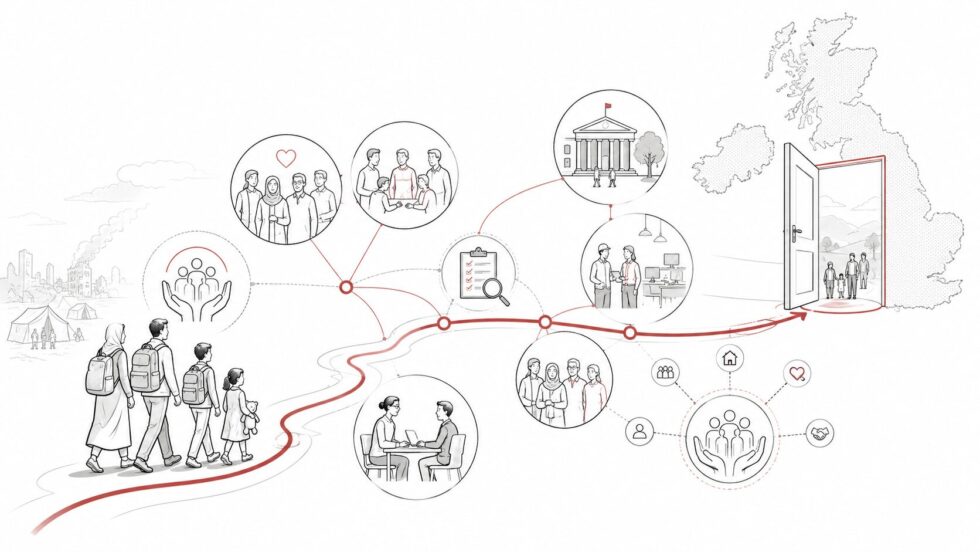
The Home Office plan is based on a sponsorship model used in Canada and partly reflected in Britain’s Homes for Ukraine programme. Under the proposed system, refugees would not simply apply from anywhere and arrive automatically. They would need to meet eligibility rules, pass checks and be linked to an approved sponsor before travelling to the UK.
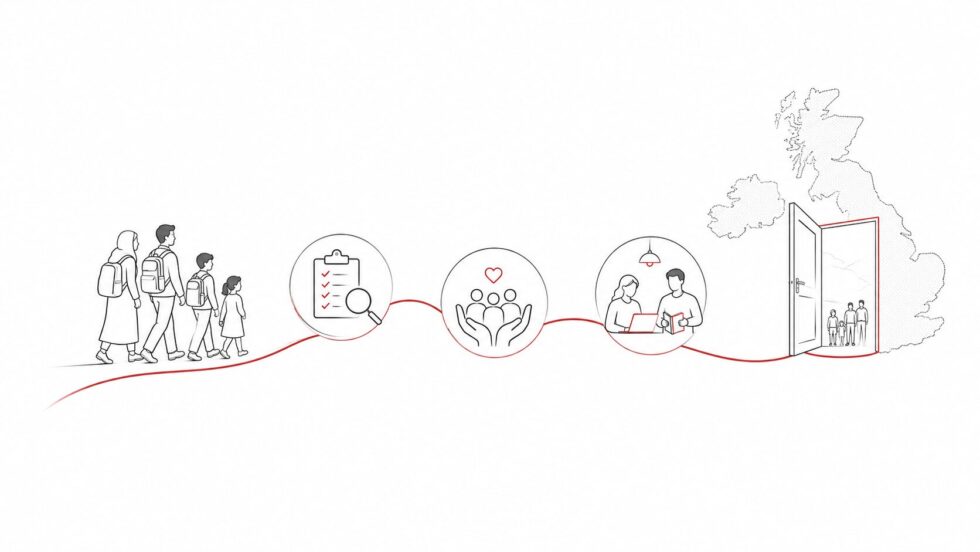
The sponsors could include voluntary organisations, community groups, faith groups, universities and, later, employers. Their role would be practical rather than symbolic. They would help refugees secure accommodation, access local services, prepare for work or study, and settle without relying entirely on local councils from day one. The Government says the route will be capped. The exact annual number has not yet been confirmed, but ministers have signalled that it will begin modestly and grow only if the system can absorb arrivals. The Home Office also says it will retain control over which organisations can sponsor refugees and who qualifies.
Key parts of the plan include:
- Community sponsorship: approved local and voluntary groups would support refugees with housing and settlement.
- University route: trusted universities would be able to sponsor eligible refugees for study-related entry.
- Work route: employers are expected to sponsor refugees through a separate work-based channel from next year.
- Security checks: applicants would be assessed before arrival, including background screening.
- UNHCR role: ministers expect to work with the UN refugee agency on identifying eligible people.
- Annual cap: numbers would be limited and linked to the capacity of communities and sponsors.
Why Mahmood says the UK needs capped safe and legal routes
Mahmood has framed the plan as a way to protect refugees who are genuinely fleeing war and persecution while restoring public confidence in border control. Her argument is that the asylum system can only survive if voters believe it is fair, controlled and not open to abuse.
The Home Secretary said Britain has a long record of offering sanctuary, but that legal routes need to sit alongside tougher enforcement. Her message is aimed at two audiences inside the same debate: Labour MPs and refugee groups calling for safer alternatives to small boats, and voters concerned about irregular migration, asylum hotels and the cost of the current system. The Government’s position is that a controlled sponsorship model could reduce pressure on emergency accommodation because support would be arranged before arrival. That is different from the standard asylum route, where people often arrive first, claim asylum, and then wait for a decision while being housed by the state. The political risk is clear. If the scheme is too small, refugee charities and Labour critics may say it will not meaningfully reduce dangerous journeys. If it grows too quickly, the Conservatives and Reform UK will argue that Labour has opened another migration route before stopping small boat crossings.
What universities, businesses and community groups would do
The university route is expected to open first, with applications later this year and the first arrivals expected in 2027. Under that plan, approved universities would sponsor eligible refugees who meet the route’s requirements. The policy is designed to give refugees a structured entry point and immediate institutional support.
The work route is expected to follow next year. Employers would be able to sponsor refugees into jobs where they meet the criteria. The Home Office has pointed to Canada’s experience, where privately sponsored refugees have often moved into employment faster than those resettled only through government programmes. Community sponsorship is likely to be the most politically visible part of the system. Local groups, churches, charities and other approved organisations could become responsible for practical support. That may include helping refugees find housing, register with services, improve English and move towards work.
The Home Office has not yet published the full criteria for approved sponsors. The unanswered questions include how much money sponsors will need to show, what housing standards will apply, how long support must last, what happens if a sponsorship breaks down, and whether named sponsorship will be allowed.
What the Government says about checks and eligibility
Ministers are stressing that the new routes will not be open-ended. Applicants would be subject to eligibility tests and security checks before being allowed to travel. The Government has also said the system will be capped and controlled centrally by the Home Office. The expected partnership with the UNHCR is important because it suggests the UK will focus on refugees already identified as needing resettlement, rather than creating a general overseas asylum application system. That could mean priority for people from major conflict and persecution contexts, although the Government has not yet published a final list of eligible countries or groups.
Officials are likely to focus on three questions before approval:
| Test | What it means |
|---|---|
| Refugee need | Whether the applicant is fleeing war, persecution or serious harm |
| UK eligibility | Whether the person fits the route’s rules and any priority criteria |
| Security and identity checks | Whether background checks, documents and risk assessments are passed |
| Sponsor capacity | Whether the approved sponsor can provide real support after arrival |
| Local pressure | Whether housing and services can absorb arrivals under the cap |
This is why ministers describe the plan as a “safe and legal” route rather than an open asylum channel. The refugee would be assessed before travel, the sponsor would be approved before arrival, and the numbers would be limited by government decision.
Conservative and Reform criticism of Mahmood’s refugee route
The Conservatives have attacked the scheme, arguing that no new refugee route should be opened while illegal migration continues. Shadow home secretary Chris Philp said people refused entry under legal schemes could still try to cross the Channel in small boats, meaning the plan would not solve the problem ministers say it targets. Reform UK has also opposed the proposal. Its home affairs spokesman Zia Yusuf said the policy was not in Labour’s manifesto and argued that a future Reform government would reverse it. Reform figures have framed the plan as another route into Britain rather than a substitute for irregular arrivals.
The core opposition argument is simple: legal routes do not automatically stop illegal routes. Critics say the Government must first show that it can end small boat crossings, clear the asylum backlog, reduce hotel use and remove people with no right to stay. They also argue that sponsorship could create pressure for higher numbers once communities and campaigners begin to demand broader eligibility. Mahmood’s counterargument is that a functioning asylum system needs both control and credible legal access. Without safe routes, ministers face pressure from courts, Labour MPs, refugee groups and international partners. With safe routes, they face criticism from the right unless the cap is tight and enforcement improves.
Liberal Democrat and refugee sector reaction
The Liberal Democrats have described the plan as a step in the right direction but have also said the Government must do more to reduce dangerous journeys and improve asylum decision-making. Their position is that safe routes are necessary, but not enough on their own. Refugee sponsorship campaigners have welcomed the principle but warned against rules that are too narrow. The Community Sponsorship Alliance has argued that local goodwill is one of the main reasons sponsorship works and that the Government should not design the system so tightly that communities are unable to participate.
That debate matters because sponsorship schemes depend on trust. If rules are too loose, ministers will face claims that the system is not controlled. If rules are too strict, only a small number of large institutions may qualify, leaving local groups frustrated and limiting the scheme’s impact. The question for the Home Office is whether it can build a route that is politically defensible, administratively workable and still meaningful for refugees who have no safe way to reach protection.
Human rights and modern slavery changes in the same asylum package
Mahmood’s refugee sponsorship route is only one part of a wider immigration and asylum package. The Government is also preparing changes to how human rights and modern slavery laws are applied in immigration cases. The Home Office says it wants to stop what it calls “vexatious” claims, especially where people raise late legal arguments after removal action has already begun. Ministers are also looking at narrowing the definition of family in immigration and asylum cases so that it means immediate family members rather than wider relatives.
Modern slavery protections are also expected to be tightened. The Government wants to remove access to protection for foreign nationals who have received custodial sentences or where there is evidence of forged documents. Ministers argue that the current system has allowed some late or weak claims to delay deportation. These measures are politically sensitive because they sit at the intersection of asylum law, criminal justice, human rights obligations and the UK’s membership of the European Convention on Human Rights. Mahmood has said ECHR membership remains in the national interest, but the Home Office wants domestic rules applied in a more restrictive way.
Why the timing matters for Labour and the Home Office
The announcement comes as Labour faces pressure from several directions on immigration. Some Labour MPs want more safe and legal routes, especially after earlier reforms reduced protection periods for newly recognised refugees and extended the path to settlement. Others worry that voters see the asylum system as too expensive and too slow. Mahmood has already moved the UK towards a more temporary protection model. Earlier changes mean refugees recognised under the reformed system receive shorter permission to stay and may have their status reviewed more regularly. That marks a shift away from an assumption that refugee protection leads quickly to permanent settlement.
The new sponsorship route is therefore not a soft standalone policy. It is being introduced alongside stricter settlement rules, tighter removals policy and a stronger emphasis on enforcement. That is why the same package can be criticised from both sides: refugee advocates may say it does too little and removes protections, while Conservatives and Reform may say it opens a new migration channel. The Immigration and Asylum Bill is expected to bring these tensions into Parliament. Labour MPs will examine whether the new safe routes are large enough, while opposition parties will focus on the cap, costs, eligibility and whether the scheme has any measurable effect on small boat crossings.
What the numbers show on UK migration and asylum
The latest migration figures show why the issue remains politically charged. Net migration fell sharply in the year to December 2025, but asylum pressures remain significant and small boat crossings continue to shape the debate. Recent official figures cited in the migration debate include:
| Measure | Latest figure | Period |
|---|---|---|
| Net migration | 171,000 | January to December 2025 |
| Immigration | 813,000 | January to December 2025 |
| Emigration | 642,000 | January to December 2025 |
| Asylum applications | 93,525 | April 2025 to March 2026 |
| Returns and deportations | 39,007 | April 2025 to March 2026 |
| Small boat arrivals | 11,638 | 1 January to 25 June 2026 |
The political difficulty for Mahmood is that these numbers point in different directions. Lower net migration gives the Government room to argue that legal migration is coming down. High asylum applications and continued Channel crossings keep pressure on the Home Office to show visible control. That is why the refugee sponsorship route is being framed as capped, selective and pre-approved. Ministers want to show that Britain can still take refugees, but only through managed channels that do not leave councils and hotels carrying the immediate burden.
What remains unclear before the new route opens
Several major details still need to be published. The annual cap is the most important. Without the number, it is impossible to know whether the route will be symbolic, modest or eventually significant. The Government also needs to define who can sponsor. Universities and employers are easier to regulate because they already operate within formal systems. Community groups are more complex because they vary in size, finances and experience.
The Home Office must also explain whether sponsors can name individuals or whether refugees will be matched through official referral systems. Named sponsorship could increase community engagement, but it could also trigger political concern about extended family routes and unequal access.
Other unanswered questions include:
How much financial support sponsors must provide
The Government has not yet set out the minimum funding requirement, length of support or liability if housing arrangements fail.
Which refugees will be prioritised
Ministers have not confirmed whether priority will be based on nationality, vulnerability, UNHCR referral status, family links, skills, education or labour market need.
How the cap will be calculated
The cap may be linked to housing, local services, sponsor capacity and public finances, but the formula has not been published.
Whether the route will reduce small boats
The Government says safe routes are part of restoring order, but critics argue that people excluded from the cap may still attempt irregular journeys.
Background: why refugee sponsorship is back on the UK agenda
Refugee sponsorship has returned to the centre of UK asylum policy because ministers are trying to solve three problems at once: dangerous Channel crossings, pressure on asylum accommodation and demands for lawful routes for people fleeing war and persecution.The UK already has experience of sponsorship-style support through Homes for Ukraine, which allowed British households to host Ukrainians after Russia’s full-scale invasion in 2022. The new plan is broader because it is not tied to one war or one nationality, but it is expected to remain capped and controlled.
Canada is the main international model. Its private sponsorship system has operated for decades and allows civil society groups to support refugees with settlement, housing and integration. The Home Office has highlighted employment outcomes in Canada as evidence that sponsored refugees can integrate faster when community support is prepared before arrival. In Britain, the debate is shaped by Channel crossings, asylum hotels and the backlog of people waiting for decisions. Ministers are under pressure to reduce costs and speed up removals while also offering a legal alternative for people who cannot safely return home. Mahmood’s plan places the new sponsorship route inside a wider enforcement package, with safe entry for selected refugees on one side and tighter rules on appeals, family claims and modern slavery protections on the other.
Read about the life of Westminster and Pimlico district, London and the world. 24/7 news with fresh and useful updates on culture, business, technology and city life:Birmingham local elections 2026 could trigger historic Labour collapse in Britain’s second city