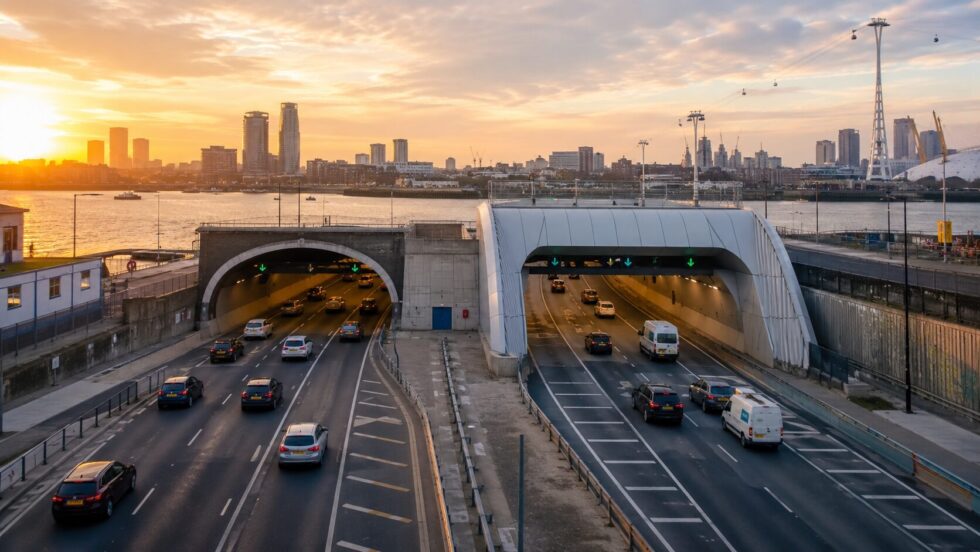
From September 2026, drivers using the Blackwall Tunnel and Silvertown Tunnel are set to pay more to cross the Thames in east London, with car and small van tolls rising from £4 to £4.20 at peak times and from £1.50 to £1.55 off-peak for Auto Pay users. The increase, put forward by Transport for London and reported by The WP Times, is described as an inflation-linked rise and would affect both river crossings between Greenwich, Newham and the wider east London road network.
The change lands less than 18 months after the Silvertown Tunnel opened to traffic on 7 April 2025, bringing tolls to the new tunnel and to the long-established Blackwall Tunnel at the same time. TfL says the charge is used to manage traffic, repay costs linked to the Silvertown Tunnel and cover the operation and maintenance of both crossings, while official rules state that charges apply from 06:00 to 22:00, seven days a week, in both directions.
What is changing for Blackwall and Silvertown Tunnel charges in September
The September rise is not a new toll system. It is an increase to the existing Blackwall Tunnel charge and Silvertown Tunnel charge, which already apply to most vehicles using either crossing during charging hours. For car drivers, the most visible change is the peak-time fare moving from £4 to £4.20 per crossing. Off-peak Auto Pay users will see a smaller increase. For cars and small vans, the off-peak charge is set to rise by 5p, from £1.50 to £1.55. That rate applies most of the time between 06:00 and 22:00 for vehicles registered with TfL Auto Pay, including weekends.
Peak pricing is narrower than many occasional drivers assume. It applies on weekdays only, northbound from 06:00 to 10:00 and southbound from 16:00 to 19:00. Anyone paying online or by phone without Auto Pay is charged the peak rate at all charging times, according to TfL’s payment rules.
The practical change is simple: the tunnels stay open as before, but the price of using them in the busiest direction at the busiest time rises.
| Vehicle type | Current Auto Pay off-peak | Proposed Auto Pay off-peak | Current peak | Proposed peak |
|---|---|---|---|---|
| Motorcycles, mopeds, motor tricycles | £1.50 | £1.55 | £2.50 | £2.60 |
| Cars and small vans | £1.50 | £1.55 | £4.00 | £4.20 |
| Large vans | £2.50 | £2.60 | £6.50 | £6.80 |
| Heavy goods vehicles | £5.00 | £5.25 | £10.00 | £10.50 |
The figures represent an increase of about 4% across the main vehicle categories. For a car driver making one peak crossing, the rise is 20p. For a driver making a return trip in peak conditions, the added cost becomes 40p a day. For a van business making repeated crossings, the effect is larger because the charge is applied per crossing, not per day.
Why are Blackwall and Silvertown Tunnel tolls going up
TfL’s stated reason is inflation. Agenda papers for TfL’s finance committee in June 2026 set out the proposed increase as a way of keeping tunnel user charges aligned with rising costs. Local reporting on the committee papers said TfL expected the rise to raise about £1.5m between September 2026 and the end of March 2027.
The deeper reason sits in the structure of the Silvertown Tunnel project. TfL has said user charges were planned from the early development of the scheme and are needed to manage demand across both crossings, not just to raise revenue. In its 2024 statement on the toll package, TfL said the proximity of the two tunnels meant both had to be charged to stop drivers avoiding the paid crossing and overloading the free one.
That is why Blackwall became chargeable when Silvertown opened. Without a matching toll at Blackwall, many drivers would have had a clear financial reason to stay with the older crossing. TfL’s argument is that this would weaken the traffic-management purpose of the new tunnel and could push congestion back onto the same approach roads that the project was meant to relieve.
“The tunnels charge exists to help manage traffic levels across both tunnels, repay costs for building the new Silvertown Tunnel and go towards maintenance and operation of both tunnels.”
Transport for London, official Blackwall and Silvertown tunnels charge guidance
There is also a public transport element. When TfL set out the original charging package, it said the Silvertown project would support more cross-river buses, with the number of buses able to cross the river in the area rising from six to 21 an hour in each direction at the busiest times. Those buses were described as zero-emission at the tailpipe.
How do I pay for Blackwall Tunnel charges
Drivers pay the Blackwall Tunnel charges through TfL’s road user charging system. The cheapest and lowest-risk method is Auto Pay, because it gives access to the off-peak rate and automatically bills registered vehicles. TfL says Auto Pay can be linked to a card or direct debit and can cover up to five vehicles on one account.
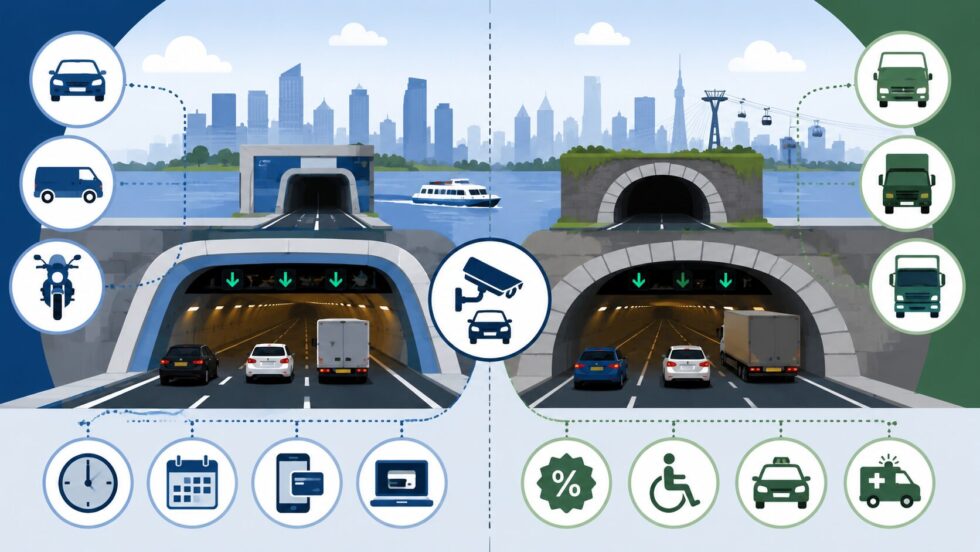
There are no toll booths at either tunnel. Cameras read number plates as vehicles enter the crossing, then TfL checks whether the vehicle has paid, is registered for Auto Pay or is exempt. Drivers cannot stop at the tunnel to pay and there are no barriers.
The basic payment options are:
- TfL Auto Pay, which applies the lower off-peak rate where eligible.
- Online payment through TfL’s Pay to drive in London system.
- The official TfL Pay to drive in London app.
- Telephone payment through TfL’s road user charging service.
The deadline matters. TfL says drivers have until midnight on the third day after the journey to pay if they are not covered by Auto Pay. Missing that deadline can trigger a Penalty Charge Notice.
Auto Pay is not just a convenience feature; it changes the price for many off-peak journeys.
For drivers who use the tunnels regularly, the difference between Auto Pay and manual payment can be substantial. A car using the tunnel off-peak with Auto Pay currently pays £1.50, rising to £1.55 under the September plan. A car paid manually online or by phone is charged the peak rate at all charging times, meaning £4 now and £4.20 if the new rate takes effect.
Is Blackwall Tunnel still free?
Blackwall Tunnel is no longer free during the day for most drivers. Since 7 April 2025, the tunnel has been charged between 06:00 and 22:00, seven days a week, in both directions. The same charging hours apply to the Silvertown Tunnel. It remains free overnight. Between 22:00 and 06:00, there is no charge to use either crossing. Charges also do not apply on Christmas Day, 25 December, according to TfL’s official guidance.
The answer therefore depends on the time, vehicle and exemption status. A private car crossing at 23:30 does not pay. The same car crossing at 09:00 northbound on a weekday pays the peak charge. A registered Blue Badge vehicle or an exempt taxi may not pay at any time, provided the vehicle meets TfL’s criteria.
Is the Blackwall Tunnel always free?
No. The phrase “Blackwall Tunnel is free” is now misleading for normal daytime use. It is free overnight from 22:00 to 06:00 and for exempt vehicles, but it is chargeable for most cars, vans, motorcycles and HGVs during the daily charging window.
This is the point that continues to catch occasional drivers. For decades, Blackwall was understood as a free crossing, even if congestion made it costly in time. Since the opening of Silvertown, its pricing has been tied to the new tunnel.
The old habit of treating Blackwall as the free east London river crossing no longer fits the rules.
TfL’s position is that charging both tunnels is necessary because they sit close to each other. If only Silvertown carried a toll, Blackwall would likely absorb more traffic from drivers trying to avoid payment. That is the policy logic behind the shared charging system.
What is a Blackwall Tunnel and why does it matter in east London
The Blackwall Tunnel is a road tunnel under the River Thames connecting Greenwich Peninsula south of the river with Poplar and the A12/A13 corridor north of the river. It has long been one of the most important road links between south-east and east London, particularly for drivers moving between Greenwich, Tower Hamlets, Newham and routes towards Essex.
Its importance also explains its problems. The tunnel’s older design, heavy traffic and restrictions have historically contributed to queues and closures. TfL said in 2024 that the Victorian-era tunnel suffered from frequent closures, with more than 700 a year, causing tailbacks and lost time for drivers.
Silvertown Tunnel was built as an additional crossing in the same corridor. It links Silvertown in Newham with the Greenwich Peninsula and is intended to give the road network more resilience when Blackwall is congested or disrupted. The new tunnel also supports bus routes that could not be delivered in the same way through the old crossing.
| Feature | Blackwall Tunnel | Silvertown Tunnel |
|---|---|---|
| Location | Greenwich Peninsula to Poplar/east London | Greenwich Peninsula to Silvertown/Newham |
| Status | Older Thames road tunnel | New tunnel opened 7 April 2025 |
| Charging | Charged 06:00–22:00 | Charged 06:00–22:00 |
| Peak car rate now | £4.00 | £4.00 |
| Proposed peak car rate from September | £4.20 | £4.20 |
| Main policy role | Existing strategic crossing | Added capacity and resilience |
For drivers, the key point is that the tunnels now function as one pricing zone. The decision is no longer “Blackwall free, Silvertown paid”. It is a choice between two charged crossings, with the final cost shaped by time of day, direction, vehicle type and payment method.
When do peak and off-peak Blackwall and Silvertown Tunnel charges apply?
Peak pricing applies only in the busiest commuting direction on weekdays. For northbound traffic, the peak period runs from 06:00 to 10:00 Monday to Friday. For southbound traffic, it runs from 16:00 to 19:00 Monday to Friday. Outside those windows, Auto Pay users normally pay the off-peak rate during charging hours.
That means weekend trips are usually off-peak for Auto Pay users, as long as they occur between 06:00 and 22:00. Overnight journeys are free because they sit outside the charging period entirely. Bank holidays are charged, except Christmas Day. For a car or small van driver under the proposed September rates, the pattern would look like this:
- Northbound weekday at 08:00: £4.20 with Auto Pay.
- Southbound weekday at 17:30: £4.20 with Auto Pay.
- Southbound weekday at 11:00: £1.55 with Auto Pay.
- Weekend crossing at 14:00: £1.55 with Auto Pay.
- Any crossing at 23:00: £0.
Manual payment changes the equation. TfL says drivers using other payment methods are charged the peak rate at all charging times. For a car, that means a weekend daytime crossing paid manually would cost the higher rate rather than the off-peak Auto Pay rate.
“For customers registered for Auto Pay, off-peak rates apply most of the time, including weekends.”
Transport for London, official payment guidance This is where the September rise matters most for occasional drivers. The difference between £1.55 and £4.20 is not a marginal administrative detail. It is the difference between being treated as an Auto Pay off-peak user and being charged at the higher rate because the vehicle is not registered.
What happens if drivers do not pay the tunnel charge
TfL can issue a Penalty Charge Notice if the tunnel charge is not paid on time. The current penalty is £180, reduced to £90 if paid within 14 days. The September proposal does not increase that penalty, according to reporting on the TfL finance committee papers.
The scale of the penalty makes the payment method more important than the 20p rise. A driver who misses a £4.20 peak charge can face a penalty many times larger than the original toll. For businesses with several vehicles, the risk multiplies if number plates are not correctly registered or staff assume another person has paid. The safest routine is administrative rather than tactical:
- Register regular vehicles for Auto Pay.
- Check that the number plate is entered correctly.
- Confirm that payment card or direct debit details are active.
- Add or remove vehicles when fleet use changes.
- Keep PCN notices and payment confirmations organised.
TfL says cameras read the number plate as a vehicle enters the tunnel. There are no toll booths, and payment cannot be made at the tunnel itself.
For hire cars, borrowed vehicles and company vans, the risk is different. The person driving may not receive the first notice if the registered keeper is a rental company or employer. That can create delay, administration fees or internal disputes over who was responsible for the charge.
Who gets discounts or exemptions from Blackwall and Silvertown Tunnel charges
The tunnel charge system includes discounts and exemptions for specific groups. TfL lists a 50% discount for drivers living in 12 east London boroughs or the City of London who receive certain benefits. It also allows small businesses, sole traders and charities operating in Greenwich, Newham or Tower Hamlets to apply for a £1 discount on the off-peak charge for up to three vehicles. Blue Badge holders can apply for a 100% discount from the tunnels charge. TfL says drivers with an active Blue Badge discount already registered with TfL do not need to take further action if the vehicle used through the tunnel is on the discount record.
There are also full exemptions for several vehicle categories. Emergency service vehicles, TfL-licensed taxis and DVLA-registered minibuses, buses and coaches do not pay. Zero-emission capable and wheelchair-accessible private hire vehicles licensed by TfL are also exempt when carrying out a booking.
Eligibility is not the same as automatic protection unless the vehicle is correctly registered in the relevant TfL system.
The discount package was politically important when the tolls were first designed. TfL said the consultation on charges, discounts and exemptions received 5,361 responses, including more than 5,000 from members of the public. The authority then recommended proceeding with the original charging package with minor amendments, including changes linked to electric vans and borough refuse vehicles.
How will the September rise affect commuters, vans and small businesses
For an occasional car driver, the September increase is modest in cash terms. A single peak crossing rises by 20p. A single off-peak Auto Pay crossing rises by 5p. The issue becomes more serious when the same journey is repeated daily or when a business vehicle crosses several times in one shift. A five-day-a-week commuter making two peak crossings a day would currently pay £40 a week in a car or small van. Under the proposed September rate, that would rise to £42. Over a four-week commuting month, that is an increase from about £160 to £168, before fuel, parking, insurance and any other road charges are considered.
Large vans face a sharper peak cost. A peak crossing is set to rise from £6.50 to £6.80. For tradespeople, delivery firms and service companies moving between south-east and east London, the tunnel toll is part of job costing. A company with three vans crossing twice a day in peak conditions would see the cost move from £39 a day to £40.80.
HGVs remain the most expensive category. Under the proposed figures reported locally, the HGV off-peak Auto Pay rate would rise from £5 to £5.25, while the peak rate would rise from £10 to £10.50.
The comparison with public transport fare rises gives some context. London Underground, Elizabeth line, Overground and DLR fares rose by 5.8% in March 2026, while the tunnel proposal is around 4%. But the tunnel charge is per crossing, and that makes repeated vehicle use the real driver of cost.
What does the rise mean for Greenwich, Newham and Tower Hamlets
The Blackwall and Silvertown charging system sits across borough boundaries, which is why it is watched closely in Greenwich, Newham and Tower Hamlets. These areas carry much of the immediate traffic impact from both the old and new tunnels. Approach roads, local junctions and alternative crossings all matter to the lived effect of the toll.
Local reporting has noted that TfL was consulting councils in east and south-east London about the revised increases. The same reporting also said traffic through the two tunnels had risen by 8% after congestion eased, while TfL was monitoring higher-than-expected traffic levels on roads including Kidbrooke Park Road, Tunnel Avenue, Blackheath Hill and Trundleys Road in Deptford.
The charge is therefore not only a payment story. It is also a traffic management story. If the tunnels become too cheap at busy times, demand can rise. If they become too expensive, some drivers may shift to other routes, including the Rotherhithe Tunnel, Woolwich Ferry or Dartford Crossing, each with its own limitations. There is no single perfect substitute. Rotherhithe has restrictions and can be slow. Woolwich Ferry is not a like-for-like option for all trips. Dartford may work for orbital journeys but not for local Greenwich-to-Newham travel. The Blackwall and Silvertown corridor remains central because it serves a specific east London movement that other crossings do not fully replace.
How does Auto Pay change the real cost of the tunnels
Auto Pay is the single biggest practical difference in the charging structure. The proposed September rise makes that clearer because the gap between off-peak Auto Pay and manual payment remains wide. For cars and small vans, £1.55 off-peak through Auto Pay compares with £4.20 if the same driver pays manually during charging hours. TfL says there are no registration or renewal fees for Auto Pay. It also says registered vehicles are protected from receiving PCNs for non-payment while correctly registered. That does not remove every possible issue, but it does reduce the risk of forgetting a one-off charge after a journey. The system is especially relevant for:
- commuters who cross several times a week;
- delivery drivers and couriers using the east London corridor;
- tradespeople with early starts or evening return trips;
- households with more than one regular vehicle;
- small businesses managing vans across Greenwich, Newham and Tower Hamlets.
For drivers who rarely use the tunnels, manual payment may feel simpler. But the price difference means that even a single off-peak crossing can cost significantly more without Auto Pay. After September, the manual car rate is expected to be £4.20 at all charging times, while the off-peak Auto Pay rate would be £1.55.
The main saving is not created by driving at a different time; it is created by being registered for the right payment method.
What should drivers check before September 2026
The first check is whether the vehicle is registered for Auto Pay. A driver who assumes a car is covered because another household vehicle is registered can still receive a penalty if the specific number plate is not on the account. Fleet operators face the same problem when vehicles are replaced, hired or reassigned.
The second check is eligibility for discounts. Low-income residents in qualifying boroughs, eligible small businesses, charities, sole traders and Blue Badge holders should use TfL’s official criteria rather than relying on hearsay. A discount only helps once it has been applied to the correct vehicle.
The third check is journey timing. Some drivers can avoid the peak rate by crossing outside the weekday peak direction, but only if their work pattern allows it. A southbound trip at 15:30 may be off-peak for Auto Pay users; the same trip at 16:30 is peak. A northbound trip at 10:05 may be cheaper than one at 09:55.
A basic September checklist looks like this:
- Confirm the new proposed rate for the vehicle category.
- Register for Auto Pay before regular tunnel use.
- Add every vehicle that may use Blackwall or Silvertown.
- Check whether a resident, business or Blue Badge discount applies.
- Avoid assuming weekends are free; they are off-peak for Auto Pay users, not free.
- Remember that payment is per crossing and in both directions.
- Pay by midnight on the third day after travel if Auto Pay is not active.
The final point is the most expensive one to miss. A £180 PCN, even reduced to £90 for early payment, outweighs months of small toll increases for many drivers.
FAQ
How much will Blackwall Tunnel charge rise in September?
For cars and small vans, the peak charge is set to rise from £4 to £4.20 per crossing. The Auto Pay off-peak rate is set to rise from £1.50 to £1.55. Larger vehicles face higher cash increases, with large vans rising to £6.80 at peak times and HGVs expected to rise to £10.50.
How do I pay for Blackwall Tunnel charges?
The easiest way is TfL Auto Pay, which automatically bills registered vehicles and gives access to lower off-peak rates. Drivers can also pay online, through the TfL Pay to drive in London app or by phone, but non-Auto Pay payment is charged at the peak rate during all charging hours.
Is Blackwall Tunnel still free?
It is not free during the day for most drivers. Blackwall Tunnel is charged from 06:00 to 22:00, seven days a week, in both directions. It is free overnight from 22:00 to 06:00 and on Christmas Day, and some vehicles are exempt.
Is the Blackwall Tunnel always free?
No. It is only free outside charging hours or for exempt vehicles. A normal car crossing during the charging window must pay, either at the Auto Pay off-peak rate or at the peak/manual rate depending on time, direction and payment method.
What is a Blackwall Tunnel?
The Blackwall Tunnel is a road tunnel under the River Thames linking Greenwich Peninsula with east London north of the river. Since 7 April 2025, it has been charged alongside the newer Silvertown Tunnel as part of TfL’s east London river-crossing system.
Why are Silvertown and Blackwall Tunnel charges increasing?
TfL’s proposed September 2026 increase is linked to inflation. The wider charge exists to manage traffic across both tunnels, help repay the cost of building Silvertown Tunnel and fund operation and maintenance of the crossings.
Read about the life of Westminster and Pimlico district, London and the world. 24/7 news with fresh and useful updates on culture, business, technology and city life: What TfL lines are shut in London in July 2026