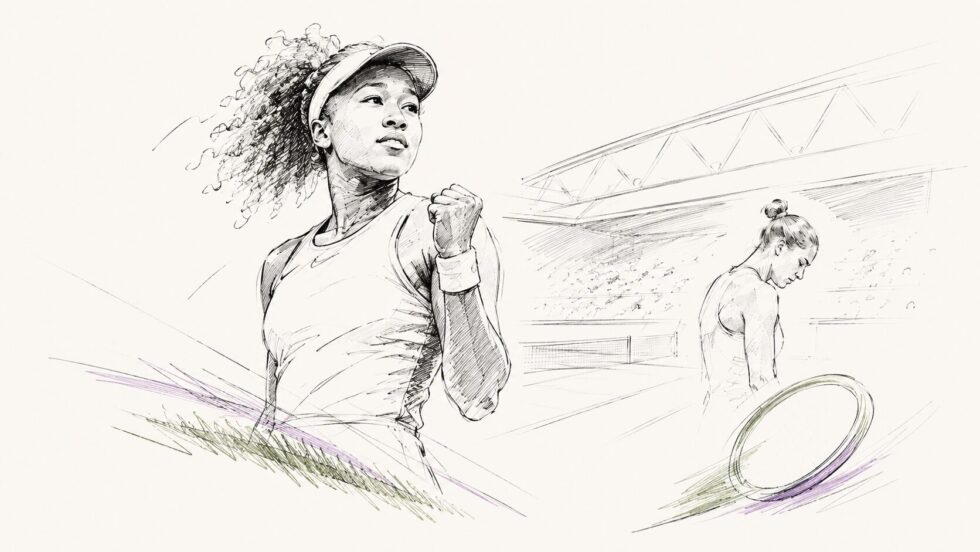
Naomi Osaka produced the biggest result of the Wimbledon women’s draw so far by beating world No 1 Aryna Sabalenka 6-2 7-6(2) on Centre Court on Sunday, 5 July 2026, to reach the quarter-finals at the All England Club for the first time. The Japanese 14th seed out-served, out-hit and out-thought the top seed in a match that was expected to be a power duel but became a statement win for Osaka’s rebuilt grass-court game, The WP Times reports.
Osaka had never previously gone beyond the third round at Wimbledon, but this victory changed the tone of her comeback season. She broke Sabalenka twice in a 32-minute opening set, held firm through the second, then dominated the tie-break to end Sabalenka’s run of 21 consecutive Grand Slam tie-break wins and move into a last-eight meeting with Czech 10th seed Karolina Muchova.
Naomi Osaka vs Aryna Sabalenka result: what happened on Centre Court
Osaka won 6-2 7-6(2), and the scoreline tells only part of the story. This was not Sabalenka throwing away a match through one bad patch; Osaka controlled the contest with first-strike tennis, clean movement and calmer decision-making under pressure.
| Match detail | Result |
|---|---|
| Tournament | Wimbledon 2026 |
| Round | Women’s singles fourth round |
| Court | Centre Court |
| Winner | Naomi Osaka |
| Score | 6-2 7-6(2) |
| Seedings | Osaka No 14, Sabalenka No 1 |
| Next opponent | Karolina Muchova |
Osaka’s opening set was brutal in its clarity. She attacked early, forced Sabalenka to defend more than she wanted, and punished short balls with the forehand. Sabalenka improved in the second set, but Osaka stayed level long enough to reach the tie-break, where she surged ahead and closed the match with the authority of a four-time Grand Slam champion.
How Naomi Osaka beat Sabalenka at her own game
The key to Osaka’s win was that she did not try to survive Sabalenka’s power. She matched it. Osaka served with purpose, took the first hit in rallies, and repeatedly redirected Sabalenka’s pace before the Belarusian could settle into rhythm. The first set showed the tactical difference. Sabalenka wanted to dominate with serve and forehand, but Osaka’s return position and early ball-striking denied her time. When Sabalenka pressed harder, errors followed. Osaka also looked far more comfortable on grass than in previous Wimbledon campaigns. Her footwork was sharper, her balance on wide balls was better, and she trusted the low, fast bounce instead of fighting it.
What Naomi Osaka said after beating Aryna Sabalenka
Osaka said the win mattered because of both the opponent and the venue. After losing three recent matches to Sabalenka, she admitted she wanted to change the pattern.
“It’s been a long time since I had so much fun on the court,” Osaka said after the match. “To do it here means a lot.” She also credited her team, including coach Tomasz Wiktorowski, for helping her improve on grass. That detail matters because Osaka’s Wimbledon record had long lagged behind her hard-court achievements, but this run now gives her a career-best result at SW19.
Why Aryna Sabalenka’s Wimbledon exit is so significant
Sabalenka’s defeat is her earliest Grand Slam exit since the 2022 French Open and her first straight-sets Grand Slam loss in 122 matches, according to BBC reporting supplied in the match material. For a player who had reached at least the semi-finals of every major last year, this is a major break in rhythm. The question many fans ask is simple: has Sabalenka won Wimbledon? No. Despite being world No 1 and one of the dominant players of the era, she has still not reached a Wimbledon final. Her 2026 Grand Slam season now has a difficult pattern. She lost the Australian Open final, fell at Roland Garros, and has now gone out in the fourth round at Wimbledon. The US Open is now her final chance this year to add another major title.
Sabalenka reaction: frustration, honesty and no excuses
Sabalenka’s reaction was sharp but controlled. During the match she looked irritated by her timing, slapped her racquet against her head in the second set and left Centre Court quickly after the final point. But in the press room she did not turn the defeat into an excuse about conditions, luck or one bad tie-break. Her main point was simple: Osaka played at a higher level when it mattered.
“I didn’t play my best, and she played probably her best,” Sabalenka said after the 6-2 7-6 defeat. “Sometimes that happens. Sometimes you can go out there and do everything you can and still lose the match. Well done to Naomi. Wishing her the best.”
That matters because Sabalenka has often been judged harshly after emotional Grand Slam losses. This time, however, the match was not a collapse from the world No 1. Osaka forced the errors with depth, early returns and cleaner first-strike tennis. Sabalenka’s power usually pushes opponents backwards, but Osaka held the baseline, absorbed the pace and then redirected it. The Belarusian had chances to drag the match into a third set, especially once the second set reached a tie-break, but Osaka won that mini-match 7-2 and finished like the calmer player.
What comes next for Osaka at Wimbledon
Osaka now faces Karolina Muchova in the Wimbledon quarter-finals after the Czech 10th seed beat 2024 champion Barbora Krejcikova 7-5 5-7 6-3. It is a very different tactical problem. Sabalenka gave Osaka pace; Muchova will give her rhythm changes, slices, net approaches, drop shots and awkward grass-court angles.
For Osaka, the match will depend less on pure power and more on patience. She cannot expect the same straight-line hitting contest she had against Sabalenka. Muchova is one of the best players on tour at breaking rhythm, so Osaka will need to serve well, step inside the court on second serves and avoid rushing when the ball stays low. The key tasks are clear:
- keep the first-serve percentage high and protect short service games;
- attack Muchova’s second serve before the Czech player can vary the rally;
- stay low on slice and not over-hit from uncomfortable positions;
- use the forehand early but avoid chasing winners too soon;
- treat the Sabalenka win as confidence, not as the final achievement.
Why this win changes the Wimbledon women’s draw
Sabalenka’s exit changes the shape of the women’s tournament because the No 1 seed and strongest power player in the draw is gone before the quarter-finals. It also means Sabalenka’s wait for a first Wimbledon title continues. She has won major titles elsewhere, but SW19 remains the gap in her Grand Slam record.
The draw is now more open, but not easier. Osaka is into her first Wimbledon quarter-final, Muchova has removed a former champion, and the tournament is moving towards another different women’s singles winner. That underlines how unpredictable the women’s field has become at Wimbledon, where momentum, grass movement and one strong serving day can quickly rewrite the bracket. For Osaka, this is bigger than one upset. It proves her comeback is no longer only about fitness, confidence or rebuilding after maternity leave. She has now beaten the world No 1 on Centre Court, reached her best Wimbledon result and shown that her game can work on grass when the serve, footwork and forehand all click together.
Wimbledon 2026 order of play: who plays on Monday, 6 July
Monday, 6 July, is the second day of the fourth round at Wimbledon 2026, with the remaining places in both the men's and women's quarter-finals to be decided. After Naomi Osaka's upset win over Aryna Sabalenka and Novak Djokovic's progress on Sunday, attention now turns to another full schedule featuring Grand Slam champions, title contenders and home favourite Arthur Fery. Official court assignments and start times are published by Wimbledon on the evening before play and remain subject to change.
Men's singles matches to watch – 6 July
| Match | Why it matters |
|---|---|
| Taylor Fritz vs Alexander Bublik | Two of the biggest servers left in the draw battle for a quarter-final place. |
| Alexander Zverev vs Jiri Lehecka | A clash between a top seed and one of the fastest-rising players on tour. |
| Grigor Dimitrov vs Arthur Fery | Britain's last remaining men's singles player faces former Wimbledon semi-finalist Dimitrov. |
Women's singles matches to watch – 6 July
| Match | Why it matters |
|---|---|
| Jasmine Paolini vs Alexandra Eala | Eala continues her breakthrough Wimbledon after eliminating defending champion Iga Swiatek. |
| Madison Keys vs Linda Noskova | Two aggressive baseliners compete for a place in the last eight. |
What is at stake on Monday
The winners on Monday complete the men's and women's quarter-final line-ups before the last-eight matches begin on Tuesday, 7 July. Every match now carries major ranking points, significant prize money and the opportunity to move within three victories of the Wimbledon singles title.
Read about the life of Westminster and Pimlico district, London and the world. 24/7 news with fresh and useful updates on culture, business, technology and city life: Why is air conditioning now a political fight as UK and Europe face record heat
Used sources - BBC Sport, Sky Sports, Reuters, Wimbledon, Tennis Majors, AP/Sportsnet, Guardian, ESPN, beIN Sports.