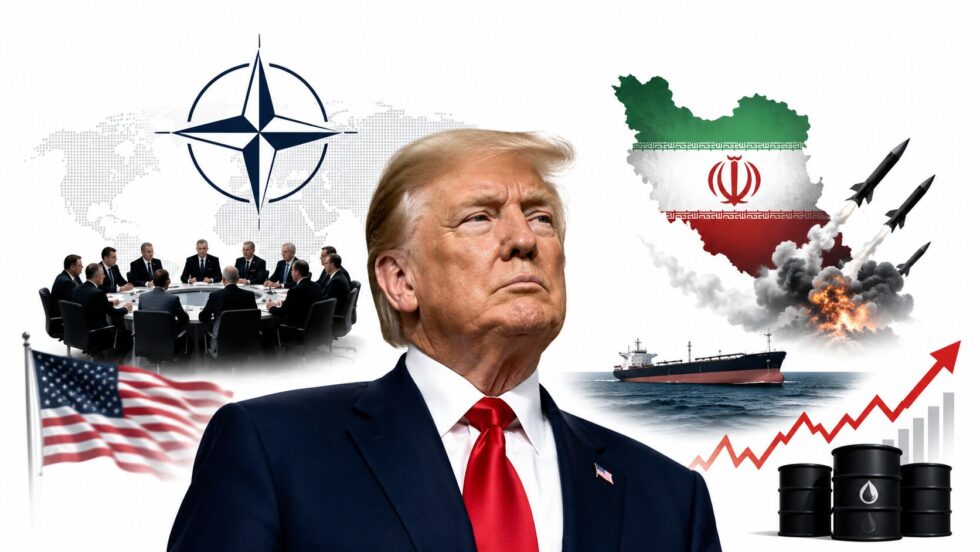
ANKARA — President Donald Trump has declared that the fragile ceasefire between the United States and Iran is "over," branding Tehran's leadership "scum" and "sick people" after the two countries exchanged a fresh wave of military strikes overnight, in an escalation that has driven oil prices sharply higher and thrown the mid-June peace framework into doubt. Speaking to reporters on the sidelines of the NATO summit in the Turkish capital on Wednesday, the American leader said he no longer wished to deal with the Islamic Republic — yet stopped short of formally abandoning negotiations, leaving a narrow diplomatic opening even as he threatened further attacks, reports the editorial team at The WP Times.
The president's remarks mark a stunning reversal from the optimism of only three weeks ago, when Washington and Tehran signed a Memorandum of Understanding intended to end the war that the United States and Israel launched against Iran on 28 February. The turnaround comes after Trump recently celebrated the signing of a memorandum of understanding between the U.S. and Iran to help end the war, insisting the deal would bring "peace and security" to the region — a claim that now looks increasingly hollow.
What Trump said in Ankara
Asked whether the ceasefire remained in force, the president was blunt. "I think it's over. I don't want to deal with them anymore," Trump told reporters on the second day of the NATO summit in Ankara, Turkey, when asked about the status of the Memorandum of Understanding signed on June 17. He went further, adding: "They're scum. They're sick people. They're led by sick people. If they had a nuclear weapon, they'd use it. As far as I'm concerned, it's over." (Time, 8 July 2026.)
Sitting alongside NATO Secretary-General Mark Rutte, Trump dismissed the process as futile. "For me, I think it's over," he said in Ankara. "As far as I'm concerned it's just a waste of time," according to Bloomberg (8 July 2026).
Despite the fury, the president notably did not shut the door entirely. He did not rule out talks continuing to permanently end the war with Iran, saying his top negotiators — special envoy Steve Witkoff and his son-in-law Jared Kushner — want to continue to negotiate. But he framed even that effort in withering terms: "as far as I'm concerned, it's just a waste of time dealing with them. They're liars," he said, as reported by NPR (8 July 2026).
More ominously for regional stability, Trump signalled that Washington's military campaign could intensify. He said the U.S. hasn't attacked Iran at the "highest level" yet, saying he could hit electric plants and desalination plants: "I don't want to do that but if we have to, we'll take them out." As NPR noted, strikes on civilian infrastructure of that kind could constitute a war crime. He also floated the idea of reinstituting the naval blockade on Iran and said he may hit Iran with more strikes on Wednesday night. Reporting from the summit, Al Jazeera said Trump indicated the US may resume its naval blockade, launch more strikes, and even "take over" Kharg island — the Gulf terminal that is the beating heart of Iran's oil-export machine.
The overnight escalation
The president's declaration followed the most serious military exchange between the two adversaries since late June. Trump's comments came after the U.S. and Iran traded attacks again overnight Wednesday, the second such escalation since the two sides signed an interim deal in mid-June.
The immediate trigger was a series of assaults on shipping in the world's most important oil chokepoint. The U.S. conducted a "series of powerful strikes" against Iran on Tuesday in retaliation for Iranian attacks on three commercial vessels transiting the Strait of Hormuz, U.S. Central Command said. Those assaults included high-value targets: on 7 July, two tankers — the Qatari-owned LNG carrier Al Rekayat and the Saudi-flagged supertanker Wedyan — were struck by projectiles in the strait. Both ships were damaged, and Al Rekayat suffered a fire in its engine room that put it at risk of exploding. Qatar accused Iran of being behind the attack on its tanker, and less than 24 hours later the IRGC attacked a third vessel in the strait.
CENTCOM's response was sweeping. The US military completed its latest round of strikes against Iran, hitting more than 80 targets, striking Iranian air defence systems, command and control networks, coastal radar sites, anti-ship missile capabilities, and more than 60 Islamic Revolutionary Guard Corps small boats in and near the strait. The command framed the operation in uncompromising language: "Iran's demonstrated aggression was unwarranted, dangerous, and a clear violation of the ceasefire," it said.
Iranian state media reported the blows landing across the country's south. Iranian state media reported explosions on Kharg island, a vital hub for Tehran's oil exports, as well as in the port cities of Bandar Abbas and Sirik and on Qeshm Island (CNN, 7 July 2026).
Tehran hit back within hours. The Iranian Revolutionary Guard said it responded to the U.S. strikes by launching missiles and drones against Kuwait and Bahrain, two Arab Gulf countries that host U.S. forces. Iran's account was more expansive still: Tehran said it had targeted 85 US military sites in Bahrain and Kuwait in response to what it described as US violations of the ceasefire. The IRGC warned that worse was to come, promising, in the words of Al Jazeera's Tehran correspondent, to retaliate in a harsher way in the coming days.
Sanctions, oil and the economic shockwave
Underpinning the military escalation was a decisive economic move by Washington. The U.S. Treasury Department announced Tuesday that it was revoking a general license issued in June that authorised Iranian oil sales — a license that was part of the ceasefire agreement, under which Iran had vowed to allow safe passage for ships through the strait.
The market reaction was immediate. Brent crude oil prices surged 5% to around $77–78 a barrel on Wednesday as escalating tensions in the Middle East fuelled concerns over further supply disruptions. As Trading Economics noted, the escalation marks a sharp reversal from earlier expectations of a supply glut, after OPEC+ increased production quotas and Middle Eastern producers moved to ramp up output. Analysts fear a renewed freeze on Hormuz traffic: the renewed conflict raised the prospect of fresh disruptions to global energy supplies by deterring shipowners and regional producers from using the vital waterway.
The stakes for the global economy are enormous. The strait is 34 kilometres wide at its narrowest point, and its two sea lanes facilitate the transit of around 20 million barrels of oil per day, representing roughly 20% of global seaborne oil trade. The passage's earlier closure this year triggered what the International Energy Agency called the "largest supply disruption in the history of the global oil market," with Brent prices surging as high as $80–82 per barrel earlier in the conflict before easing back towards $70 by July.
The political calculus around those prices is delicate for Trump. As Berenberg's chief economist Holger Schmieding observed before the latest flare-up, ahead of the mid-term elections to Congress on 3 November, Trump wants low oil prices whereas the Revolutionary Guards in Tehran covet the money from potential sanctions relief. NPR noted the domestic risk plainly: the renewed conflict leaves his party, and his own approval ratings, in a precarious position with four months until the midterm election.
How the deal was meant to work
The agreement now unravelling was signed with considerable fanfare. Trump and Iranian president Masoud Pezeshkian signed the Memorandum of Understanding roughly three weeks ago to cease fighting, lift the US naval blockade of Iran, and open the Strait of Hormuz. That agreement served as a launch point for 60 days of talks on more intractable issues, including the future of Iran's nuclear programme, future administration of the Strait of Hormuz, and access to billions of dollars in frozen Iranian funds.
That 60-day clock is running down. The deadline is set to expire in mid-August, but amid flare-ups of violence and accusations of violations from both sides, it seems little progress has been made. U.S. envoy Steve Witkoff and Jared Kushner discussed the Iran deal with mediators in Doha at the end of June, but no high-level talks with Iran have been confirmed.
Tehran blames Washington
Iranian officials have flatly rejected the American framing, insisting the United States is the party in breach. Iranian Parliament Speaker Mohammad Bagher Ghalibaf accused the U.S. of "major violations" of the memorandum in a post on X, citing the new U.S. strikes and the reinstatement of oil sanctions. "The era of bullying and extortion is over," Ghalibaf wrote.
Iran's Foreign Ministry echoed the charge. It condemned the Treasury move to revoke the sanctions suspension, saying Iran "holds the United States responsible for violating the memorandum of understanding, and will take any measures we deem necessary to safeguard our interests and national security." Notably, Al Jazeera's correspondent in Tehran observed that while both sides trade accusations, neither side has formally said the agreement is over.
Allies uneasy at the NATO summit
The escalation cast a long shadow over the alliance gathering in Ankara. NATO's leadership rallied behind Washington's tough line: "I think it is totally crucial that the U.S. forcefully reacts," Rutte told reporters. "I expect allies today to reconfirm that Iran should never, ever get its hands on a nuclear capability." He also pressed for the waterway to reopen fully, calling freedom of navigation through Hormuz "crucial for all 32 allies."The European Union struck a more cautious note. Foreign affairs chief Kaja Kallas warned that the exchanges of fire between the U.S. and Iran further complicate already fraught talks to end the war, adding that Iran's attacks on Bahrain and Kuwait are "unacceptable" and that its strikes on ships near the strait violate its commitment to reopen the waterway.
Yet Trump used the summit stage to air his familiar grievances against those same allies, complaining they had failed to back his Iran campaign. "Italy turned us down, and Germany turned us down, and France turned us down," he said, questioning why the US spends "hundreds of billions of dollars" on their defence.
For now, the picture is one of dangerous ambiguity. The president has pronounced the ceasefire dead in his own mind while conceding negotiators may press on; Iran denounces Washington's conduct but has not walked away formally; and the mid-August deadline for a permanent settlement looms with little to show for it. Adding to the volatility, the latest flare-up comes against the raw backdrop of Iranian mourning — funeral processions continue for Supreme Leader Ayatollah Ali Khamenei, who was killed in joint US and Israeli strikes at the start of the war on 28 February — with mourners in recent days chanting for vengeance against both Trump and Israeli Prime Minister Benjamin Netanyahu.
With oil markets jittery, Gulf capitals scrambling to mediate, and the American president threatening to strike "at the highest level," the coming days will test whether the mid-June understanding can survive at all — or whether the region is sliding back towards open war.
Read about the life of Westminster and Pimlico district, London and the world. 24/7 news with fresh and useful updates on culture, business, technology and city life: K2 Airways Cargo 737 missing near Karachi after Sharjah flight
Materials used: Time, Bloomberg, NPR, Al Jazeera, CNN, CNBC, The Jerusalem Post, MSNBC, Trading Economics, Wikipedia and the U.S. Energy Information Administration.