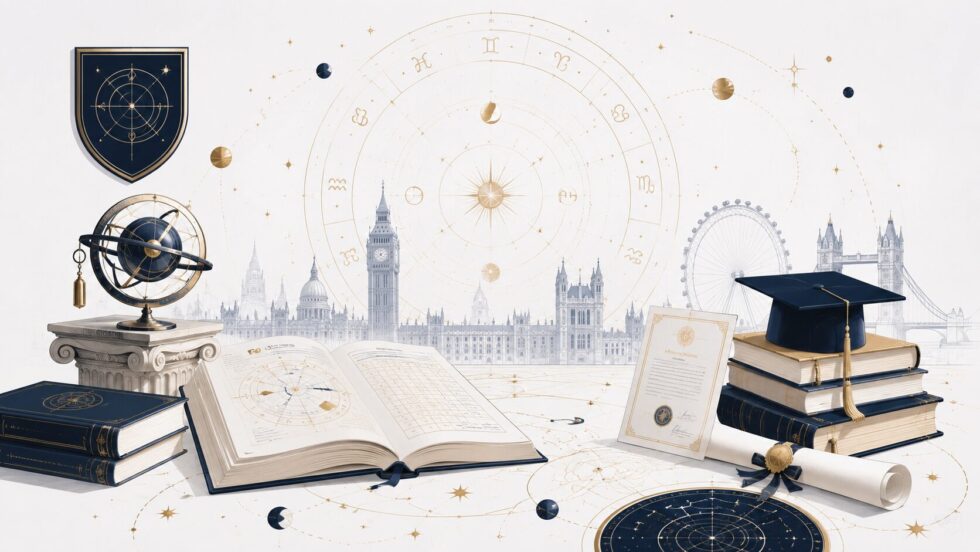
The demand for astrological training in the capital has quietly outrun the number of people who realise it is possible to gain a recognised, examined qualification here at all. Search traffic for a London astrology school, a London school of astrology certificate and reviews of the leading academies has climbed steadily over the past two years, driven partly by career-changers and partly by a generation that treats a birth chart the way an earlier one treated a personality quiz. Yet the practical questions — where you actually enrol, what a certificate costs, whether it means anything, and whether anyone earns a living from it — rarely get a straight answer. This report, compiled by the newsroom at The WP Times, sets out to give one, with named institutions, current fees, exam structures and market rates, so that a prospective student walking down Euston Road or logging in from abroad knows exactly what they are buying.
London occupies an unusual position in this field. It is not merely one option among many; it is arguably the world capital of formal astrological education, home to both the oldest examining body of its kind and one of the most commercially successful modern schools. The Faculty of Astrological Studies was founded in London on 7 June 1948 and has since enrolled more than 10,000 students from ninety countries, its Diploma recognised internationally by the letters DFAstrolS after a graduate's name. The London School of Astrology, established in 2000 to mark the millennium and now run by the astrologer, writer and publisher Frank Clifford, has become one of the most renowned places to study the subject anywhere, with branches in China and Japan. Between them these two institutions define what a serious London astrology education looks like — and this article walks through both, alongside the shops, centres and alternatives that surround them, with concrete figures throughout.
How to Get a Certificate in Astrology in London: The Two Serious Routes
There is no state-issued licence to practise astrology in the United Kingdom, and that fact shapes everything that follows. Anyone can call themselves an astrologer tomorrow. What distinguishes a credible practitioner is not a government qualification but an examined certificate or diploma from a respected teaching body — and in London two names dominate the conversation. Understanding how each one structures its awards is the difference between paying for genuine credentials and paying for a weekend of enthusiasm.
The London School of Astrology (LSA) runs a three-year curriculum built around a simple ladder. Year 1, coded as courses 101, 102 and 103, is the beginners' foundation, covering the zodiac signs, planets, aspects and houses. Year 2 (201, 202, 203) moves into interpretation and forecasting — transits, solar arc directions, secondary progressions, solar and lunar returns, plus astrocartography and synastry. Year 3 (301, 302, 303) is the Professional Training Apprenticeship Programme, designed to prepare students for paid client work through case studies and live client sessions. Crucially, the LSA offers Certificate exams each year and an internationally recognised Diploma (LSA Dip.) that students can tailor to their own interests. There are no admission requirements whatsoever, students may enrol at any point in the year, and coursework is optional — you can study for the joy of it or work systematically towards the qualification. The school's certificate and diploma are accredited within the astrological community by the APAE, the Advisory Panel on Astrological Education.
The Faculty of Astrological Studies (FAS) takes a more formal, examination-led approach that many regard as the gold standard. Its programme runs across nine modules and two Diploma levels. To earn the full Faculty Diploma you must pass three examinations — a Certificate exam, an Intermediate exam and an Advanced exam — and accumulate 360 credits across the nine modules. The Certificate itself is awarded after completing the Foundation Course (Modules 1, 2 and 3, worth 60 credits) and passing the Certificate exam, which yields a further 60 credits for a total of 120. The Faculty is careful to note that the Certificate, while a genuine achievement, is not in itself a professional qualification; that status arrives only with the full Diploma and the DFAstrolS designation, which also requires signing the school's Code of Ethics. Past and present Diploma holders read like a hall of fame for the field: Liz Greene, Howard Sasportas, Melanie Reinhart, Clare Martin, Sue Tompkins, Julia Parker and Charles Harvey among them.
The short answer to how to get a certificate in astrology is therefore this: choose one of these two London bodies, complete a foundation year or its equivalent module block, submit or sit the assessed work, and pass the certificate-level examination. At the LSA the coursework is woven flexibly into the year; at the Faculty it is a defined credit-and-exam pathway. Neither requires prior knowledge, and both accept complete beginners.
London School of Astrology: Fees, Format and Reviews
The LSA has built its reputation on a practical, vibrant style that keeps classes fun and accessible, and on tuition delivered by full-time practising astrologers rather than hobbyists. For twenty-four years it has run what it describes as the UK's foremost school of astrology, and the reviews from students in London, New York, Sydney, Beijing and beyond repeatedly praise the same qualities: accessibility, enthusiasm and a genuine care for the student's confidence.
On format, the school is deliberately flexible. Foundation Course 101 includes roughly 22 hours of pre-recorded video alongside six two-hour live weeknight classes on Zoom, with the alternative option of three Saturday seminars held live in London. Once enrolled, you retain online access to the videos, handouts and presentations for 18 months, extendable for a small fee. The live London sessions have historically been held at Rudolf Steiner House near Baker Street and at Steiner House, 35 Park Road, NW1, while the school's administrative base sits in the King's Cross area. Individual short courses give a sense of the price architecture: the school's teaching course, for example, is listed at £99 with recordings and unlimited access included, and standalone weekend seminars have been offered from around £75 early-bird to £99 full price. The single-seminar London Saturdays are attendance-only and not live-streamed, a detail worth checking before you book a train.
The verdict from reviews is consistent enough to be useful. Students value the humane, encouraging teaching and the sheer volume of resources; the recurring note is that Frank Clifford and his hand-picked tutors give people confidence in their own abilities rather than simply transmitting technique. For a prospective student weighing a London school of astrology certificate against the more austere Faculty route, the LSA sells itself as the warmer, more contemporary and more commercially polished of the two.
Faculty of Astrological Studies: The Gold-Standard Diploma
If the LSA is the modern crowd-pleaser, the Faculty is the institution. Founded in 1948 under the auspices of the Astrological Lodge of London and independent since 1954, it has an international reputation for rigour that no other English-language school quite matches. Its London classes are held in the Bloomsbury area — the birthplace of the Faculty — a few minutes' walk from King's Cross and Euston, with sessions at venues including the Art Workers' Guild at 6 Queen Square. There are also online classes run across time zones, distance learning by email that can be started at any time, and the celebrated annual Summer School held in Oxford each August, one of the highlights of the international astrological year.
The fees are transparent and modular. Under the current structure, Modules 4 to 9 cost £425 each when taken as online classes or distance learning; the optional Intermediate Practice Module is £235 and the Advanced Practice Module £245, on top of a one-time student registration fee of £35. (An alternative published schedule lists Modules 4 to 6 at £415 each, with Module 7's two pathways at £415 singly or £525 together, and Modules 8 and 9 at £415 — the precise figure depends on the content and options you choose.) Exams are optional if you study purely for personal enrichment, but they are mandatory for anyone wanting the Certificate, and then the Diploma and its DFAstrolS letters. Credits expire after six years, which imposes a gentle discipline on the pace of study. For the student who wants a qualification that opens professional doors and carries weight across the global astrological community, this is the route the field itself respects most.
Beyond the Classroom: Astrology Shops, Centres and the Oxford Question
A London astrology education does not happen in a vacuum. The city is dotted with astrology shops and centres that serve as informal extensions of the classroom — places to buy ephemerides, chart software, tarot decks and second-hand texts, and to pick up news of talks and workshops. Searches for an astrology centre London or an astrology shop London reliably surface long-standing esoteric bookshops in and around Covent Garden, Bloomsbury and Camden, and these are worth visiting early in your studies; the staff are often practitioners themselves and the noticeboards are a genuine route into the community. The Astrological Lodge of London, the parent body from which the Faculty sprang, continues to run lectures that are open to newcomers.
One question recurs so often it deserves a direct answer: does Oxford University teach astrology? No — and the confusion is understandable. The Faculty's Summer School is held in Oxford, and the city's dreaming-spires association lends a scholarly glow to anything staged there, but this is a private astrological event using Oxford as a venue, not a University of Oxford degree. No British university awards a degree in practising astrology. What universities do offer, occasionally, is the academic study of astrology's history — its place in the history of science, religion and culture — which is a different discipline entirely. If your goal is to read and cast charts professionally, the accredited private schools, not the universities, are your address. The phrase "college of astrology" in a London context points you back to bodies like the LSA and the Faculty rather than to any chartered university college.
What Is the Best Astrology School in the World? An Honest Assessment
Prospective students inevitably want a ranking, and the search term best astrology school in the world is among the most common in this field. The honest answer is that there is no accrediting authority above the schools themselves to hand out such a title, so any ranking is a matter of reputation, lineage and fit. That said, London's claim to the top tier is not marketing bluster.
The Faculty of Astrological Studies has the strongest case for the single most prestigious institution: three-quarters of a century of continuous operation, an internationally recognised Diploma, an alumni roster that includes the most influential astrologers of the modern era, and a genuinely rigorous three-exam structure. If "best" means "most respected credential," it is hard to look past it. The LSA has the strongest case for the best contemporary school — the most vibrant teaching, the widest reach, international branches and, since 2025, ownership of The Mountain Astrologer, the most respected English-language astrology magazine in the world. Outside London, serious contenders exist — Kepler College and the National Council for Geocosmic Research in the United States, and psychologically-oriented schools founded by London-trained astrologers — but the lineage of nearly all of them traces back, one way or another, to teachers who studied or taught in London. For the student asking which school is best, the more useful reframing is: rigour-and-prestige points to the Faculty; energy-and-accessibility points to the LSA; and both are, by any reasonable measure, among the finest in the world.
The Money Question: Do Billionaires Believe in Astrology
No discussion of studying astrology survives long before someone invokes the most famous quotation in the field. Do JP Morgan billionaires believe in astrology? The line usually cited — "Millionaires don't use astrology, billionaires do" — is attributed to the banker J. Pierpont Morgan and repeated with the confidence of scripture. It is worth handling honestly, because a good astrologer, like a good journalist, checks a source.
The uncomfortable truth is that nobody can find where Morgan said it. The astrologer and biographer Karen Christino went looking and traced the earliest printed version to the newspaper columnist Sydney Omarr in 1989 — more than seventy years after Morgan was in his grave. Archivists at the Morgan Library in New York hold no documents supporting his interest in astrology. What is documented is real but narrower: Morgan knew the celebrity astrologer Evangeline Adams, who ran a practice out of Carnegie Hall and claimed in her 1926 memoir The Bowl of Heaven to have taught him and supplied him a regular planetary service in his final years. Her clientele reportedly included the steel magnate Charles Schwab and two presidents of the New York Stock Exchange. Even if Morgan consulted her, though, he owed his fortune to being born into a banking family and making his money in railroads and steel long before he could have met her — so the seductive causal story does not hold. The quotation is, in Christino's memorable framing, a fossil with no animal inside it. The intellectually honest takeaway for a student is that wealth and astrology have a long, glamorous association in the popular imagination, and a much thinner evidentiary connection. Learn the craft for what it is, not for a Gilded Age myth.
The modern counterpoint is just as instructive. What does Elon Musk say about astrology? Musk, a Cancer Sun born on 28 June 1971, is a documented sceptic. He has expressed dismissive views consistent with his engineering, evidence-based worldview, and there is no record of him consulting astrologers or endorsing the practice. Astrologers may find symbolic resonance in his chart — Cancer's themes of protection and legacy mapped onto his talk of making humanity multi-planetary — but any honest practitioner will tell you that is interpretation applied to a public figure after the fact, not evidence of belief. Holding both the Morgan myth and the Musk scepticism in view is, frankly, part of a mature astrological education: the field's own history rewards those who can separate what someone actually said from what the marketing wants them to have said.
What Do Astrologers Actually Earn in London
The practical question behind most enrolments is whether any of this pays. Because astrology is unregulated and overwhelmingly self-employed, there is no salary band to quote with a straight face — earnings vary enormously with reputation, niche and hustle. What follows is a realistic picture rather than a promise.
At the entry level, a newly certified astrologer in London offering personal chart readings typically charges somewhere in the region of £50 to £90 for a first consultation, with many working part-time alongside another income while they build a client base. Established practitioners with a strong reputation and a waiting list commonly charge £120 to £250 per reading, and the most sought-after names — those who lecture, publish and appear in the media — command more still. The genuine money in modern astrology, however, tends not to sit in one-to-one readings at all. It sits in scale: teaching courses (as both the LSA and Faculty demonstrate), writing books and columns, running subscription newsletters and apps, corporate and event work, and selling recorded content to a global online audience. A practitioner who combines a modest reading practice with teaching and digital products can build a full-time living; one relying on readings alone in a saturated market will find it hard going. In blunt terms, the qualification is what earns a client's trust at the door, but the income comes from what you build around it. Anyone enrolling primarily as a route to riches should reread the Morgan section above.
Frequently Asked Questions
How do I get a certificate in astrology in London? Enrol with the London School of Astrology or the Faculty of Astrological Studies, complete a foundation year or the equivalent module block, and pass the assessed certificate-level work or examination. Neither requires prior knowledge and both accept absolute beginners.
How much does it cost? At the LSA, short courses and seminars run from roughly £75 to £99, with full three-year study costing more across the terms. At the Faculty, individual modules are around £415–£425 each, with a £35 one-time registration fee and additional practice modules at £235–£245.
Is a London astrology certificate recognised? Within the astrological community, yes. The LSA's certificate and diploma are accredited by the APAE, and the Faculty's DFAstrolS Diploma is internationally regarded as the gold standard. There is no government licence for astrology in the UK.
Does Oxford University teach astrology? No. The Faculty's Summer School is held in Oxford as a venue, but no British university awards a degree in practising astrology. Universities occasionally study astrology's history as an academic subject.
Can I study entirely online? Yes. Both schools offer full online and distance-learning routes, with the LSA providing 18 months of access to recorded material and the Faculty running email distance learning that can be started at any time of year.
Read about the life of Westminster and Pimlico district, London and the world. 24/7 news with fresh and useful updates on culture, business, technology and city life: Westquay Bunsik launches limited BTS menu in Southampton