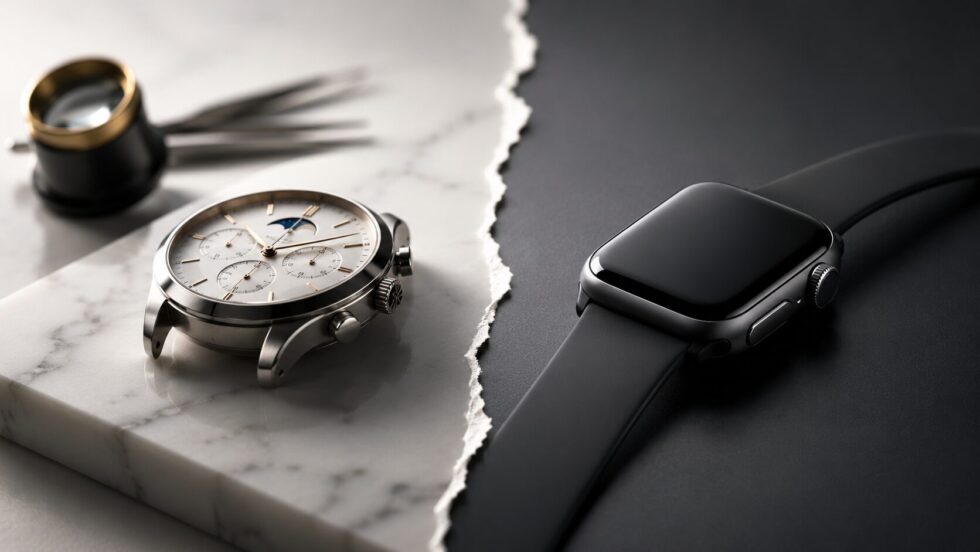
Swatch Group is seeking $170 million from Samsung in a London damages trial over digital watch-face apps that allegedly copied the appearance of Omega, Tissot, Breguet and other protected Swiss watch designs on Samsung smartwatches. The case concerns 26 downloadable “watch face” apps and follows a 2022 High Court ruling that found Samsung liable for trade mark infringement, despite the apps being created by third-party developers, The WP Times reports, citing the Financial Times.
The hearing now turns on damages. Swatch says the infringement should be priced as a hypothetical licence for the digital use of its marks, while Samsung argues the claim is detached from the apps’ actual revenue. Samsung’s barrister Daniel Alexander KC described the demand as “extravagant” and said the benefit to Samsung was negligible, with total download revenue just over $1,000 and about $300 attributable to the company, according to the Financial Times. Reuters says the case is one of the largest of its kind in the UK and dates back to a dispute launched in 2019.
What happened in the London trade mark case
Swatch Group, controlled by the Hayek family and led by Nick Hayek, is pursuing Samsung over watch-face apps made available for Samsung smartwatches through the Samsung Galaxy App Store. The apps allegedly reproduced visual elements associated with several Swatch-owned brands, including Omega, Tissot and Breguet. The complaint is framed as a trade mark case, not merely a design dispute, because Swatch says the apps used signs and dial branding that consumers would associate with its watch houses. The legal fight has been running for years. In 2022, the High Court in London found Samsung liable for trade mark infringement. In December 2023, the Court of Appeal upheld that decision in Montres Breguet SA v Samsung Electronics Co Ltd, a judgment that examined whether an app-store operator could be liable where third-party developers supplied the infringing apps. Swatch Group described that appeal result as a “milestone trade mark case” in its own statement.
The present stage is about damages. Swatch is asking the court to award $170 million for alleged infringements between October 2015 and February 2019. The FT reports that the apps were downloaded about 160,000 times in the UK and EU.
The central question is no longer whether Samsung was liable, but how much that liability is worth.
The brands named in the dispute
The case matters because the names involved are not generic watch labels. Omega, Tissot, Breguet, Longines and Swatch sit inside the same Swiss group but occupy different price positions, histories and marketing strategies. A copied dial can therefore raise different commercial problems depending on the brand it imitates.
Swatch’s argument is that a digital watch face does not need to be a physical watch to damage a mark. If a Samsung smartwatch can be made to look like an Omega or Tissot dial, the company says the exclusivity of the original brand is weakened. For high-end watchmakers, the dial is not just a functional interface. It carries the name, layout, colour language, hands, numerals and visual codes that let a buyer recognise the product instantly.
The brands cited in reporting include:
- Omega, one of Swatch Group’s most globally recognised luxury watch brands;
- Tissot, a major Swiss brand positioned below Omega but built around heritage and official timing associations;
- Breguet, a historic high-end watchmaker owned by Swatch Group;
- Swatch, the group’s mass-market name and corporate identity;
- Longines, referenced in earlier court reporting and Swatch’s public statement on the UK appeal.
This mix is legally important. The claim is not limited to one prestige watch copied once. Swatch says a cluster of apps allowed Samsung watch users to display dials that drew on a portfolio of marks, across luxury, premium and mainstream categories.
Why Samsung was held liable
Samsung’s central defence has been that independent developers created the watch-face apps. That argument did not prevent liability in the earlier UK rulings. The courts looked at Samsung’s role in the app ecosystem, including review processes, availability through its app store and the way smartwatches were marketed with changeable faces.
The issue is familiar in platform disputes: when does a marketplace stop being a neutral shelf and become legally responsible for what appears on it? In this case, the courts found that Samsung’s involvement was enough to make it liable. Legal commentary after the Court of Appeal ruling described the case as a warning for app-store operators, because it treated platform control as relevant to trade mark infringement.
“The case examines the extent to which App Store proprietors, such as Samsung, are responsible for the apps listed on their platforms as primary infringers,” Mishcon de Reya wrote after the appeal ruling. The earlier High Court case concerned 30 apps and 23 trade marks, according to legal summaries of the judgment. The current damages reporting focuses on 26 digital watch-face apps. That difference reflects how claims and evidence can narrow or shift between liability and damages stages.
Swatch’s $170 million calculation
Swatch’s damages case is built around a hypothetical licence. In simple terms, the company is asking what Samsung would have had to pay if it had sought permission to use the marks digitally on smartwatch faces. That method can produce a far larger figure than the actual revenue from app downloads, because it values the right that was allegedly taken, not just the cash generated by the infringing apps.
According to the FT, Swatch has put forward valuation evidence to calculate the price of such a licence. Its position is that the marks are valuable, carefully controlled and not normally available for this kind of use. The argument has three practical layers:
- Swatch says the marks have substantial commercial value even when used on a screen rather than a mechanical or quartz watch.
- It says a licence for digital use would need to reflect the prestige and exclusivity of the underlying brands.
- It says Samsung’s app-store role means the infringement cannot be treated as a minor developer-side mistake.
Samsung rejects that approach. Its case is that the apps were not prominent, were not used in Samsung marketing and were removed when the issue was raised. The company says nearly all the apps were free and that the revenue was tiny compared with the claim.
The gap between $170 million and roughly $300 in Samsung-attributed revenue is the commercial heart of the hearing.
What the lawyers are saying
Swatch’s side has used the language of appropriation. Daniel Selmi, acting for Swatch, described the dispute as a “large-scale appropriation” of valuable trade marks, according to the FT. The phrase matters because it frames the case as more than accidental availability of a few niche downloads. It presents the apps as a systematic taking of protected brand value. Samsung’s side has pushed the court towards actual economic impact. Daniel Alexander KC, for Samsung, said Swatch’s demand “departs from reality” and argued that damages should be tiny. He also said the apps “had no prominence” and that Samsung did not want them there, according to the same report.
Samsung’s position is that “the benefit to Samsung was negligible”, while Swatch’s position is that the licence value of the marks is the proper measure.
There is also a brand-policy argument. Sylvain Dolla, chief executive of Tissot, said in a witness statement that Swatch does not license its brands to third parties, and “definitely not” to other watch companies or smartwatch companies, according to the FT. He argued that putting high-end Swiss watch names on commodity smartwatches would damage the value of fine Swiss watchmaking. That evidence helps Swatch answer a problem in the hypothetical-licence model. If Swatch would never willingly license Omega or Tissot faces to Samsung, the court still has to imagine a negotiated fee for infringement valuation. Swatch says that fee must be high precisely because the group guards those brands tightly.
Why the case reaches beyond Britain
The London court’s damages decision could matter beyond the UK. The FT reports that the judge has power to determine damages across the EU because Swatch brought the lawsuit before the end of the Brexit transition period in 2020. That timing gives the English proceedings a wider commercial reach than a normal post-Brexit UK-only dispute.
There are also related proceedings in the United States. Reuters reports that the legal battle began in 2019 and that US proceedings have been brought, while the FT says the US case has been stayed pending the outcome in England.
| Issue | Swatch’s position | Samsung’s position |
|---|---|---|
| Nature of infringement | Digital copies weakened protected watch marks | Third-party apps caused minimal real-world harm |
| Proper damages measure | Hypothetical licence for digital use of luxury marks | Actual revenue and benefit were negligible |
| App responsibility | Samsung controlled review and distribution | Developers created the apps |
| Commercial impact | Brand exclusivity was appropriated | Apps were obscure and removed after complaint |
| Geographic reach | UK case may cover EU damages due to timing | Damages should remain limited by evidence |
This is why the case is being watched by both luxury groups and technology platforms. For luxury brands, the ruling may affect how courts value unauthorised digital uses of protected signs. For app-store operators, it reinforces the idea that review systems and platform control can create exposure even where third-party developers made the infringing content.
The timeline of the dispute
The dispute has moved through several legal stages rather than appearing suddenly in 2026. The latest hearing is the damages stage after liability and appeal.
- Between October 2015 and February 2019, the disputed watch-face apps were available, according to the FT’s description of Swatch’s claim.
- In 2019, Swatch began legal action against Samsung over smartwatch faces in the US and UK context, with early reporting focusing on alleged copies of brands such as Longines, Omega, Swatch and Tissot.
- In 2022, the High Court in London found Samsung liable for trade mark infringement.
- In December 2023, the Court of Appeal upheld the ruling, and Swatch publicly welcomed the decision.
- In June 2026, the High Court heard arguments over the size of damages, with Swatch seeking $170 million and Samsung disputing the scale of the claim.
The judge named in the FT report is Mr Justice Marcus Smith. Closing arguments were due on Friday, 26 June 2026, with judgment expected at a later date.
Why digital watch faces are legally sensitive
A smartwatch face is software, but it performs the same visible role as the dial of a physical watch. That is why luxury watchmakers treat it as commercially sensitive. A dial contains the brand name, design grammar and emotional signal that sit at the front of the product. On a wrist, a copied digital face can give the appearance of association even when no physical Swiss watch has been bought.
For Samsung and other platform operators, the difficult point is scale. App stores can host thousands of developer products, and infringing content may appear without corporate intent. The Swatch litigation shows that courts may still look at who approved the app, who distributed it, who benefited from the ecosystem and whether the platform used watch faces as part of smartwatch appeal.
The case turns a small screen into a large trade mark problem.
There is also a strategic clash between Swiss watchmaking and consumer electronics. Swatch Group sells watches as objects with controlled design, production and distribution. Samsung sells devices whose value comes partly from customisation. Watch-face apps sit exactly between those models: they make a smartwatch more personal, but they can also borrow the visual status of brands that did not agree to appear there.
The damages fight in numbers
The numbers in the case are unusually stark. Swatch’s demand is $170 million. Samsung says total revenue from the apps was just over $1,000, with about $300 attributable to Samsung. The reported download figure is about 160,000 across the UK and EU. Those figures do not answer the legal question by themselves. Swatch is not simply asking for lost sales of watches. It is arguing that the court should price the unauthorised use of brands such as Omega, Tissot and Breguet as if Samsung had negotiated for permission. Samsung says that scenario is artificial because the licence would never have happened and because the apps generated almost no income.
A damages award close to Swatch’s number would treat digital brand use as a high-value licence even when direct revenue is small. A much lower award would suggest that courts will require stronger evidence of commercial loss or platform benefit before imposing large sums for app-store trade mark infringements.
What to watch in the judgment
The High Court’s damages ruling will show how English law values trade mark infringement in a digital marketplace where the infringing product is cheap, downloadable and visually powerful. It will also clarify how far a luxury brand can push the hypothetical-licence model when its own witnesses say the brand would not have granted such a licence in real life. The key points in the judgment will be:
- whether the court accepts Swatch’s valuation evidence for a hypothetical digital licence;
- how much weight is given to Samsung’s limited app revenue;
- whether brand dilution and loss of exclusivity affect the damages figure;
- how the court treats Samsung’s app-review control after the earlier liability finding;
- whether the award has practical consequences for EU-linked damages and the stayed US proceedings.
For Nick Hayek’s Swatch Group, the case is a test of how far traditional watch trade marks travel into wearable technology. For Samsung, it is a fight against turning obscure third-party downloads into a nine-figure bill.
Read about the life of Westminster and Pimlico district, London and the world. 24/7 news with fresh and useful updates on culture, business, technology and city life: How will Samsung Galaxy Watch 9 and Samsung Galaxy Watch Ultra 2 change the smartwatch race in 2026
Sources used: Financial Times, Reuters, Swatch Group official statement, UK Court of Appeal case reporting.