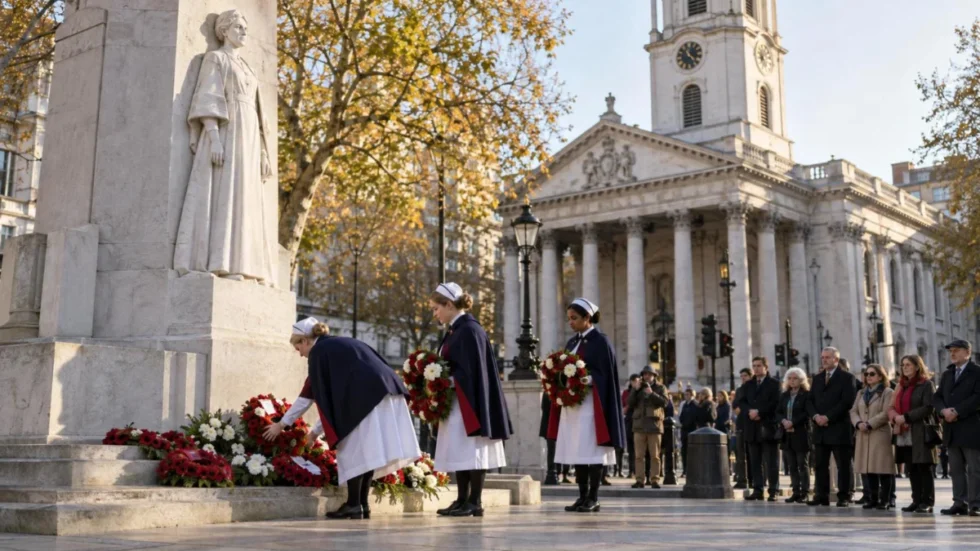
The Edith Cavell ceremony takes place today, Monday 12 October 2026, at her Grade I-listed memorial on St Martin's Place, just off the north-east corner of Trafalgar Square, with nurses laying wreaths on the 111th anniversary of her execution by a German firing squad in Brussels in 1915. The event is listed for 10:00 to 11:00, it is free, and passers-by can watch from the pavement, The WP Times reports.
The tradition dates back to 12 October 1920, when nurses from the Royal London Hospital first laid flowers at the newly unveiled statue. Today it is led by the Cavell Nurses' Trust, the charity founded in her name in 1917, and brings together nursing organisations, military nurses and members of the public for a hymn, a minute's silence marked by the bells of St Martin-in-the-Fields, and the laying of wreaths.
What time does the Edith Cavell ceremony start today?
The event is listed from 10:00 to 11:00, although organisers had not confirmed the exact running order at the time of publication. In recent years the formal part has begun at around 10:30, so arriving by 10:15 gives time to find a spot on the pavement facing the statue.
| Detail | Information |
|---|---|
| Date | Monday 12 October 2026 |
| Time | 10:00–11:00 (formal ceremony usually around 10:30) |
| Place | Edith Cavell Memorial, St Martin's Place, London WC2N 4JJ |
| Landmark | Between St Martin-in-the-Fields and the National Portrait Gallery |
| Organiser | Cavell Nurses' Trust, with nursing organisations |
| Price | Free, no ticket needed |
| Duration | About 30–45 minutes |
Where exactly is the Edith Cavell statue?
The memorial stands on a traffic island on St Martin's Place, where Charing Cross Road meets Trafalgar Square. It faces south towards Nelson's Column, with St Martin-in-the-Fields church to the east and the National Portrait Gallery and the London Coliseum close by. The statue is hard to miss: a white marble figure of Cavell in nurse's uniform set against a tall granite block topped by a figure representing humanity protecting the small states.
What happens at the ceremony?
The format has stayed simple and largely unchanged for decades. At the 2024 ceremony, reported by the Royal College of Nursing, the order was:
- welcome and short address by the chair of the Cavell Nurses' Trust;
- the hymn Abide with Me, which Cavell sang with the prison chaplain on the eve of her death;
- the bells of St Martin-in-the-Fields chiming to open a minute's silence;
- wreaths laid by nursing bodies, including the Royal College of Nursing, military nursing services and the Queen's Nursing Institute;
- an informal gathering afterwards, when members of the public can lay their own flowers.
Visitors who want to pay respects can bring a single flower or a small posy and leave it at the base of the memorial once the official wreaths are in place.
Who was Edith Cavell?
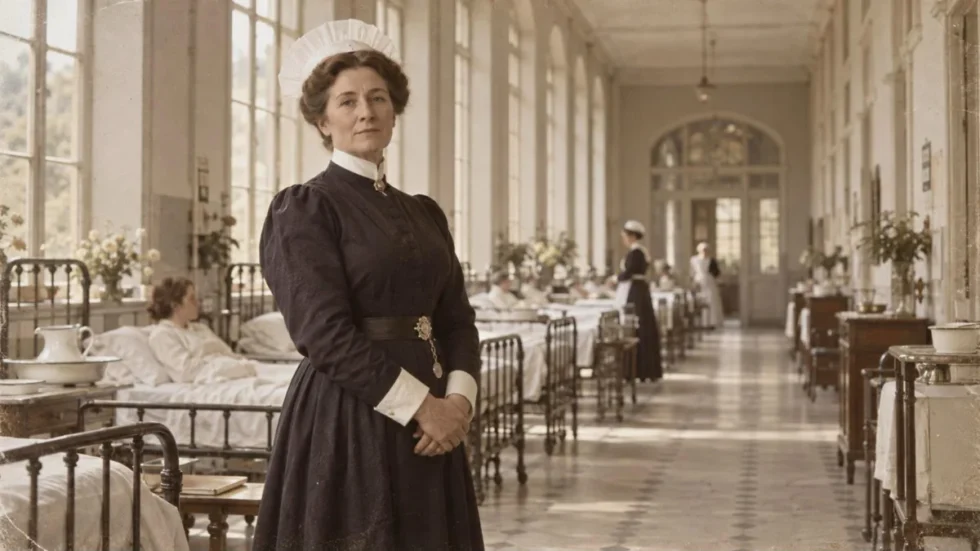
Edith Louisa Cavell was born on 4 December 1865 in Swardeston, Norfolk, the daughter of the village vicar. She trained as a nurse at the London Hospital in Whitechapel and in 1907 became matron of a pioneering nursing school in Brussels, often described as the first modern training school for nurses in Belgium.
When war broke out in 1914 and Germany occupied Belgium, Cavell stayed at her post. She treated wounded soldiers from both sides, but she also joined a resistance network that hid Allied servicemen and helped them cross the border into the neutral Netherlands. Around 200 men are thought to have escaped with her help.
She was arrested on 3 August 1915, tried by a German court martial for treason and sentenced to death. Despite appeals from the United States and Spain, she was shot at dawn on 12 October 1915 at the Tir National rifle range in Schaerbeek, Brussels, alongside the Belgian architect Philippe Baucq. She was 49.
| Year | Event |
|---|---|
| 1865 | Born in Swardeston, Norfolk, on 4 December |
| 1896 | Begins nurse training at the London Hospital |
| 1907 | Becomes matron of a nursing school in Brussels |
| 1914 | Germany occupies Belgium; Cavell stays and treats the wounded |
| 1915 | Arrested on 3 August, executed on 12 October |
| 1917 | Cavell Nurses' Trust founded |
| 1919 | State funeral at Westminster Abbey, burial at Norwich Cathedral |
| 1920 | Statue unveiled by Queen Alexandra on 17 March |
| 2014 | Memorial upgraded to Grade I |
What did Edith Cavell say before she died?
On the night before her execution, Cavell told the Anglican chaplain Stirling Gahan that patriotism was not enough and that she must have no hatred or bitterness towards anyone. A shortened form of those words, "I must have no hatred or bitterness for anyone", was carved on the memorial in 1924 at the request of the National Council of Women. Her death caused international outrage, was used heavily in British recruitment propaganda and became one of the defining stories of the First World War.
Why is her statue at Trafalgar Square?
The memorial was designed by Sir George Frampton, who accepted the commission in 1915 and refused a fee. It was unveiled by Queen Alexandra on 17 March 1920, a year after Cavell's body was brought home for a state funeral at Westminster Abbey on 15 May 1919. The site, at the heart of London and next to St Martin-in-the-Fields, was chosen to give her a national place of remembrance close to Nelson and the capital's main war memorials on Whitehall. The granite block carries the words Humanity, Devotion, Fortitude, Sacrifice and Faithful until death. It was listed Grade II in 1970 and upgraded to Grade I in 2014, the highest level of protection.
How to get there
| Option | Nearest stop | Walk to the statue |
|---|---|---|
| Tube | Charing Cross (Northern, Bakerloo) | 2–3 minutes |
| Tube | Leicester Square (Northern, Piccadilly) | 4 minutes |
| Tube | Embankment (District, Circle, Northern, Bakerloo) | 7 minutes |
| Rail | Charing Cross mainline | 3 minutes |
| Bus | Trafalgar Square / Charing Cross Station stops, routes 24, 29, 176 and others | 1–3 minutes |
From Westminster and Pimlico, the quickest route is the Victoria line to Victoria and a short bus ride up Whitehall, or the District and Circle lines to Embankment followed by a walk along Villiers Street. Step-free access is available at Charing Cross mainline station.
What else is happening nearby today?
St Martin-in-the-Fields usually holds free lunchtime concerts on weekdays, and the National Gallery and National Portrait Gallery, both free to enter, are within a minute's walk of the memorial. The church crypt café is the nearest place for a hot drink after the ceremony.
Frequently asked questions
Is the Edith Cavell ceremony open to the public?
Yes. It takes place on the street, there is no ticket or registration and anyone can watch from the pavement.
What time should I arrive?
Aim for 10:15. The event is listed from 10:00 to 11:00, with the main part usually starting around 10:30.
Can I lay flowers at the Edith Cavell statue?
Yes. Members of the public traditionally leave flowers after the official wreaths have been laid.
Where is Edith Cavell buried?
At Norwich Cathedral, after a state funeral at Westminster Abbey in May 1919.
Why is the ceremony held on 12 October?
It marks the date of her execution in Brussels on 12 October 1915.
Read also:
- What's on in London this weekend: 10–11 October 2026
- Japan Matsuri London 2026: start times and Trafalgar Square programme
- Renoir and Love at the National Gallery: tickets and what to see
Sources used: IanVisits, Royal College of Nursing, RCNi, Cavell Nurses' Trust, Historic England, Westminster Abbey, Guided Walks in London