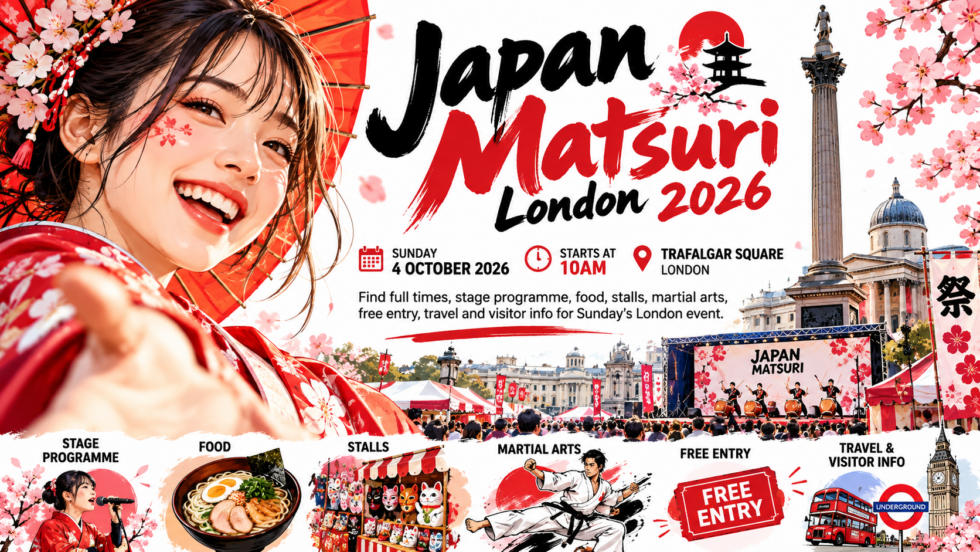
Japan Matsuri London 2026 starts at 10am on Sunday 4 October and runs until 8pm at Trafalgar Square, turning one of central London’s busiest public spaces into a ten-hour programme of Japanese music, dance, food, martial arts, community groups and cultural demonstrations. The first hour is already substantial: Tamashii School of Wadaiko-Dō opens with taiko, Naomi Suzuki performs the official Japan Matsuri song IBUKI with Chelsea Kodomo no Hiroba and Universal Young Stars, and the formal opening from 10.30am includes kagami biraki and a mikoshi procession carried by students from Teikyo School UK. Across the rest of the day, the Main Stage moves through Sōran Bushi, Japanese folk music, Okinawan traditions, Awa Odori, Bon Odori, cosplay, British sumo, visual-kei, shamisen pop, Kenbu and a final programme featuring Japanese dancers from three major British ballet companies. Entry is free and no advance booking is required, while 64 listed stalls will spread food, products, crafts, tourism and cultural organisations across the square, The WP Times reports.
The practical details matter as much as the stage bill. Trafalgar Square is the festival site, at London WC2N 5DS, rather than simply a meeting point for another venue, and food stalls will sit in the centre of the square on either side of the fountains. Charing Cross is the nearest mainline station, with Charing Cross, Leicester Square, Piccadilly Circus and Embankment all listed by the organisers as Tube options. Visitors cannot bring bags larger than A4, bikes, scooters, e-scooters, hoverboards, opened bottles or cans of alcohol, animals other than assistance dogs, or weapons and bladed items. Capacity is also controlled: once Trafalgar Square reaches its permitted limit, organisers say entry will operate on a “one in, one out” basis. The official Japan Matsuri website confirms the 10am-8pm hours and free admission, while The Japan Society lists the same date, venue and hours and states that no booking is required.
What time does Japan Matsuri London 2026 start and when are the main events
The confirmed Japan Matsuri times are 10am to 8pm on Sunday 4 October 2026. The ten-hour opening period should not be read as a general access window before the entertainment begins: the Main Stage programme starts at 10am, and several of the festival’s most recognisable traditional elements appear during the first hour. The official timetable lists taiko and IBUKI at 10am and the opening ceremony and mikoshi procession at 10.30am. A more detailed performer schedule groups the morning into an opening block from 10am to 11am, followed by further hour-long or near-hour-long sections throughout the day.
Anyone arriving at lunchtime will have missed the formal opening, the first taiko performance and the first Teikyo School UK mikoshi procession.
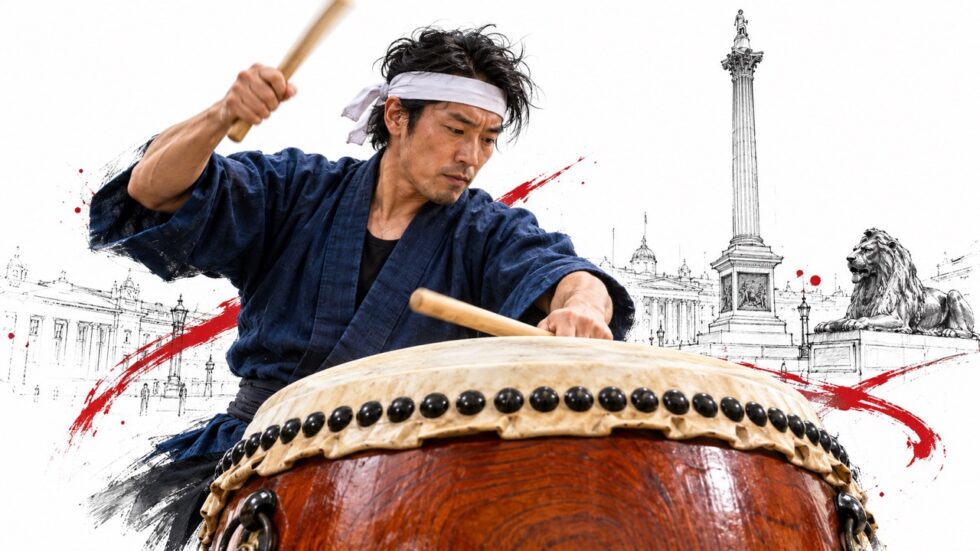
Tamashii School of Wadaiko-Dō opens the day. The official programme describes a performance using several wadaiko styles, including the Fukui style associated with western Japan, before Naomi Suzuki appears with Chelsea Kodomo no Hiroba and Universal Young Stars for IBUKI. That song returns again in the finale, giving the programme a deliberate bookend between the opening and closing sections rather than treating it as a single early-stage number.
At 10.30am, the Japan Matsuri Executive Committee chairman and the Ambassador of Japan to the UK are scheduled to lead the official opening. The ceremony includes kagami biraki, the ceremonial opening of a sake barrel, accompanied by festival guests. Teikyo School UK then brings a phoenix-topped mikoshi, or portable shrine, around Trafalgar Square. The organisers describe the procession as accompanied by repeated calls of “Wasshoi! Wasshoi!”, making this part of the programme mobile rather than confined to the stage.
“Wasshoi! Wasshoi!” is the call highlighted by the organisers for the Teikyo School UK mikoshi procession around Trafalgar Square. (Japan Matsuri 2026 performer programme)
The next stage period changes character. From 11am to noon, students from Rikkyo School in England perform Sōran Bushi with taiko and choreography, followed by Radio Taiso with Kibitan, The Green Chorus and the SOAS Min’yō Group. The Green Chorus is the Nippon Club Japanese Women’s Choir; Japan Matsuri says the group has spent 40 years performing at churches, festivals and concerts around London and will present five songs at this year’s event. SOAS Min’yō Group brings Japanese folk repertoire and instruments including shamisen and shakuhachi, with audience participation also part of its format.
Noon brings another change. Shimizu Minato-kai, a mikoshi organisation from Shimizu in Shizuoka, is scheduled to present a procession involving local students and volunteers. Kendama follows, alongside London Okinawa Sanshinkai and Ryukyu Kobujutsu. The result is a one-hour block covering portable-shrine culture, a traditional skill toy, Okinawan folk and classical music, dance and classical martial arts rather than one continuous genre.
The published stage structure is therefore best read as a sequence of cultural blocks:
| Time | Main confirmed programme |
|---|---|
| 10am-11am | Wadaiko, IBUKI, official opening, kagami biraki, Teikyo School UK mikoshi |
| 11am-noon | Rikkyo School Sōran Bushi, Radio Taiso with Kibitan, The Green Chorus, SOAS Min’yō Group |
| Noon-1pm | Shimizu mikoshi, kendama, London Okinawa Sanshinkai, Ryukyu Kobujutsu |
| 1pm-2pm | Awa Odori, Ready Singer One, Smilewalking Club fashion performance |
| 2.15pm-3pm | Tankō Bushi Bon Odori, cosplay, Radio Taiso |
| 3pm-4.25pm | Naomi Suzuki with Press X, kendama, Seth, British Sumo |
| 4.30pm-6pm | Kenbu, wadaiko, Yosakoi London Temuzu, Nihon Buyo |
| 6pm-7pm | Radio Taiso, YUZU shamisen pop, mikoshi, Sakura Cherry Tree Project |
| 7pm-8pm | UK Ballet Dancers Summit, Bon Odori, IBUKI and closing taiko |
The official short timetable and the detailed performer programme are not identical in presentation. The timetable page highlights selected acts at individual times, while the performer page provides fuller hourly blocks and descriptions. For planning a complete day, the detailed performer listing is therefore the more useful of the two, particularly after lunchtime.
What happens between 1pm and 3pm?
At 1pm, Awa Odori brings Tokushima festival culture to central London through the Japan Association in the UK. The association was founded in 1996 with aims including support for the Japanese community in Britain and the promotion of Anglo-Japanese relations. Its Japan Matsuri performance uses singers, wadaiko and shamisen, with the audience invited to take part rather than remain outside the dance.
That participatory element is one of the clearest examples of why Japan Matsuri is not simply an outdoor concert. Several performances are staged as cultural practices that can extend into the crowd, and the distinction becomes particularly clear in the dance programme. Ready Singer One then shifts the hour towards popular culture with eight-part choral arrangements connected to anime and Japanese culture. The group is described in the programme as the UK’s only film and videogame choir and has previously appeared at events including Science Museum Lates and Comic Con.
Smilewalking Club follows with a fashion performance built around its “Fashion × Beauty × Smile” approach and the inclusive idol group IRIS Angel. The programme then pauses before a 2.15pm block centred on Tankō Bushi, cosplay and Radio Taiso. This is one of the sections where traditional community dance, pop-cultural costume and everyday Japanese physical culture appear next to one another without being treated as competing definitions of Japan.
Tankō Bushi is presented through workshops organised by Japan House London and the Japan Association in the UK. The dance originated in the coal-mining communities of Tagawa in Fukuoka Prefecture, and the choreography contains movements linked to miners’ work. At Trafalgar Square, participants from those workshops will perform the dance and the audience is invited to follow the simple rhythmic movements.
The cosplay section then turns to characters from anime, manga and games. Japan Matsuri describes cosplay as a hobby established in Japan from the 1980s and now practised internationally. Its inclusion sits directly beside Bon Odori and Radio Taiso, which is useful context for the breadth of the festival: Japanese heritage, community life and contemporary media culture are being presented within one programme, rather than divided into separate themed events.
The programme is deliberately mixed, moving from regional festival traditions to anime culture and back to communal activities within the same afternoon.
What happens from 3pm to the evening programme?
From 3pm to 4.25pm, the stage shifts again. Japanese singer-songwriter Naomi Suzuki appears with London rock band Press X for material spanning City Pop, anime songs and original music. The official listing names “Stay with Me” and “Plastic Love” among the City Pop material in the set and describes Press X as a London-based band influenced by videogames. Kendama then returns before Seth, best known as the vocalist of the gothic visual-kei project Moi dix Mois, performs.
Seth’s listing matters because it broadens the contemporary-music section beyond pop. The programme describes a career of more than two decades in visual-kei and also notes his work in enka and kayō under the stage name Miyoshi Seiji, as well as his involvement in Sakura Zensen. That crossover between visual-kei presentation and older Japanese popular-song forms is consistent with the day’s wider refusal to separate “traditional” and “modern” into rigid blocks.
British Sumo completes this section. Youth and senior wrestlers from across England, including British champions, are due to demonstrate winning techniques on stage. The official programme says organised British sumo has UK roots dating to 1985, placing the demonstration within a domestic sporting history rather than presenting sumo only as something imported for a one-day show. From 4.30pm, the tone returns to performance traditions. Kenbu, often translated as sword dance, combines movements with the katana and sensu folding fan with classical poetry. Auga Magari, founder and artistic director of Samurai Kenbu Theater in Kyoto, is listed for the special programme. Tamashii School of Wadaiko-Dō then returns, followed by Yosakoi London Temuzu and Nihon Buyo Group UK with Kimonodego.
Yosakoi London Temuzu is an amateur group based in London. Yosakoi combines Japanese dance and musical traditions with influences that can include jazz, rock and hip-hop, and the group has performed across Britain and Europe. Japan Matsuri notes that Kōchi Prefecture, the birthplace of Yosakoi, awarded the group official Yosakoi Ambassador status in 2019.
The Nihon Buyo performance follows a different visual language. The London-based group uses costumes and dance drawing on Japanese traditional forms while also blending in Western styles. This sequence means that the late-afternoon period moves from sword dance to taiko, then to modern Yosakoi and Nihon Buyo without requiring visitors to leave the Main Stage area.
What is happening from 6pm until the 8pm finish
Radio Taiso returns at 6pm, led by teachers and graduates from Chelsea Kodomo no Hiroba. YUZU, or Yuzu Natsumi, then performs shamisen pop, combining the traditional three-string instrument with pop, anime songs and original work. Japan Matsuri says she has performed in 29 countries.
A further Teikyo School UK mikoshi procession is listed in this evening period. It gives anyone who misses the morning procession another opportunity to see the portable shrine moving around the square, although the early ceremony itself is not repeated. The Sakura Cherry Tree Project follows with koto, Sakura Choir London and soprano Nozomi Fukushima. Its listed music includes “Sakura Sakura”, “Furusato”, “The Moon over the Ruined Castle” and the main theme from Princess Mononoke.
The final hour, from 7pm to 8pm, has an unusually British-Japanese focus. UK Ballet Dancers Summit - The Real Story brings Japanese dancers associated with The Royal Ballet, Birmingham Royal Ballet and English National Ballet onto the same stage for an interview about their professional journeys and connections to Japan. Japan Matsuri lists Ryoichi Hirano, Luca Acri, Taisuke Nakao and Daichi Ikarashi from The Royal Ballet, Miki Mizutani from Birmingham Royal Ballet and Anri Sugiura from English National Ballet. The listing presents this as a conversation rather than a complete ballet performance, an important distinction for anyone attending specifically for that item. The summit then gives way to the festival finale: Tankō Bushi returns, IBUKI is performed again by Naomi Suzuki with Chelsea Kodomo no Hiroba and Universal Young Stars, and Joji Hirota’s London Taiko Drummers bring the final percussion section. The group was founded in the early 1980s and has appeared at large British events, including the Live Earth programme at Wembley Stadium.
Japan Matsuri describes the 7pm ballet section as a gathering in which Japanese dancers from Britain’s three major ballet companies “appear together in a special interview”. (Japan Matsuri performer programme) The festival’s stated closing time is 8pm. That matters for anyone planning dinner or another central-London event afterwards because there is no separately advertised late-night Japan Matsuri programme at Trafalgar Square after the scheduled finale.
What is on at Japan Matsuri Trafalgar Square beyond the Main Stage
The Japan Matsuri Trafalgar Square programme extends well beyond what happens under stage lighting. The 2026 stall map lists 64 numbered participants across North Terrace, West Square, East Square and the South East Corner, plus the Japan Matsuri Information Centre. Those exhibitors are divided into Food & Drink, Food Products, Crafts & Goods, Travel & Tourism and Info & Experience. The balance is significant: this is as much a temporary Japanese cultural, food and travel marketplace as a performance event.
Food is the largest individual category. The organisers list 26 Food & Drink stalls and another eight Food Products exhibitors. Crafts & Goods accounts for 14 stalls, Travel & Tourism for nine and Info & Experience for six. The distribution across the square is not random. West Square and East Square are heavily food-focused, North Terrace carries many of the institutional and tourism organisations, and the South East Corner concentrates crafts and products.
Where will the Japanese food stalls be
Japan Matsuri says food stalls are positioned in the centre of Trafalgar Square on either side of the fountains. West Square contains 16 listed stalls and is the most concentrated food zone on the published map. Shoryu Ramen, IPPUDO, Kōfuku, RiceWineShop, Bite Mi Buns, PEKO PEKO, Mugen, Suzuya Chelsea, Warabi-Mochi Kamakura, Onigiri Heads, MOGU ONIGIRI & DANGO and Tsujiri are among the names listed there, alongside product exhibitors Yakult UK and K. Minamoto.
East Square is even more straightforward in category terms. All eight listed exhibitors are Food & Drink: Matchado, Banzai Kitchen, Oishī Don, Buy and Bite, Japan Centre Retail, SHOKUDŌ, AUN and KOINOBORI. This gives the eastern side a clear food identity and means the central food offer is not concentrated exclusively west of the fountains.
North Terrace also has food, but its character is much broader. ITO EN, UCC Europe, Cleve Studio and Fruit Mochi Nanaka sit alongside tourism bodies, schools, airlines, cultural organisations and Nintendo. The practical implication is simple: visitors looking mainly for lunch or snacks have the largest concentration around the central and west/east areas, while anyone also wanting Japan-related information has more reason to spend time on North Terrace.
| Festival area | What the official map shows |
|---|---|
| North Terrace | 27 stalls spanning tourism, culture, travel, food, products and information |
| West Square | 16 stalls, dominated by Japanese food and drink |
| East Square | 8 stalls, all listed as Food & Drink |
| South East Corner | 12 stalls, mainly crafts, goods and food products |
| Information Centre | Separate Japan Matsuri information point |
Free admission applies to entry, not to food and retail purchases. Traders set out commercial food, drink, products and crafts within the event, and no official statement suggests those purchases are included in festival admission. The distinction is straightforward but useful for a free public event where “free” can otherwise be misread as describing the whole visitor experience.
Japan Matsuri is free to enter; meals, drinks, gifts and other goods sold by individual stallholders are separate purchases.
Which Japanese organisations and travel bodies will be there
North Terrace is the strongest part of the site for visitors interested in Japan beyond the immediate festival programme. Its 27 listed stalls include Hokkaido Tourism Organization, British Airways with Finnair, Iberia and Japan Airlines, Japan Airlines separately, Central Japan Railway Company, JR EAST with Miyagi Prefecture and Tohoku, Tokyo Tourism, InsideJapan, Japan Local Government Centre and Japan National Tourism Organization.
That combination makes the area useful for people considering a trip to Japan because airlines, rail operators, regional destinations and national tourism bodies are represented within the same section. It also places commercial travel information next to cultural organisations, rather than isolating it in a trade-only area.
Nintendo is listed at N12 under Info & Experience. Rikkyo School in England is at N18, Japan House London at N19, The Japan Society at N20 and The Japan Foundation, London at N27. The Japan Society separately confirms that its team will be on North Terrace opposite The National Gallery with matsuri-related activities and information about its programmes.
The institutional mix also explains why Japan Matsuri has a different character from a purely commercial Japanese-pop-culture convention. The Japan Society is one of the festival’s four corporate directors alongside the Japan Association, the Japanese Chamber of Commerce and Industry in the UK and Nippon Club. The current executive committee is chaired by Hiroyuki Miyagawa of the Japanese Chamber of Commerce & Industry in the UK, with representatives from those bodies as well as Japan House London, the Embassy of Japan, JETAA UK and other organisations.
What crafts and products are on the square
The South East Corner contains much of the craft-heavy offer. The list includes Doki, AYAKO, NOLTY, Tomomi Yamamoto, Krom Kendama, Sonoeha, Siamurai Apparel, Obsidian & Flame and Ezen Designs. The Makers’ Tent at SE9 brings together HanaMizuki London, KOKORO Creation, no.michi.london, Noriko Nagaoka Ceramic, Remy’s Crafts and Tamakurya. Food products also appear in this area through AWAIDO and Clearspring, while North Terrace includes Hokkaido Fine Foods, Mizkan Europe, Ajinomoto Foods Europe and London Shakunage-kai. The distinction between Food & Drink and Food Products is useful when reading the map: the former category largely indicates ready-to-eat or drink offers, while the latter points towards packaged or retail food items.
The Japan Association in the UK appears at N1 under Crafts & Goods, while Japanese Gallery Kensington is at N24. MIKI HOUSE and Vallebona are also positioned on North Terrace. This dispersal means the shopping component is not restricted to one market lane; it is threaded through different parts of Trafalgar Square.
What martial arts can visitors see
The Japan Matsuri programme has a dedicated martial-arts element in addition to British Sumo on the Main Stage. Wakaba Kendo Club is scheduled to give a kendo demonstration. Founded in 1993 and based in Hoxton, Shoreditch, the club is described by Japan Matsuri as London’s largest children’s kendo dojo, with about 40 registered students aged from five to 18.
Ryukyu Kobujyutsu is represented by Shihan Julian Mead, a 7th Dan practitioner who trained in Japan under Grandmaster Motokatsu Inoue. The demonstration is scheduled to include traditional Okinawan weapons through kihon, kata and kumite, allowing visitors to see basic techniques, formal sequences and fighting applications rather than only a choreographed weapons display.
London Aikikai Traditional Aikido completes the dedicated martial-arts listing. The group, described by the festival as one of London’s oldest aikido clubs, will demonstrate aikido and weapons techniques including sword against sword and stick against stick.
These demonstrations sit alongside martial or martial-adjacent elements elsewhere in the day, including British Sumo and Kenbu. They should not be treated as the same discipline: kendo, Ryukyu Kobujyutsu, aikido, sumo and Kenbu differ substantially in purpose, history and performance context. Japan Matsuri presents them together because the festival is surveying different aspects of Japanese physical and performance culture, not because they form one unified martial-art programme.
Ryukyu Kobujyutsu at the festival will demonstrate traditional weapons through “Kihon (basics), Kata (form), and Kumite (fighting)”. (Japan Matsuri martial arts programme)
How should a full day at Japan Matsuri be planned?
The amount of simultaneous activity makes strict completionism unrealistic. The stage alone runs for most of the ten-hour event, while food queues, stalls, martial arts and moving mikoshi processions require time away from a fixed viewing position. A practical schedule can therefore be built around the acts that happen only once and the activities that remain available for much of the day.
- Arrive for 10am if the opening ceremony, first taiko performance and first mikoshi procession are priorities.
- Use late morning for the folk, choral and Okinawan programme before the busiest lunch period.
- Move through the food and North Terrace areas between stage blocks rather than expecting all 64 stalls to be covered at once.
- Return to the Main Stage from mid-afternoon for Naomi Suzuki, Seth, British Sumo, Kenbu and Yosakoi if contemporary and performance culture is the main interest.
- Stay until the 7pm-8pm section for the UK Ballet Dancers Summit and the finale with Bon Odori, IBUKI and taiko.
That schedule is based on the official order rather than an assessment that one act is more important than another. Different sections serve distinct interests: the opening is strongest in ceremonial matsuri elements, lunchtime brings Okinawan and folk material, early afternoon carries participatory dance and cosplay, mid-afternoon leans towards music and sumo, and the final hours return to traditional performance alongside the ballet summit.
Is Japan Matsuri free, how do visitors get there and what else should be known
The short answer to “Is Japan Matsuri free?” is yes. Admission to the Japan festival London event is free of charge, and no booking is required. That position is stated by both Japan Matsuri and The Japan Society. The absence of tickets does not remove crowd controls, however: if Trafalgar Square reaches its permitted capacity, entry changes to a one-in, one-out system. The square’s location makes public transport the obvious access route. The organisers list Charing Cross on the Bakerloo and Northern lines; Leicester Square on the Northern and Piccadilly lines; Piccadilly Circus on the Bakerloo and Piccadilly lines; and Embankment on the Bakerloo, Northern, District and Circle lines. Charing Cross is also the listed mainline railway station. The official Japan Matsuri location page gives the postcode as London WC2N 5DS.
Bus routes listed by Japan Matsuri are 3, 6, 9, 11, 12, 13, 15, 23, 24, 53, 77A, 88, 91, 139, 159, 176 and 453. The organisers’ transport page provides these as routes serving the area rather than a guarantee of the operating status of each individual service at a particular time. For a central-London event, checking live transport information before travel remains separate from the festival’s own location guidance.
What cannot be brought into Trafalgar Square
Japan Matsuri has published unusually clear headline restrictions. These are not simply recommendations about convenience; the event site states that the listed items will not be allowed into Trafalgar Square and refers visitors to its full Conditions of Entry for the more detailed prohibited-items policy.
The main published restrictions cover:
- bags larger than a piece of A4 paper;
- bikes, scooters, e-scooters and hoverboards;
- opened bottles or cans of alcohol;
- animals other than assistance dogs;
- any type of weapon or bladed item.
The A4 bag rule is particularly easy to overlook because Trafalgar Square is normally an open civic space rather than a conventional ticketed arena. Festival conditions change that context for the day. The rule means that luggage, large backpacks and other bags exceeding the stated dimensions can create an entry problem even though no admission ticket is required.
Free entry removes the ticket barrier, but it does not remove security checks, prohibited-item rules or the square’s capacity limit.
What is matsuri 2026
“Matsuri” is commonly used for a Japanese festival, but in this London context it refers specifically to Japan Matsuri, the annual event devoted to Japanese culture and food. The London festival has taken place annually since 2009: the organisers list Spitalfields as the location in 2009 and 2010, County Hall in 2011 and Trafalgar Square from 2012.
The name is reflected in several elements of the programme rather than functioning as a generic branding term. Mikoshi processions, Awa Odori, Bon Odori, wadaiko and other festival-associated traditions appear alongside contemporary music, cosplay, food, travel organisations and British-Japanese community groups. The event is therefore not reconstructing one specific local Japanese matsuri. It is presenting a broad London festival around Japanese culture through both traditional and contemporary forms.
The organisational structure also places the festival within Britain’s established Japanese community. The Japan Society, Japan Association, Japanese Chamber of Commerce and Industry in the UK and Nippon Club are identified as the four corporate directors. The executive committee additionally includes representatives associated with Japan House London, the Embassy of Japan and other UK-Japan organisations.
Where was HYPER JAPAN 2026 held in London
HYPER JAPAN 2026 was a separate event and should not be confused with Japan Matsuri. HYPER JAPAN Festival took place at Olympia London, Hammersmith Road, London W14 8UX, from 24 to 26 July 2026. Its published opening hours were noon-8pm on Friday 24 July, 10am-8pm on Saturday 25 July and 10am-5pm on Sunday 26 July.
The distinction is more than a difference of venue. HYPER JAPAN operates as a ticketed multi-day festival with exhibitors, workshops, a Main Stage, food hall and HYPER MARKET, while Japan Matsuri is a free one-day Trafalgar Square event. Both cover aspects of Japanese culture in Britain, which explains why search results and visitor questions can overlap, but the dates, admission structure and programme format are separate.
For anyone searching specifically for 4 October 2026, the correct event is Japan Matsuri at Trafalgar Square, not HYPER JAPAN at Olympia.
Is Sakura Matsuri the same event, and is Sakura Matsuri worth it
Sakura Matsuri is not another name for the 4 October Trafalgar Square event. The prominent Sakura Matsuri - Japanese Street Festival run by the Japan-America Society of Washington DC is an American festival, not the London Japan Matsuri. Its organisers describe it as a large celebration of Japanese culture in the United States.
Whether a Sakura Matsuri suits a particular visit depends on the location, programme and purpose of that trip, so it cannot be treated as a substitute for Japan Matsuri London simply because both use the Japanese word “matsuri”. For a London visitor deciding what is happening at Trafalgar Square on Sunday 4 October, Sakura Matsuri is not the relevant event. The correct name, timetable and visitor conditions are those published by Japan Matsuri London.
FAQ: Japan Matsuri London 2026
What time does Japan Matsuri London 2026 start?
Japan Matsuri starts at 10am on Sunday 4 October 2026 and finishes at 8pm. The first Main Stage items are wadaiko and IBUKI, while the official opening and first mikoshi procession are scheduled within the opening hour.
Is Japan Matsuri free?
Yes. Entry is free of charge and no advance booking is required. Once Trafalgar Square reaches permitted capacity, however, organisers will use a one-in, one-out entry system. Food, drinks and merchandise from commercial stalls are separate purchases.
Where is Japan Matsuri London 2026?
The festival is held at Trafalgar Square, London WC2N 5DS. Charing Cross, Leicester Square, Piccadilly Circus and Embankment are the Tube stations listed by organisers, with Charing Cross also the nearest listed mainline railway station.
What is on at Trafalgar Square?
The programme includes taiko, mikoshi processions, Sōran Bushi, Radio Taiso, min’yō, Okinawan music and dance, Ryukyu Kobujutsu, Awa Odori, Bon Odori, cosplay, Japanese contemporary music, British Sumo, Kenbu, Yosakoi, Nihon Buyo, shamisen pop, the Sakura Cherry Tree Project and a final UK Ballet Dancers Summit. Away from the stage, the official map lists 64 stalls covering food, products, crafts, tourism and cultural information.
What time is the opening ceremony?
The short official timetable lists the opening ceremony at 10.30am, following the 10am taiko and IBUKI section. The ceremony includes kagami biraki and is followed by the Teikyo School UK mikoshi procession.
What happens at Japan Matsuri after 7pm?
The 7pm-8pm section includes the UK Ballet Dancers Summit with Japanese dancers from The Royal Ballet, Birmingham Royal Ballet and English National Ballet. The finale then includes Tankō Bushi Bon Odori, IBUKI and Joji Hirota’s London Taiko Drummers before the scheduled 8pm finish.
Japan Matsuri London 2026 is open from 10am to 8pm on Sunday 4 October at Trafalgar Square, with free entry and a programme running from the opening taiko performance through to the final evening taiko set.
Materials used: Japan Matsuri London official 2026 event information, Japan Matsuri 2026 timetable, Japan Matsuri 2026 performer programme, Japan Matsuri stalls map, Japan Matsuri martial arts programme, Japan Matsuri location information, The Japan Society, HYPER JAPAN official festival information, Sakura Matsuri Japanese Street Festival official information.
Read about the life of Westminster and Pimlico district, London and the world. 24/7 news with fresh and useful updates on culture, business, technology and city life: When will Oasis 2027 tour dates be announced and could 12 Etihad nights define Manchester next summer