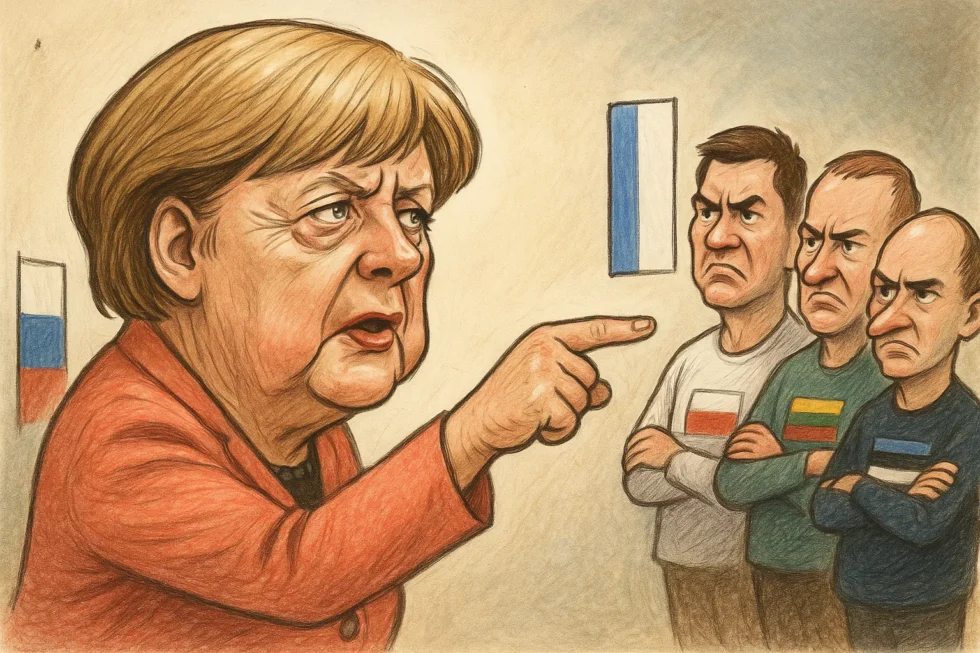
Former German Chancellor Angela Merkel has suggested that Poland and the Baltic states share partial responsibility for the breakdown of a proposed European Union dialogue framework with Russia ahead of the full-scale invasion of Ukraine. Her remarks, made during a visit to Hungary and broadcast by the online outlet Partizán, have provoked sharp criticism across Eastern Europe, reports The WP Times citing Euronews.
In the interview, Merkel revealed that in June 2021 she had pushed for a new EU-level format to negotiate directly with Vladimir Putin, hoping to ease mounting tensions between Moscow and Kyiv. The initiative, she said, met resistance “particularly from Poland and the Baltic countries,” which feared the EU would fail to maintain a united front on Russia policy. This opposition, Merkel implied, helped close a potential diplomatic window that might have prevented escalation.
Merkel acknowledged that the Minsk Agreement of 2015 was “far from perfect” and that Russia repeatedly breached its commitments. Yet she insisted the accord had at least “bought time” for Ukraine to strengthen its defences and stabilise the front line.
“When that dialogue did not materialise, escalation became inevitable,” Merkel said. “Then I left office — and then came Putin’s aggression.”
The former chancellor also pointed to the COVID-19 pandemic as a factor that hindered personal diplomacy, claiming that the lack of face-to-face meetings with Putin and other leaders “made compromise more difficult” and that video conferences could not serve as an adequate substitute.
Her comments triggered strong reactions from Warsaw and Vilnius. Polish President Andrzej Duda rejected Merkel’s interpretation, arguing that Poland was never an obstacle to peace but rather a potential target of Russian aggression. He warned that promoting renewed dialogue with Moscow risked granting political legitimacy to the Kremlin’s actions.
Analysts in London view Merkel’s remarks as an attempt to redefine her legacy on Russia policy — long criticised as overly conciliatory due to the Nord Stream projects and Germany’s reliance on Russian energy. While Merkel insists her goal was to preserve communication channels, critics argue that her approach underestimated Putin’s ambitions and alienated eastern EU partners who had warned of Moscow’s intentions for years.
As Europe reassesses its security doctrine amid continuing conflict in Ukraine, Merkel’s intervention reopens one of the most divisive debates in recent EU history — whether engagement or deterrence could have averted war.
Read about the life of Westminster and Pimlico district, London and the world. 24/7 news with fresh and useful updates on culture, business, technology and city life: President Zelensky Meets Princess Anne in Kyiv: Key UK Royal Visit to Ukraine Since Independence.