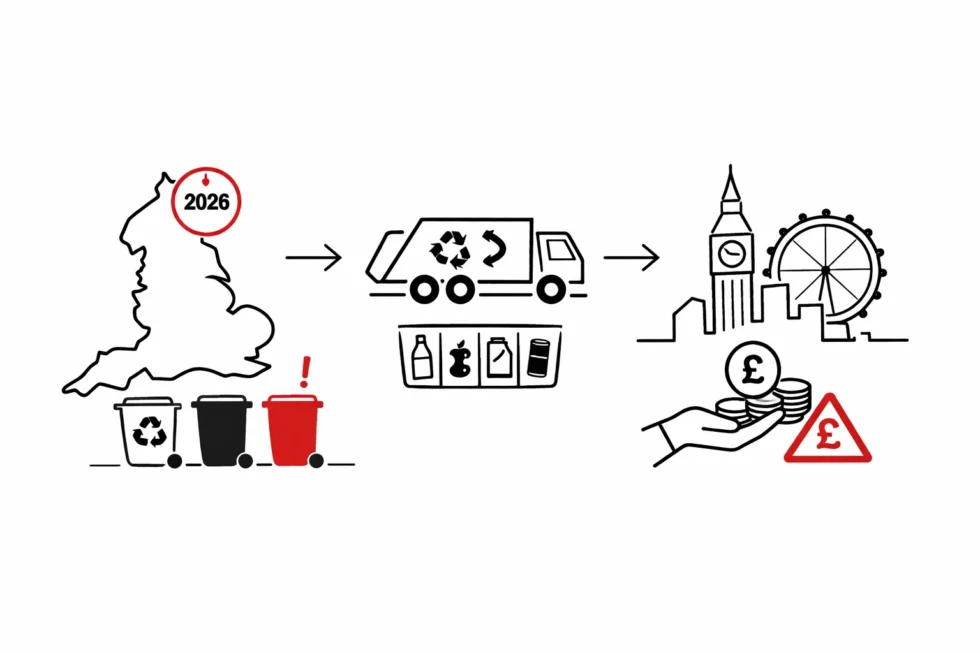
From March 2026, England’s waste system will undergo its biggest overhaul in more than three decades. The new England bin collection rules 2026 will legally force every household — from London tower blocks to rural cottages — to separate rubbish into four different waste streams or face rising penalties, refused collections and enforcement action.
UK households generated more than 28 million tonnes of waste in 2025, while London alone produced over 7.4 million tonnes, according to local authority returns and Environment Agency data. More than 30% of what ends up in black bins is food waste, which contaminates recycling and drives up landfill and incineration costs. Councils now spend more than £250 million a year dealing with wrongly sorted waste.
As The WP Times editorial team reports, citing the Department for Environment, Food & Rural Affairs (DEFRA) and London borough waste authorities, 2026 marks the point where England moves from “encouraging” recycling to legally enforcing it.
Legal basis and penalties under England bin collection rules 2026
The 2026 system is not guidance — it is law. It is enforced under:
- the Environment Act 2021
- the Environmental Protection Act 1990 (Section 46)
- the Waste (England and Wales) Regulations
From 31 March 2026, every household, rental property and business producing domestic waste must separate refuse into four streams: food waste, paper and card, dry recyclables, and residual waste.
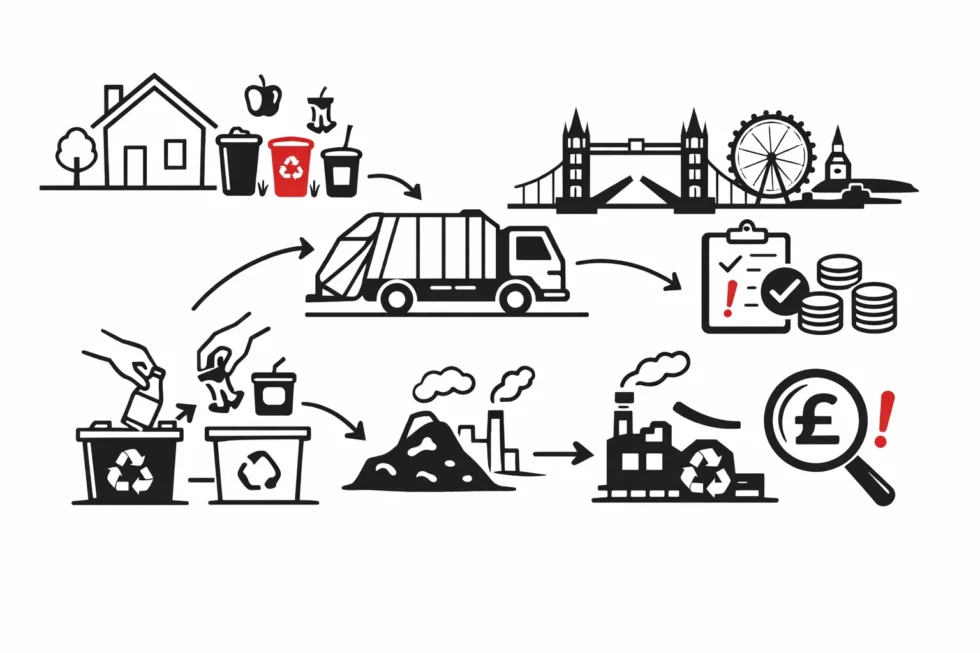
Councils can issue Section 46 Notices, which legally tell residents how to sort, store and present their bins. Ignoring these instructions is a civil offence, similar in law to fly-tipping. In practice this means:
| Offence | Legal basis | England penalty | London enforcement |
|---|---|---|---|
| Food waste in black bin | EPA 1990, s46 | £80–£150 | £100–£150 |
| Contaminated recycling | Waste Regulations | £60–£100 | £80–£120 |
| Repeated non-compliance | Environment Act 2021 | Up to £400 | Up to £400 |
| Landlord provides no bins | Housing & waste law | Up to £1,000 | Actively enforced |
| Illegal dumping | EPA & Environment Act | Up to £5,000 | Criminal prosecution |
Councils can also refuse to empty bins that are wrongly sorted, leaving residents legally responsible for re-sorting their own waste.
Why fines are rising so sharply in London
London has some of the highest waste-processing costs in Europe. In 2025, boroughs spent more than £1.1 billiondisposing of rubbish. Contaminated recycling can cost councils up to £180 per tonne to send to landfill or incineration.
Under national law, councils that fail to improve recycling now face financial penalties from central government — which they are passing directly on to households and landlords. That is why the England bin collection rules 2026 bring four-bin sorting, weekly food waste and higher London fines. The system is designed so that not sorting becomes more expensive than sorting.
What exactly changes from 31 March 2026
From 31 March 2026, recycling in England becomes fully standardised for the first time in history. Every council, from central London boroughs to rural district authorities, must operate under the same legally binding waste system. The long-standing postcode lottery — where what could be recycled depended on where you lived — officially ends.
Every home, whether it is a house, flat, Airbnb or rented property, must have access to four separate waste streams:
- Food and garden waste — all leftovers, peelings, tea bags and organic waste
- Paper and cardboard — newspapers, boxes, envelopes and packaging
- Dry recycling — plastic bottles, metal cans, glass, cartons and packaging
- Residual waste — everything that cannot be recycled
The most significant change is food waste. Under the new rules, food waste must be collected every week, including from blocks of flats, tower buildings and communal housing. Councils must provide either individual food caddies or shared food waste bins, and residents are legally required to use them.
This means throwing food into the black bin will no longer be treated as a mistake — it will be treated as a breach of waste law.Incorrect sorting is now legally treated as a breach of waste duty.
How London’s system will be stricter
London will not simply adopt the national recycling rules — it will enforce them more aggressively than anywhere else in England. Because the capital pays some of the highest landfill and incineration charges in Europe, boroughs are under intense financial pressure to reduce contaminated waste.
Councils including Westminster, Camden, Hackney and Lambeth are rolling out a tougher enforcement model that goes well beyond basic bin collection. From 2026 this will include:
- Regular bin inspections in houses, flats and communal waste rooms
- Smart tags and barcoded bins to track which properties are repeatedly breaking the rules
- Automatic penalties for bins found to contain food waste or contaminated recycling
- Direct fines for landlords and housing associations when rental properties fail to comply
In practice, this means London boroughs will be able to identify problem properties, issue Section 46 legal notices, and move quickly from warnings to fines. For residents and renters, the capital will be the strictest place in the country to get recycling wrong.
London recycling fines in 2026
| Violation | Typical fine |
|---|---|
| Food waste in black bin | £80–£150 |
| Contaminated recycling | £60–£100 |
| Repeated non-compliance | Up to £400 |
| Rental properties with wrong waste | Up to £1,000 |
| Commercial waste dumped in bins | Up to £5,000 |
What renters, tourists and Airbnb guests must know
If you are staying in a London flat, serviced apartment or Airbnb, the recycling law applies to you in exactly the same way as it does to permanent residents. The council does not care who created the waste — it only cares which property it came from.
By law, all short-term rental properties must provide:
- A food waste bin or caddy
- Separate recycling bins for paper, card and dry recyclables
- Clear written instructions explaining what goes in each bin and when it is collected
If waste from a rental property is wrongly sorted, the fine is issued to the address and the property owner, not the visitor. In response, many London landlords and Airbnb hosts are now including recycling compliance clauses in booking agreements and charging guests for any council penalties.
Hotels and serviced hotels handle rubbish through their own waste contracts, so guests are not responsible. But in self-catering flats and Airbnbs, sorting waste correctly is a legal duty — not a courtesy.
England currently recycles only 44% of household waste, far below the legally binding national target of 65% by 2035. At the same time, food waste makes up around 30% of what goes into black bins, according to DEFRA — making it the single biggest reason why recycling rates are failing.
When food is mixed with general rubbish, it contaminates paper, plastic and packaging, turning what could be recycled into landfill or incineration. That costs councils hundreds of millions of pounds every year and produces methane, one of the most damaging greenhouse gases.
The new 2026 system forces councils to collect food waste separately so it can be processed into biogas for energy and fertiliser for agriculture, instead of being buried or burned. In other words, the reform is designed to turn waste into a resource — and to make throwing it away in the wrong bin financially and legally painful.
Read about the life of Westminster and Pimlico district, London and the world. 24/7 news with fresh and useful updates on culture, business, technology and city life: Pimlico private doctors: same-day GP, blood tests and private medical clinics near Westminster