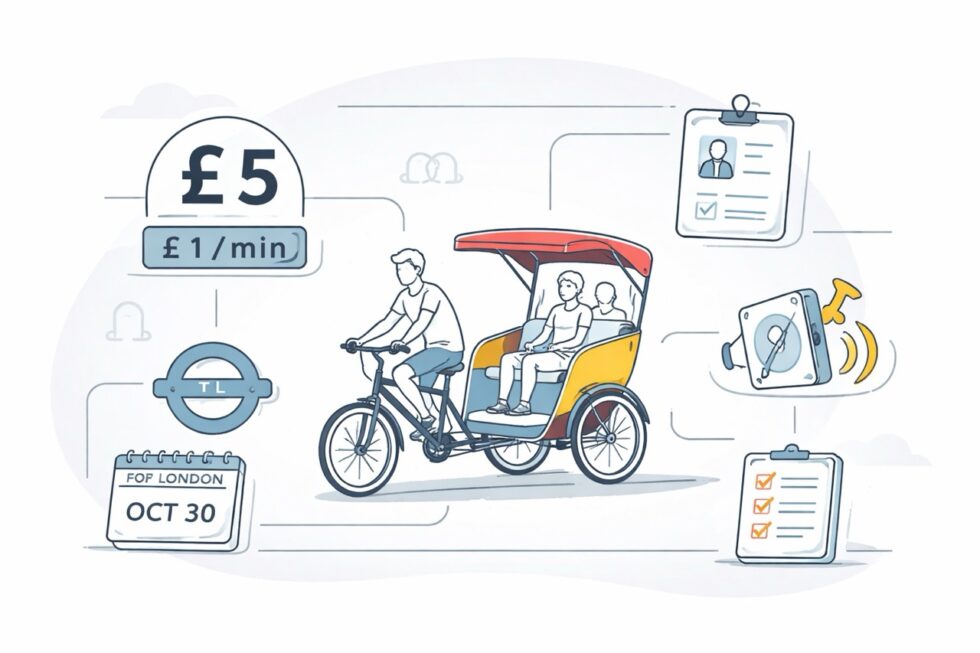
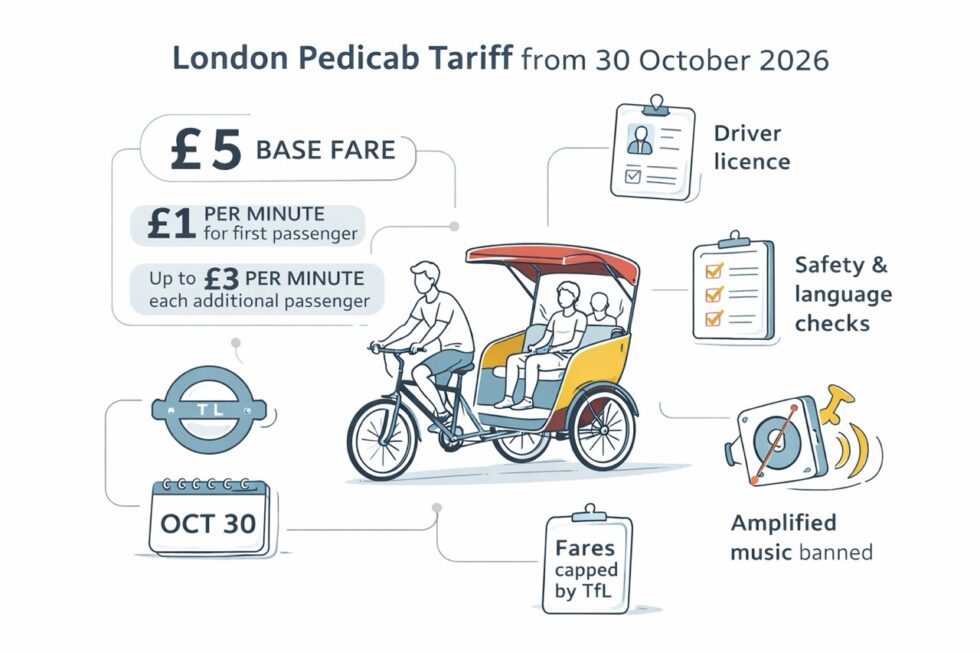
The London pedicab tariff in 2026 establishes fixed prices, defined start dates and enforceable standards for a sector that has operated for years without formal regulation. From 30 October 2026, pedicab journeys in London will be subject to a maximum base fare of £5 per ride, with an additional £1 per minute for the first passenger and up to £3 per minute for each additional passenger. The capped tariff is intended to end the long-standing practice of open-ended and unpredictable pricing that has repeatedly prompted complaints from passengers and residents.This is reported by The WP Times, citing BBC.
In London, pedicabs have long occupied a legal grey zone: highly visible in the West End and popular with tourists, yet largely unregulated in terms of fares, noise and driver standards. The term often searched as “London pedicab tariff” refers to how much passengers are charged for a ride and whether those prices are subject to legal control. Until now, the absence of binding rules has allowed some operators to set prices at their discretion, while concerns over amplified music, safety and aggressive behaviour have persisted in central areas, particularly late at night.
In 2026, that uncertainty is set to end. London is introducing its first comprehensive regulatory framework for pedicabs, covering fare caps, mandatory driver licensing, safety requirements and restrictions on amplified music. The measures follow years of political pressure and public criticism over excessive charges and disruption, and are designed to bring greater transparency, accountability and consumer protection to a previously unregulated part of the capital’s transport landscape.
Pedicabs, sometimes referred to as cycle rickshaws, are human-powered three-wheeled vehicles offering short-distance rides, mainly around Soho, Covent Garden, Leicester Square and Westminster. Unlike black cabs or private hire vehicles, pedicabs have historically fallen outside fare regulation and licensing regimes. This regulatory gap allowed some operators to charge passengers without displaying prices, a practice that has repeatedly drawn scrutiny in Parliament after cases in which tourists were billed hundreds of pounds for journeys lasting only minutes.
The push for reform gained momentum following sustained pressure from residents, local councils and the Mayor’s office. The new rules are being introduced by Transport for London, which will, for the first time, license pedicab drivers and vehicles and set mandatory fare limits. TfL has described the changes as a major step towards improving safety, fairness and professionalism within the sector.
Under the new system, drivers will be required to hold a TfL licence, meet English language requirements, pass safety assessments and hold at least a driving theory test certificate. Vehicles will also require separate licences and must meet defined safety and maintenance standards. A further key measure is the restriction of amplified music, long cited by residents as a source of late-night disturbance in central London.
Political backing for the reforms has been explicit. London Mayor Sadiq Khan said the new rules are intended to ensure pedicabs remain a safe and enjoyable way to explore the city without exposing passengers to unfair charges or unsafe practices. MPs representing central London constituencies have also welcomed the move as overdue.
The rollout will be phased. Driver licensing requirements and maximum fare caps will come into force from 30 October 2026, while vehicle licensing is scheduled for early 2027, allowing time for inspections and compliance. TfL says the staged approach is designed to minimise disruption while ensuring that unlicensed operators are gradually removed from the streets.
London pedicab tariff and licensing framework (2026–2027)
| Element | Rule | Timing |
|---|---|---|
| Base fare | £5 maximum per journey | From 30 October 2026 |
| Time charge | £1 per minute (first passenger) | From 30 October 2026 |
| Additional passengers | Up to £3 per minute | From 30 October 2026 |
| Driver licence | £114 per year | From 30 October 2026 |
| Vehicle licence | £100 per year | Early 2027 |
| Amplified music | Restricted | From 30 October 2026 |
| Safety & language checks | Mandatory | From 30 October 2026 |
For passengers, the impact is expected to be clearer pricing and greater accountability. For drivers, the changes introduce higher compliance costs but also formal recognition of pedicabbing as a regulated activity. TfL has stressed that pedicabs will remain distinct from black cabs and private hire vehicles, but that distinction no longer justifies the absence of basic consumer protections.
Read about the life of Westminster and Pimlico district, London and the world. 24/7 news with fresh and useful updates on culture, business, technology and city life: Why Is London Zipcar free parking being offered in 200 bays as Southwark tries to stop Zipcar leaving