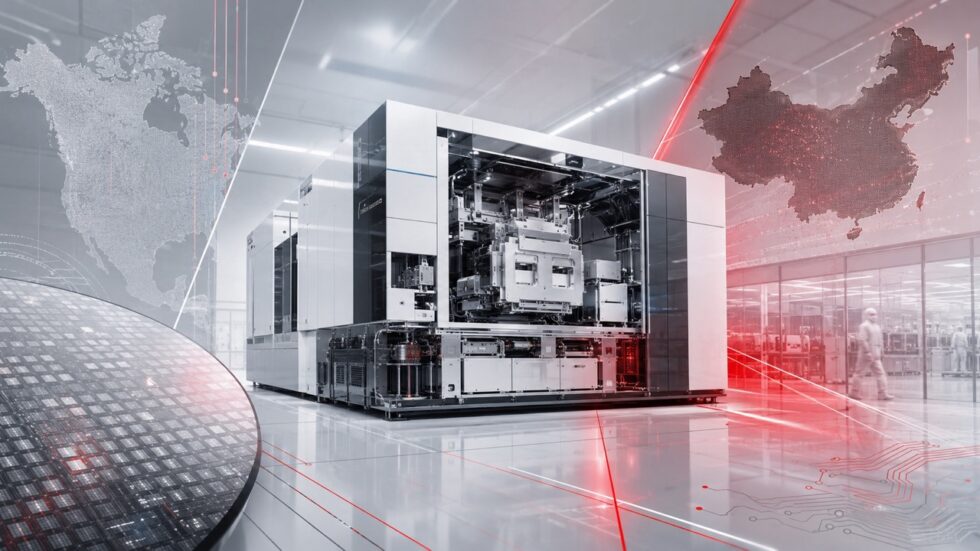
ASML has denied that one of its restricted EUV lithography systems or EUV-specific components may have reached China, after US officials reportedly raised concerns over a possible breach of semiconductor export controls, Westminster Pimlico News reports, citing NUME.ch and Reuters. The case, reported on 19 June 2026, puts fresh pressure on the Western system of chip controls because ASML is the only company in the world that can produce industrial EUV machines used for the most advanced semiconductor manufacturing.
The Dutch company said it had never shipped an EUV machine to China and had not supplied China with components, modules or equipment specifically designed for EUV use. The denial comes as Washington continues to limit Beijing’s access to high-end chipmaking technology used in artificial intelligence, high-performance computing and strategic industries, making any allegation involving ASML one of the most sensitive issues in the global semiconductor supply chain.
What Washington is concerned about
The US concern is not, at this stage, a publicly proven case of illegal export. According to the Reuters account of Bloomberg’s report, Washington is worried that one of ASML’s most advanced EUV lithography tools may have reached China in breach of US-led export restrictions. No public evidence has so far been presented showing that a complete EUV system is operating in China. ASML has rejected the allegation and said it has repeatedly refuted claims about non-compliance with export controls related to China.
The company’s denial is unusually direct. ASML said it had not shipped an EUV machine to China and had not shipped China any component, module or equipment specially designed for EUV use. That distinction matters because a modern lithography system is not a single movable device in the ordinary industrial sense. It is a vast technical platform requiring specialist components, installation, calibration, servicing and software support. For Washington, however, the question is broader: whether China has obtained, copied or accessed enough restricted technology to narrow the gap in advanced chip production. The US has spent years tightening controls on China’s access to advanced semiconductor technology. Earlier Reuters reporting said the US began pressing the Netherlands in 2018 to block ASML from selling EUV systems to China, with restrictions later expanding under broader export controls targeting advanced chips and chipmaking equipment. ASML has also previously told Reuters that no EUV system has ever been sold to a customer in China.
Why EUV machines matter
EUV stands for extreme ultraviolet lithography. The technology uses very short-wavelength light to print extremely small patterns on silicon wafers. These patterns allow chipmakers to produce more powerful and efficient processors. Without industrial EUV systems, manufacturing the most advanced chips at scale becomes significantly more difficult. ASML occupies a unique position in this supply chain. Its lithography technology is central to mass-producing semiconductor chips, and the company says it gives leading chipmakers the ability to create smaller, faster and more energy-efficient microchips. That makes ASML not only a commercial supplier, but also a strategic gatekeeper in the global race over artificial intelligence, data centres and defence-linked technologies.
China has been trying to reduce its dependence on Western chipmaking tools. Reuters reported in December 2025 that Chinese scientists in Shenzhen had built a prototype machine modelled on ASML’s EUV tools, but the existence of a prototype is not the same as industrial-scale chip production. The latest US concern therefore comes against a wider background: Beijing wants domestic lithography capability, while Washington wants to slow China’s access to the most advanced manufacturing equipment.
The numbers behind ASML’s strategic weight
ASML’s own 2025 figures show why the case has drawn immediate attention. The company reported total net sales of €32.7 billion, a gross margin of 52.8% and €4.7 billion in research and development spending. It sold 535 systems during the year.
| ASML 2025 figure | Reported number |
|---|---|
| Total net sales | €32.7bn |
| Gross margin | 52.8% |
| Net income | €9.6bn |
| R&D spending | €4.7bn |
| System sales | 535 |
| Total employees | More than 44,000 |
ASML also said total net sales increased by €4.4 billion to €32.7 billion in 2025, a 15.6% year-on-year rise. The company linked the growth to leading-edge foundry demand, AI-related capacity expansion and memory investment, including high-bandwidth memory and DDR5. These figures explain why any export-control dispute involving ASML is treated as a market and security issue. The company is a bottleneck in one of the world’s most valuable supply chains. Its customers include the major chipmakers that supply the processors used in AI servers, consumer electronics and advanced computing. A political dispute over access to ASML technology can therefore affect not only the company’s shares, but also investor confidence across the semiconductor sector.
Market reaction and political risk
ASML shares slipped after the report of US concern, according to the Wall Street Journal summary of market reaction. The stock initially fell by as much as 2.6% before recovering part of the loss. The reaction was limited, but it showed how sensitive investors are to any suggestion that export controls could tighten further or that ASML may face additional scrutiny from Washington. The larger risk is not only reputational. ASML still does business in China in areas not covered by the strictest EUV ban, including certain older-generation tools where licences permit sales. If US concerns lead to tighter rules on service, spare parts or less advanced lithography systems, the commercial impact could be broader than the current EUV dispute. Barron’s reported that China accounted for around a third of ASML’s 2025 sales and that ASML had previously projected China would represent about 20% of 2026 revenue.
For the Netherlands and the European Union, the case also creates a diplomatic problem. ASML is a European champion, but the strongest pressure on China-related controls has often come from Washington. If the US demands more proof, tighter licensing or broader restrictions, European authorities will face pressure to align security policy with American objectives while protecting one of Europe’s most valuable technology companies.
What remains unproven
The central point remains that no public evidence has been produced showing that an ASML EUV machine has been delivered to or is operating in China. ASML’s position is clear: it denies shipping any EUV machine to China and denies shipping EUV-specific components, modules or equipment there. Reuters reported that the company said it has adjusted its business to developments in export-control rules and complies with new regulations. The unresolved question is what information Washington believes it has. It is not publicly known whether US officials are relying on intelligence, trade records, technical signals, supplier information or a broader assessment of China’s domestic EUV development. It is also unclear whether the concern will lead to a formal investigation, new restrictions or additional compliance demands on ASML.
For now, the story is a high-stakes dispute between allegation and denial. The US concern is serious because EUV technology is one of the most controlled tools in the semiconductor industry. ASML’s denial is equally significant because the company says the alleged shipment did not happen. Until Washington produces public evidence or regulators announce formal action, the case remains a major export-control flashpoint rather than a proven breach.
FAQ
Did ASML ship an EUV machine to China?
ASML says no. The company told Reuters it had never shipped an EUV machine to China and had not shipped EUV-specific components, modules or equipment there.
Why is the allegation serious?
EUV lithography is needed to manufacture the most advanced chips. The US has sought for years to block China’s access to this technology because of its importance for AI, advanced computing and security-sensitive applications.
How big is ASML?
ASML reported €32.7bn in 2025 net sales, a 52.8% gross margin and €4.7bn in R&D spending.
Is there public proof that China has an ASML EUV machine?
No public proof has been presented in the reports cited so far. The story is based on reported US concerns, while ASML has issued a direct denial.
Read about the life of Westminster and Pimlico district, London and the world. 24/7 news with fresh and useful updates on culture, business, technology and city life: Xbox Showcase 2026 Delivers Major Reveals, Release Dates and a New Look at Gears of War: E-Day