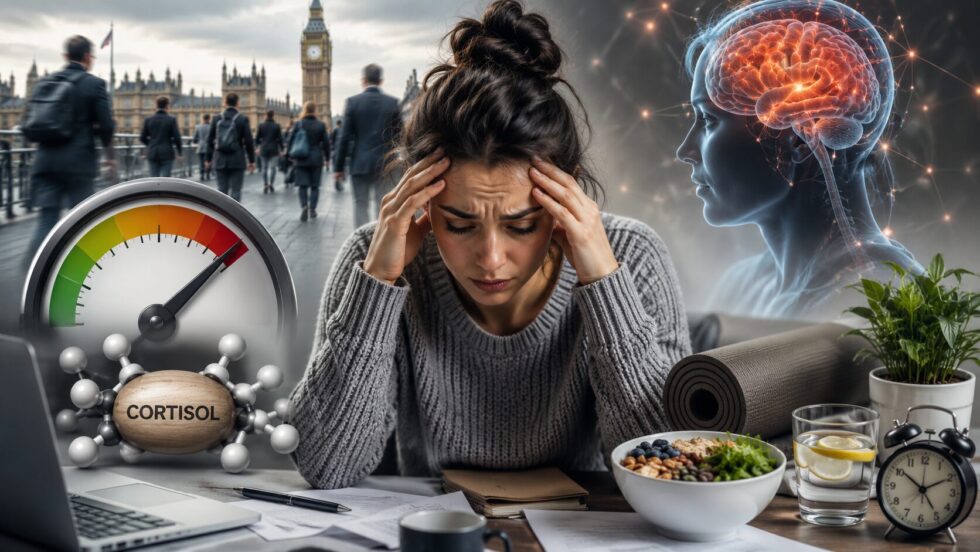
Cortisol sits at the centre of Britain’s growing stress problem. Almost a quarter of UK adults — 24 per cent — say they have felt so overwhelmed by stress that they were unable to cope, according to survey data collected for the Mental Health Foundation. Meanwhile, stress, depression and anxiety account for roughly half of all work-related ill health in Great Britain and an estimated 16.4 million lost working days each year, the Health and Safety Executive says, reports The WP Times.
The hormone has also become a convenient villain of the wellness industry, blamed for weight gain, poor sleep, facial puffiness and burnout, while supplements, “cortisol detoxes” and de-puffing devices promise quick solutions. Much of that marketing runs ahead of the evidence, but the underlying biology is real: chronically raised cortisol can affect both physical and mental health, and the most reliable ways to regulate it remain consistent sleep, regular movement, balanced meals and practical changes to the way stress is managed.
What Cortisol Actually Is
Cortisol is a glucocorticoid hormone produced by the adrenal glands, two small structures sitting above the kidneys. It is released under instruction from a chain of command known as the hypothalamic-pituitary-adrenal axis, or HPA axis. The hypothalamus detects a threat — physical, psychological or metabolic — and signals the pituitary gland, which in turn signals the adrenals to release cortisol into the bloodstream.
Its purpose is not to make you miserable. Cortisol is a survival hormone. Within minutes of release it raises blood glucose so muscles and brain have fuel, sharpens attention, suppresses non-urgent functions such as digestion and reproduction, and dampens inflammation. In an acute crisis this is exactly what a body needs. A person who could not mount a cortisol response would struggle to get out of bed, let alone escape danger. The problem is not cortisol. The problem is duration.
The Difference Between Acute and Chronic Elevation
An acute cortisol spike — missing a train, a difficult conversation, a hard sprint — is self-limiting. Cortisol rises, does its job, and a negative feedback loop tells the hypothalamus to stand down. The whole cycle resolves in perhaps sixty to ninety minutes.
Chronic elevation is different. When the perceived threat never resolves — an unmanageable workload, financial insecurity, a caring responsibility with no end date, six hours of sleep a night sustained across months — the feedback loop is repeatedly overridden. The system does not simply stay switched on; it becomes dysregulated. The daily rhythm flattens, the response to genuine stressors becomes blunted or exaggerated, and tissues that are constantly bathed in cortisol begin to respond differently. This distinction matters enormously for anyone trying to fix the problem. The goal is not to have less cortisol. It is to restore the shape of the curve.
The Cortisol Awakening Response
In a healthy system, cortisol follows a strong circadian pattern. It is at its lowest around midnight, begins climbing in the small hours, and surges sharply in the thirty to forty-five minutes after waking — a phenomenon researchers call the cortisol awakening response, or CAR. It then declines steadily across the day.
That morning surge is a feature, not a fault. It is what mobilises glucose, raises blood pressure and produces the shift from sleep to alertness. People with a flattened CAR — a curve that barely rises in the morning and fails to fall at night — consistently show worse outcomes in the research literature: more fatigue, poorer immune function, higher rates of burnout.
The practical implication is counter-intuitive. Someone who wakes exhausted, drags through the morning, and then feels wired at eleven at night does not necessarily have "too much cortisol". They have cortisol in the wrong place. Almost every intervention below works, at least in part, by restoring that curve.
Signs of High Cortisol
Recognising chronically elevated cortisol is complicated by the fact that its symptoms overlap with a dozen other conditions, from thyroid dysfunction to iron deficiency to ordinary poor sleep. What follows is a pattern-recognition guide, not a diagnostic tool.
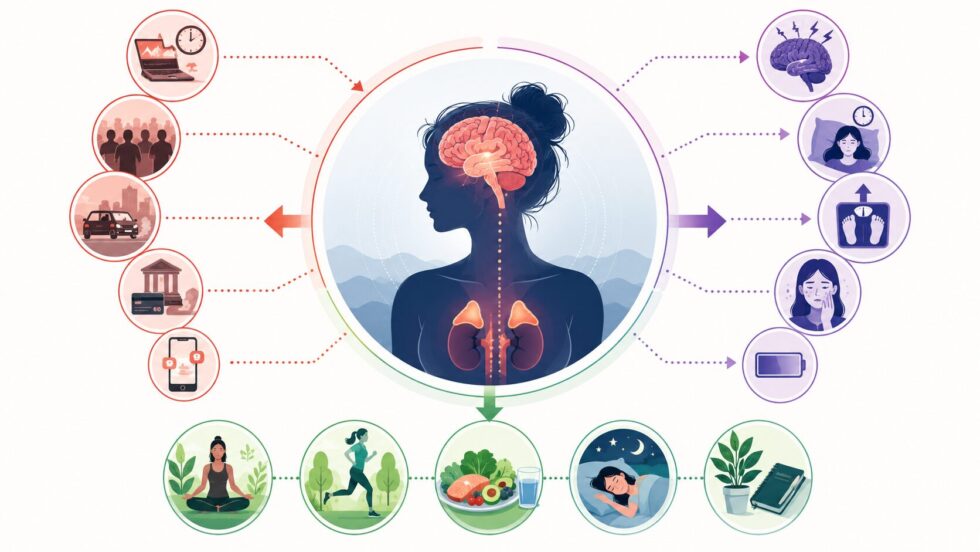
Physical Signs
Sleep that breaks in the early hours. The classic pattern is not difficulty falling asleep but waking at three or four in the morning, alert and unable to settle. This is often a cortisol curve that has drifted early.
Weight redistribution rather than weight gain. Cortisol preferentially drives fat storage in the abdomen and, in more marked cases, the upper back and face. Someone whose overall weight is stable but whose midsection has changed shape may be seeing a hormonal signal rather than a caloric one.
Persistent low-grade infections. Frequent colds, cold sores that recur, cuts that heal slowly. Cortisol suppresses immune function; sustained levels leave the system underpowered.
Muscle loss alongside fat retention. Cortisol is catabolic — it breaks tissue down for fuel. People under chronic stress frequently report that training that used to build strength now produces nothing.
Blood pressure creeping upward in the absence of other explanations, and blood glucose numbers drifting into pre-diabetic range on routine testing.
Cognitive and Emotional Signs
A shortened fuse. Disproportionate irritability at minor frustrations is one of the earliest and most reliable markers, and usually the one other people notice first.
Brain fog and word-finding difficulty. The hippocampus, central to memory formation, is dense with cortisol receptors and is measurably affected by prolonged exposure.
Anhedonia. Not sadness but flatness — the sense that things which used to be enjoyable now simply are not.
Tired but wired. Exhaustion coexisting with an inability to switch off. This is the single most characteristic subjective description of a dysregulated HPA axis.
When It Is Not Just Stress
A small number of people have a genuine endocrine disorder. Cushing's syndrome — caused by a tumour on the pituitary or adrenal gland, or by long-term steroid medication — produces markedly elevated cortisol and a distinctive presentation: purple stretch marks across the abdomen, a rounded face, a fatty pad between the shoulders, easy bruising, thin skin, and profound muscle weakness in the upper legs.
Cushing's is rare, affecting perhaps two to three people per million per year. But it is not something to manage with breathing exercises. Anyone with that constellation of symptoms should see their GP, who can request a 24-hour urinary free cortisol test, a late-night salivary cortisol test, or a dexamethasone suppression test.
The same applies in the opposite direction. Adrenal insufficiency — too little cortisol — presents with fatigue, weight loss, low blood pressure, salt cravings and darkened skin, and is a medical emergency when it decompensates. Fatigue alone is not a diagnosis.
The State of British Stress
The scale of the problem in the UK is not in dispute. The Health and Safety Executive's most recent labour force analysis found stress, depression or anxiety accounted for around 776,000 cases of work-related ill health and 16.4 million lost working days — approximately half of all work-related ill health in Great Britain and slightly more than half of all days lost.
The Mental Health Foundation's stress research found that 74 per cent of UK adults had, at some point in the previous year, felt so stressed they were overwhelmed or unable to cope. Money and work dominated the cited causes. Certain sectors carry more of it than others. HSE data consistently shows human health and social work, education, and public administration and defence reporting rates of work-related stress significantly above the all-industry average. Nurses, teachers and social workers are not imagining it. The demographic pattern is also consistent: reported stress is higher in women than men, higher in younger adults than older ones, and higher in those on lower incomes. The last of these is worth dwelling on, because it complicates every piece of lifestyle advice that follows. Chronic financial insecurity is one of the most potent HPA-axis stressors known, and it is not amenable to a breathing exercise. Where the advice below assumes a degree of control over one's own schedule, sleep environment and food budget, that assumption does not hold universally.
The Evidence-Based Interventions
What follows is ordered roughly by strength of evidence and size of effect, not by ease.
Sleep: The Non-Negotiable Foundation
No other intervention comes close. Sleep restriction is one of the few things reliably demonstrated to raise cortisol in controlled laboratory conditions, and the effect is dose-dependent. Restricting sleep to four to six hours a night produces measurable elevations in evening cortisol within days, alongside impaired glucose tolerance and increased hunger signalling.
The mechanism is straightforward: the HPA axis and the circadian clock are physically coupled. Disrupt one and the other follows.
What to do, in order of impact:
Fix the wake time before the bedtime. A consistent wake time anchors the circadian clock more powerfully than a consistent bedtime, because morning light exposure is the primary entraining signal. Waking at the same time seven days a week — yes, including Saturday — does more than any bedtime routine.
Get light into your eyes within an hour of waking. Ten to twenty minutes outdoors, without sunglasses, even under British cloud. Outdoor illuminance on an overcast day in Britain is typically 1,000 to 10,000 lux; a well-lit indoor room is perhaps 200 to 500. The difference is not marginal. In winter, when a January morning in London does not reach civil twilight until nearly eight o'clock, a 10,000-lux light box used for twenty to thirty minutes is a reasonable substitute and is the same technology used for seasonal affective disorder.
Drop the bedroom temperature. Core body temperature must fall by roughly one degree Celsius for sleep to initiate. The Sleep Council's guidance puts the optimal bedroom temperature at 16 to 18°C — considerably cooler than most British homes are heated. A hot bath ninety minutes before bed works by the same mechanism: peripheral vasodilation dumps core heat.
Reserve the bed for sleep. If you are awake for more than twenty minutes, get up. This is the core of cognitive behavioural therapy for insomnia (CBT-I), which is recommended by NICE as first-line treatment ahead of medication, and which is available free through the NHS in many areas via digital programmes such as Sleepio.
Movement: The Dose Matters More Than the Type
Exercise has a genuinely paradoxical relationship with cortisol. A hard training session raises it acutely — that is the point, it is a stressor. But regular moderate exercise lowers resting cortisol and, more importantly, improves the recovery speed of the whole axis.
The dose-response curve is an inverted U. Too little and nothing improves. Too much, particularly high-intensity work in someone already sleep-deprived and under-recovered, and cortisol goes the wrong way. Overtraining syndrome in endurance athletes is, in part, an HPA-axis disorder.
The practical version:
- Zone 2 cardio — brisk walking, easy cycling, anything at a pace where conversation remains possible — for 150 minutes a week, which is the UK Chief Medical Officers' baseline recommendation anyway. This is the highest-return, lowest-cost cortisol intervention in the movement category.
- Resistance training twice weekly. Counters the catabolic effect on muscle and improves insulin sensitivity, which matters because cortisol and insulin resistance reinforce one another.
- Walking after meals. Ten to fifteen minutes after eating blunts the post-prandial glucose spike, and glucose volatility is itself a cortisol trigger.
- Cap high-intensity work at two sessions a week if you are sleeping badly. A person running on five hours of sleep who adds four HIIT sessions is not building resilience; they are compounding a stressor.
Timing helps at the margins. Morning exercise reinforces the natural cortisol peak and supports the circadian curve. Hard training within three hours of bed can delay sleep onset in sensitive individuals — though for anyone whose only realistic training window is nine at night, evening exercise still beats none.
Caffeine: The One Most People Get Wrong
Caffeine raises cortisol. This is well-established and not seriously disputed. Doses in the range of 200 to 300 milligrams — roughly two to three cups of coffee — produce measurable increases in circulating cortisol, and the effect is larger in people under psychological stress. Habitual consumers develop partial tolerance to this, but it does not disappear entirely. The problem is not usually total intake. It is timing on two axes.
The morning axis. Drinking coffee immediately on waking stacks caffeine's effect on top of the natural cortisol awakening response — the moment the body is already at peak alertness. Delaying the first coffee by ninety minutes to two hours means the caffeine arrives as the CAR is subsiding, which is when it is genuinely useful, and it reduces the reflexive escalation of dose that comes from drinking coffee when it is doing nothing.
The evening axis. Caffeine's half-life is around five to six hours in most adults, but the variation is enormous — genetic differences in the CYP1A2 enzyme mean some people clear it in three hours and others in nine. A coffee at four in the afternoon can still have a quarter of its dose circulating at ten at night for a slow metaboliser. The practical rule is a hard cut-off eight hours before bed, which for most British working patterns means nothing after two in the afternoon.
A meaningful proportion of people who describe themselves as chronically stressed are, in substantial part, describing a caffeine-and-sleep loop: poor sleep drives caffeine consumption, caffeine degrades sleep, and cortisol dysregulation sits in the middle.
Alcohol: The Sedative That Is a Stressor
Alcohol is widely used in Britain as a stress management tool and is one of the worst available. It is a direct HPA-axis activator — acute intake raises cortisol, and the elevation persists into the following day. Simultaneously it fragments sleep architecture, suppressing REM in the first half of the night and producing rebound wakefulness in the second. The three-in-the-morning wake-up after an evening's drinking is a textbook cortisol-and-rebound phenomenon. The UK Chief Medical Officers' guideline is no more than 14 units a week for both men and women, spread across three or more days, with several drink-free days. From a cortisol perspective, the spread matters as much as the total: four units on each of three nights is measurably less disruptive than twelve units on a Saturday. For anyone using alcohol specifically to unwind after work — a common and entirely understandable pattern — this is the intervention with the largest gap between perceived benefit and actual effect.
Breathing: The Fastest-Acting Lever
Of everything on this list, controlled breathing is the only intervention that works within minutes, and it is the one with the lowest barrier to entry. The mechanism is vagal. Slow, extended exhalation stimulates the vagus nerve, which activates the parasympathetic nervous system and directly opposes the sympathetic "fight or flight" state that drives cortisol release. This is not mysticism; it is measurable in heart rate variability within a single breath cycle.
The evidence base has strengthened considerably. A randomised controlled trial published in Cell Reports Medicine in 2023 compared three breathwork protocols against mindfulness meditation over one month and found that "cyclic sighing" — a double inhale through the nose followed by a long, slow exhale through the mouth — produced the greatest improvement in mood and the largest reduction in respiratory rate, outperforming meditation on those measures.
Two protocols worth knowing:
The physiological sigh. Two short inhales through the nose, one immediately after the other, followed by a long slow exhale through the mouth. One to three repetitions drops acute arousal within thirty seconds. This is the tool for the moment before a difficult meeting.
Extended exhale breathing. Inhale for four counts, exhale for eight. Five minutes daily. The rule is simply that the exhale must be longer than the inhale — the exact numbers are less important than the ratio.
Five minutes is enough. This is a case where consistency beats duration by a wide margin.
Nutrition: Glucose Stability Over Everything
The nutritional advice in this space is heavily contaminated by supplement marketing. The signal in the noise is narrower than the industry would like.
Blood glucose volatility is a cortisol trigger. When glucose crashes, the body releases cortisol to mobilise stored energy. Someone eating a high-refined-carbohydrate breakfast, crashing at eleven, and eating again is riding a hormonal rollercoaster several times daily. Protein at breakfast — 25 to 30 grams — flattens that curve more effectively than any supplement.
Chronic under-eating is a stressor. This is the point most often missed. Aggressive caloric restriction raises cortisol; it is a physiological emergency signal. People simultaneously dieting hard, training hard and sleeping badly frequently cannot understand why their stress markers are worsening.
Omega-3s have modest, real support. Several trials show attenuated cortisol response to acute stress with supplementation in the range of 2 grams EPA/DHA daily. The effect is not dramatic. Two portions of oily fish a week — the NHS recommendation — is a reasonable target before considering capsules.
Magnesium is genuinely common to be short of, and genuinely oversold. The UK reference nutrient intake is 300mg daily for men and 270mg for women, and British dietary surveys show a meaningful minority falling below the lower reference intake, particularly younger women. If you are deficient, correcting it helps sleep and stress markers. If you are not, supplementing does very little. Green leafy vegetables, nuts, seeds and wholegrains first.
Adaptogens: the honest position. Ashwagandha has the most credible evidence of the herbal category, with several small randomised trials showing reductions in serum cortisol in the region of 20 to 30 per cent alongside improved subjective stress scores. The trials are mostly small, several are industry-funded, and duration is typically eight to twelve weeks. It is not nothing — but it is not a substitute for sleep, and it interacts with thyroid medication and immunosuppressants. Anyone on regular medication should speak to a pharmacist before starting it.
Social Contact and Nature
Two interventions that are easy to dismiss as soft and are not.
Loneliness is an independent predictor of HPA dysregulation, and the effect size is not small. Positive social contact — genuine contact, not notifications — measurably reduces cortisol reactivity to subsequent stressors. Time in green space produces reliable cortisol reductions in field studies, including several conducted in UK urban environments. The threshold that recurs in the literature is around 120 minutes a week, in any distribution — a single long walk or six short ones. For most British city-dwellers this is achievable without any structural life change, which is more than can be said for most of this list.
Comparison Table: What Works, How Fast, How Well
| Intervention | Time to Effect | Strength of Evidence | Effort Required | Cost |
|---|---|---|---|---|
| Extended-exhale breathing | Minutes | Moderate–strong (RCT-supported) | Very low | Free |
| Consistent wake time | 1–2 weeks | Strong | Moderate | Free |
| Morning light exposure | 1–2 weeks | Strong | Low | Free (or £40–120 for a light box) |
| Sleep extension to 7–9 hours | 1–2 weeks | Very strong | High | Free |
| Caffeine timing (delay + cut-off) | 3–7 days | Moderate–strong | Low | Free |
| Reducing alcohol | 1–2 weeks | Strong | Moderate–high | Saves money |
| Zone 2 cardio, 150 min/week | 4–8 weeks | Strong | Moderate | Free |
| Resistance training, 2×/week | 8–12 weeks | Moderate–strong | Moderate | Free–£40/month |
| Protein-forward breakfast | 1–2 weeks | Moderate | Low | Neutral |
| 120 min/week in green space | 2–4 weeks | Moderate | Low | Free |
| CBT-I (for insomnia) | 4–8 weeks | Very strong | Moderate | Free on NHS in many areas |
| Omega-3 supplementation | 8–12 weeks | Moderate | Very low | £8–20/month |
| Magnesium (if deficient) | 2–4 weeks | Moderate if deficient; weak if not | Very low | £5–15/month |
| Ashwagandha | 8–12 weeks | Weak–moderate; small trials | Very low | £10–25/month |
| "Cortisol detox" protocols | — | None | Varies | Varies |
The ordering carries the message. Everything with strong evidence at the top of the table is free. Everything that costs money sits in the moderate-to-weak band. That is not a coincidence, and it is worth remembering the next time an advertisement suggests otherwise.
A Seven-Day Starting Protocol
Attempting all of the above simultaneously is itself a stressor. What follows is a sequenced version, designed so each day adds one thing and keeps it.
Day 1 — Fix the wake time. Choose a wake time that works seven days a week and set it. This is the anchor for everything else. Do not change the bedtime yet.
Day 2 — Add morning light. Ten to twenty minutes outdoors within an hour of waking. Walk to get a coffee rather than making one at home if that is what it takes. Keep the wake time.
Day 3 — Move the coffee. Delay the first caffeine to ninety minutes after waking, and set a hard cut-off eight hours before bed. Keep days 1 and 2.
Day 4 — Add the breathing. Five minutes of extended-exhale breathing, at the same point each day — the commute, the moment the front door closes after work. Keep days 1 to 3.
Day 5 — Change breakfast. 25 to 30 grams of protein. Eggs, Greek yoghurt, leftover meat, a decent protein shake if mornings are chaotic. Keep days 1 to 4.
Day 6 — Add the walk. Thirty minutes at conversational pace. Outdoors if at all possible, which stacks it with the green-space effect. Keep days 1 to 5.
Day 7 — Audit the alcohol. Look honestly at the week's units and the pattern. If the answer is "four glasses on three evenings to switch off after work", that is the next target, and it is best approached by replacing the function rather than removing the substance.
Then hold all seven for a fortnight before adding anything else. The single most common failure in this area is the person who overhauls everything on a Monday and has abandoned all of it by the following Sunday.
What Does Not Work
Worth stating plainly, because the market is loud.
"Cortisol detoxes" and "cortisol face" protocols. Cortisol is not a toxin and cannot be detoxed. Facial puffiness has many causes — salt, alcohol, sleep position, allergy — and attributing it to cortisol is a marketing move, not a diagnosis.
Home saliva or hair cortisol test kits sold direct to consumers. Cortisol varies by an order of magnitude across a single day. A single reading is close to meaningless without the timing controls, reference ranges and clinical context that a properly requested test provides. These kits reliably produce anxiety, which is not an obvious therapeutic win.
Adrenal fatigue. The claim that chronic stress "exhausts" the adrenal glands into underproduction is not supported by evidence. A 2016 systematic review in BMC Endocrine Disorders assessed 58 studies and concluded there was no substantiation for adrenal fatigue as a medical condition. The symptoms people describe are real. The proposed mechanism is not, and the label frequently delays diagnosis of conditions that are — thyroid dysfunction, anaemia, sleep apnoea, depression.
Cold plunges as a cortisol treatment. Cold water immersion is an acute stressor and raises cortisol. There may be benefits — mood, inflammation, the psychological value of doing something difficult before eight in the morning — but lowering cortisol is not among them. Anyone plunging specifically for cortisol is doing the opposite of what they intend.
When to See a GP
Lifestyle change is appropriate for ordinary stress. It is not appropriate as a substitute for assessment when the picture suggests something else. Book an appointment if:
- Symptoms have persisted more than a few months without improvement despite genuine changes to sleep and workload
- There are purple or reddish stretch marks across the abdomen, easy bruising, or marked muscle weakness in the thighs
- Blood pressure or blood glucose readings are rising
- There is unexplained weight loss, dizziness on standing, or skin darkening
- Sleep is broken most nights for more than three months — NICE recommends CBT-I first-line, and a GP can refer
- Low mood, anxiety or hopelessness are present most days, or there is any thought of self-harm
On that last point: NHS 111 offers a 24-hour mental health option, and Samaritans can be reached free on 116 123 at any hour.
A GP consultation for suspected cortisol dysfunction will typically involve blood pressure, HbA1c, thyroid function and full blood count before any cortisol testing, precisely because those conditions are far more common and present similarly.
Frequently Asked Questions
How long does it take to lower cortisol? Acute reduction from breathing takes minutes. Restoring a disrupted circadian curve typically takes one to two weeks of consistent wake times and morning light. Structural changes from exercise and improved fitness show at eight to twelve weeks. Anyone promising results in three days is selling something.
Can you test your cortisol at home? Direct-to-consumer kits exist, but a single reading is difficult to interpret without timing controls and clinical reference ranges, and results frequently cause more anxiety than they resolve. If there is genuine reason to suspect a disorder, a GP can request a 24-hour urinary free cortisol test, a late-night salivary test or a dexamethasone suppression test, all with proper interpretation attached.
Does cortisol cause weight gain? Chronically elevated cortisol drives fat storage toward the abdomen and increases appetite, particularly for energy-dense food, and it promotes muscle breakdown. It is a genuine contributor to body composition change rather than a primary cause of weight gain in isolation. It is also not a reason to stop eating — under-eating raises cortisol.
Is coffee bad for cortisol? Caffeine raises cortisol, with tolerance developing partially in habitual users. For most people the fix is timing rather than abstinence: delay the first cup ninety minutes after waking and stop eight hours before bed.
Does ashwagandha actually work? Several small randomised trials show reductions in serum cortisol of roughly 20 to 30 per cent over eight to twelve weeks. The evidence is real but limited by small sample sizes and industry funding, and it is far weaker than the evidence for sleep. It interacts with thyroid medication and immunosuppressants; check with a pharmacist first.
What is adrenal fatigue? It is not a recognised medical diagnosis. A 2016 systematic review found no evidence supporting it. The symptoms attributed to it are real and deserve investigation — but under a different heading.
Do cold plunges lower cortisol? No. Cold water immersion acutely raises cortisol. It may have other benefits, but this is not one of them.
The uncomfortable truth about cortisol is that the interventions with the strongest evidence are the ones nobody wants to hear, and the ones being actively marketed are the ones with the least support behind them. Sleep, light, movement, timing, and reducing the caffeine and alcohol used to paper over the first four — that is the list. It is free, it is unglamorous, and it works. The second uncomfortable truth is that a substantial proportion of British stress is structural rather than personal. Someone working two jobs to cover rent, or caring for a parent without support, is not experiencing a lifestyle deficit. No breathing protocol resolves an unmanageable workload, and it is worth being honest that the advice above is more available to some people than others.Within that constraint, though, the curve is more modifiable than most people assume. The body is not trying to sabotage anyone. It is responding, accurately, to the information it is given about how safe the world is. Most of the work is in changing the information.
This article is for general information and does not constitute medical advice. Anyone concerned about their health should consult a GP or NHS 111.
Read about the life of Westminster and Pimlico district, London and the world. 24/7 news with fresh and useful updates on culture, business, technology and city life: How can UK fans reach Tomorrowland and PAROOKAVILLE 2026 from London