
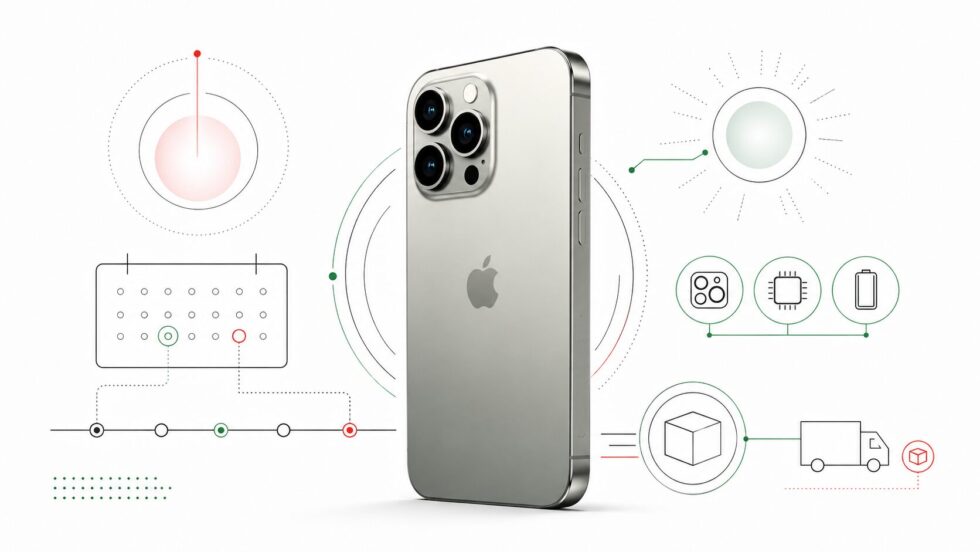
The iPhone 18 Pro release date is shaping up for mid-September 2026, with the unveiling expected in the second week of the month and the on-sale date across the UK and Ireland likely falling on 18 or 25 September — that's the picture The WP Times has pieced together from supply-chain and analyst reports by MacRumors, Macworld and PhoneArena. Apple is sticking to the autumn rhythm it has kept for nearly a decade, but in 2026 it is overhauling the strategy behind that date, leaving shoppers from London to Edinburgh and Dublin facing a choice they've never had before.
For the first time, Apple is splitting the iPhone line across the calendar: only the pricier iPhone 18 Pro, iPhone 18 Pro Max and the first foldable iPhone will reach shelves in autumn 2026, while the cheaper iPhone 18 and iPhone 18e are held back until spring 2027. Anyone wanting to upgrade on the usual September cadence is therefore funnelled straight towards a Pro handset — and its steep price. This guide sets out exactly when the phone arrives, what it's expected to do, what it could cost on EE, Vodafone and Three, and whether holding out actually makes sense.
iPhone 18 Pro release date: the key dates at a glance
Apple hasn't confirmed anything officially. But the pattern of recent years pins the date down with surprising precision. Apple traditionally reveals new iPhones on a Tuesday in the second week of September, opens pre-orders that Friday, and ships the first units the following Friday. Mapped onto 2026, that means a keynote around 8–15 September, pre-orders shortly after, and an on-sale date of 18 or 25 September.
| Event | Expected date 2026 | Status |
|---|---|---|
| Apple keynote | Week of 8–15 September | Expected |
| Pre-orders open | Friday after the keynote | Expected |
| On sale (UK & Ireland) | 18 or 25 September | Expected |
| Available on EE / Vodafone / Three | from launch day | Expected |
| iPhone 18 / 18e (standard models) | Spring 2027 | Delayed |
The good news for British and Irish buyers: the UK and Ireland sit firmly in Apple's first launch wave, on the same day as the US, Germany and France. There's no risk of the weeks-long wait smaller markets sometimes face. Even so, pre-ordering matters — popular colours and the larger storage tiers routinely slip to multi-week delivery estimates within minutes of pre-orders opening.
Why Apple is changing tack in 2026
The break with tradition is the real story behind the date. Rather than showing the whole iPhone family in September, Apple is sending only its flagship trio into autumn. The logic is straightforward: the Pro models and the first foldable carry the bulk of the new technology, deserve the undivided attention of the press and the public, and shouldn't be diluted by a cheaper standard model launching alongside them.
For UK and Irish shoppers, the consequence is blunt. If you want a brand-new iPhone this autumn, you'll be reaching for a Pro or the foldable. A more affordable option simply won't exist in that window — which pushes the whole price conversation upward and makes trade-in, contract choice and refurbished stock far more important.
The models arriving in September 2026
Three of Apple's most expensive iPhones go on sale together this autumn. A classic entry-level model is absent entirely.
- iPhone 18 Pro — 6.3-inch display, the more compact of the two Pro models
- iPhone 18 Pro Max — 6.9-inch display, biggest battery, highest price
- Foldable iPhone (rumoured as iPhone Fold or iPhone Ultra) — likely well beyond £2,000
The iPhone 18 and iPhone 18e arrive as cheaper alternatives only in spring 2027. So anyone deliberately keeping spend down has just two autumn routes: last year's iPhone 17 at a discount, or a quality refurbished handset.
What's new on the iPhone 18 Pro? The upgrades that matter
A fresh date alone wouldn't be headline news. What makes the iPhone 18 Pro interesting is a hardware jump larger than the average in-between year.
A20 Pro: Apple's first 2nm chip
At the heart sits the A20 Pro, Apple's first processor built on a 2-nanometre process. The number refers to how small the transistors on the chip are: the smaller they get, the more computing power fits in the same space, and the more efficiently the whole thing runs. Reports point to roughly 15 per cent more speed and around 30 per cent better energy efficiency over the current A19 Pro — a noticeably bigger step than recent years, where gains often sat in single digits.
You'll feel it most in heavy lifting: photo editing, gaming, and the AI features that increasingly run directly on the device rather than in the cloud. If you keep a phone four or five years, that efficiency headroom is what pays off longest.
A variable-aperture camera
The standout upgrade for photographers is the variable aperture on the 48-megapixel main camera. Until now the iPhone's aperture has been fixed; in future the opening can be adjusted, giving direct control over depth of field. In plain terms: a wide aperture for a soft, blurred background that isolates your subject, or a narrow one to keep everything sharp front to back — handy for a skyline shot across the Thames, the Giant's Causeway, or the view from Arthur's Seat.
The module is expensive: supply-chain analysts say Apple is paying around 50 per cent more for it than the previous camera unit. It's particularly valuable for video, where it lets you control motion blur without screwing on extra filters.
Smaller Dynamic Island and new colours
Apple is moving a Face ID component beneath the display, shrinking the Dynamic Island noticeably and leaving a calmer screen with less interruption at the top. Face ID won't disappear fully under the glass yet — that step has been pushed to a later year.
On colour, the signs point to a deep crimson called "Dark Cherry" as the new signature shade, replacing last year's bold orange, alongside light blue, dark grey and silver. A classic black is again unlikely.
C2 modem and the best battery life yet
The iPhone 18 Pro gets Apple's first fully in-house C2 modem, replacing the Qualcomm part used until now. Apple's modems have proven efficient in earlier handsets; the C2 is expected to build on that and handle fast mmWave 5G. Paired with the leaner 2nm chip, the result is the longest battery life ever put in an iPhone, with a slightly larger cell than the iPhone 17 Pro too.
There's a privacy bonus for the cautious: the C2 supports a setting that shares only your approximate location with mobile networks rather than a precise fix.
Display and build
Screen sizes stay at 6.3 and 6.9 inches. Apple is reportedly pushing higher peak brightness, which helps readability in direct sun — useful whether you're on the terraces, on the hills, or just caught out by a rare bright day. The rear glass panel for MagSafe wireless charging is also being made more uniform, after the two-tone look of the iPhone 17 Pro divided opinion.
What will the iPhone 18 Pro cost in the UK
There are no official prices yet, and this is where a level head helps. Analyst Ming-Chi Kuo expects Apple to hold pricing steady and absorb rising memory costs itself to protect market share. Others, citing a global memory squeeze, anticipate modest increases. Current UK deals give a useful benchmark.
On Vodafone and EE, the iPhone 17 Pro currently runs on pay-monthly plans with the device cost spread over 24 or 36 months at 0% APR, with trade-in savings of up to around £439 on an eligible handset. The iPhone 17 Pro launched at £1,099 SIM-free; the Pro Max started higher and the 2TB range topped the line-up. A similar or slightly higher entry point is most likely for the iPhone 18 Pro.
| For reference (iPhone 17 Pro) | UK pricing |
|---|---|
| iPhone 17 Pro, SIM-free from | ~£1,099 |
| Pay-monthly term | 24 or 36 months, 0% APR |
| Trade-in saving (eligible iPhone) | up to ~£439 |
| Storage range | 256GB – 2TB |
In Ireland, expect euro pricing in line with the rest of the eurozone, typically a little above the straight pound conversion once VAT is applied. Beyond the networks, SIM-free stock comes from Apple directly, plus Currys, Argos and John Lewis in the UK and Harvey Norman in Ireland. Refurbished and customer-return units, covered by a 12-month warranty from most retailers, remain the simplest way to cut the cost.
Practical buying tips
Apple's split launch makes 2026 a year to plan ahead. Weigh these before you commit:
- Diarise the pre-order. Popular colour and storage combinations sell out within minutes. To get a launch-day delivery, be ready when pre-orders open — Apple account signed in, payment details saved.
- Do the contract maths. A pay-monthly plan spreads the high upfront cost but usually locks you in for 24 months. Buying SIM-free plus a separate, cancellable data SIM often works out cheaper and more flexible.
- Use trade-in. A well-kept iPhone 14 or newer cuts the price noticeably. Check the residual value first — third-party buyers sometimes pay more than Apple's trade-in scheme.
- Pick storage realistically. Heavy 4K filming or making full use of the new variable-aperture camera points to 512GB. For everyday use with cloud backup, 256GB is plenty.
- Wait for the standard model — or don't. If a Pro budget is a stretch, the iPhone 18 in spring 2027 is the cheaper play. If you need a phone now, a discounted iPhone 17 is usually the most sensible buy.
Is it worth waiting? An honest verdict
For anyone on an iPhone 14 or older, the position is clear: this autumn the Pro is effectively the only new iPhone on the shelves, and the leap in chip, camera and battery is big enough to justify the outlay.
If you already own an iPhone 17 Pro, relax. The improvements are real but not a year-on-year must-buy. And if you're determined to save, it's worth seriously weighing the spring 2027 iPhone 18 or a discounted previous model against the Pro's premium.
Frequently asked questions about the iPhone 18 Pro release date
When does the iPhone 18 Pro come out in the UK and Ireland?
The unveiling is expected in mid-September 2026, with an on-sale date of 18 or 25 September — the same day as the US.
Is the cheaper iPhone 18 launching at the same time?
No. The standard iPhone 18 and iPhone 18e are expected only in spring 2027.
What new features does the iPhone 18 Pro bring?
The first 2nm A20 Pro chip, a variable-aperture main camera, a smaller Dynamic Island, the new C2 modem and the best battery life yet.
What new colour is coming?
"Dark Cherry," a deep crimson, is tipped as the signature shade, replacing last year's orange.
What will the iPhone 18 Pro cost?
Prices aren't confirmed. Analysts expect a steady-to-slightly-higher level; for reference the iPhone 17 Pro started at £1,099 SIM-free.
Is it worth waiting for the iPhone 18 Pro?
For iPhone 14 owners and older, yes — it's the only new iPhone this autumn. iPhone 17 Pro owners can comfortably skip it.
All details are based on supply-chain reports and leaks; Apple has not officially confirmed them.
Read about the life of Westminster and Pimlico district, London and the world. 24/7 news with fresh and useful updates on culture, business, technology and city life: ASML denies China EUV claim as US scrutiny puts chip export controls under pressure