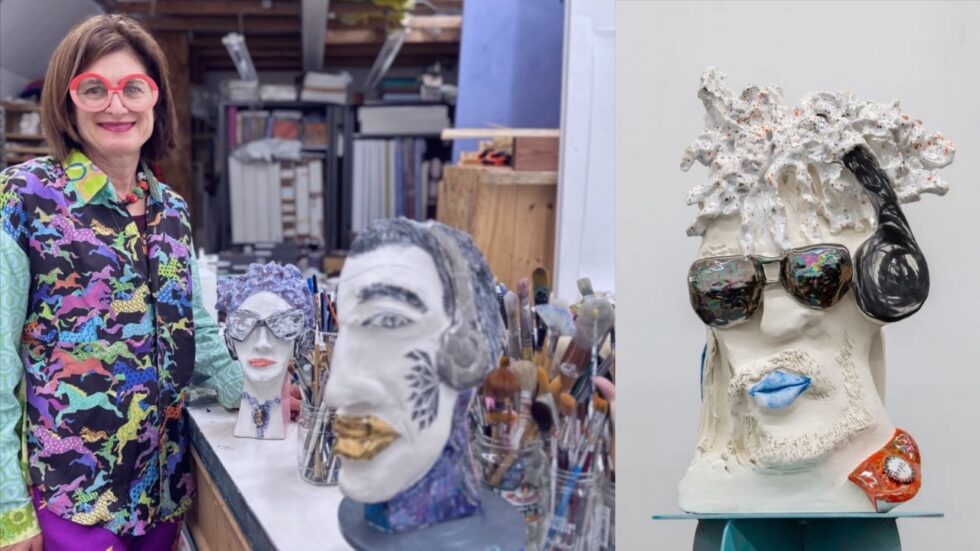
From 16 April to 15 May 2026, a new free exhibition in London presents the latest work of Kimberley Gundle at Long & Ryle Gallery in Pimlico. Titled “My Head Is a Fairground”, the solo show brings together ceramic sculpture, works on paper and sculptural objects to examine how individuals process instability, routine and emotional fluctuation through everyday observation. Staged within London’s independent gallery sector, the exhibition is open to the public without admission fees, reports The WP Times.
Kimberley Gundle: London practice rooted in observation and real people
Kimberley Gundle builds her work on direct observation rather than constructed concepts. Trained at the Slade School of Fine Art, she developed a figurative approach grounded in lived encounters. Between 2009 and 2017, she worked in Maasai communities in Kenya and Tanzania, producing drawings and photographic studies that later informed installations shown at the Venice Biennale (Palazzo Bembo, 2013, 2015, 2017). These projects combined close observation with a focus on identity and visual culture. From 2018, her focus shifted back to London. She began sketching daily on the Underground, documenting commuters and transient encounters. These drawings now form the basis of her sculptural work.
My Head Is a Fairground exhibition: structure, materials and key works
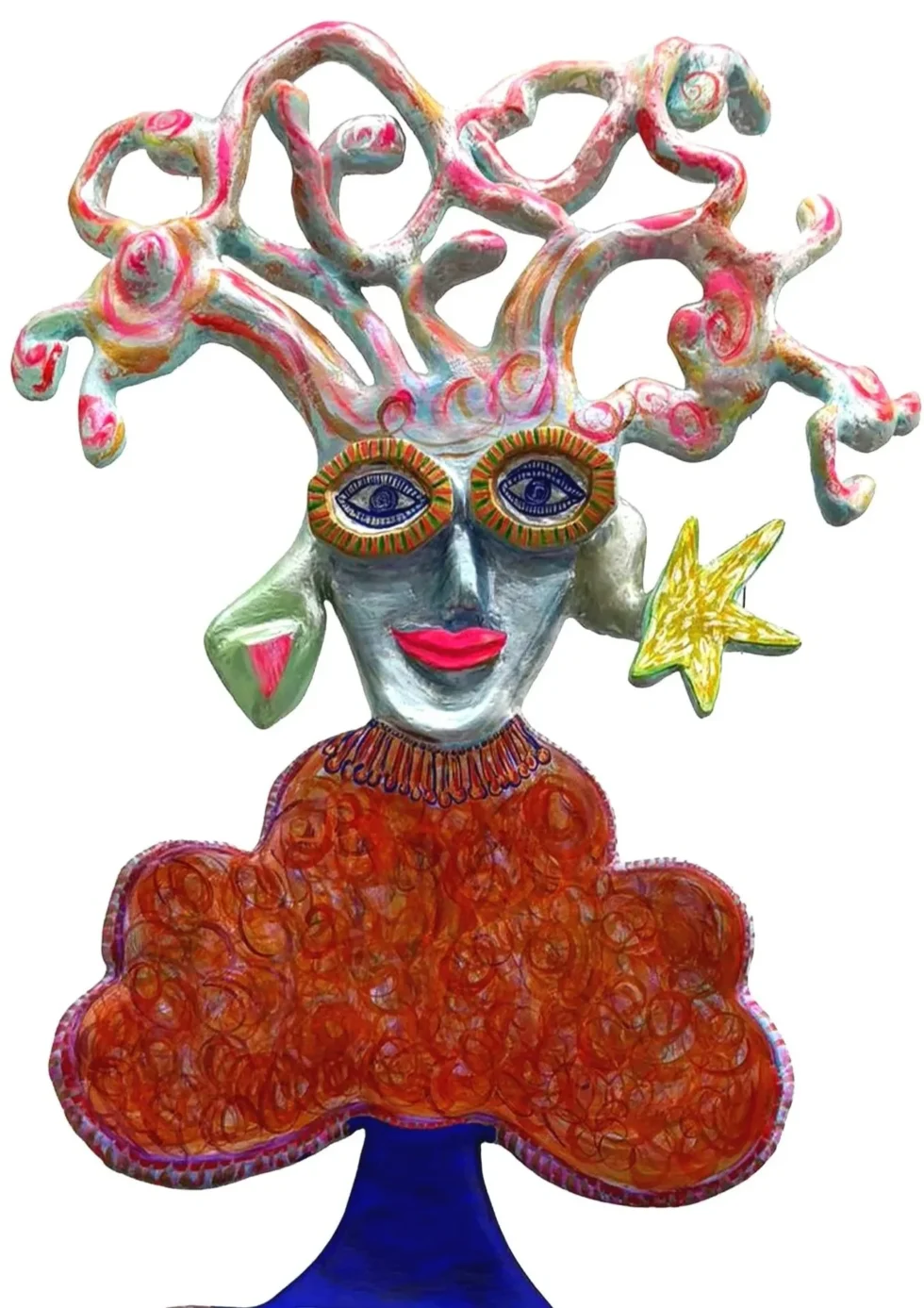
“My Head Is a Fairground” is organised around a clear idea: the mind is not stable, but constantly shifting under external and internal pressures. The exhibition is structured across three formats:
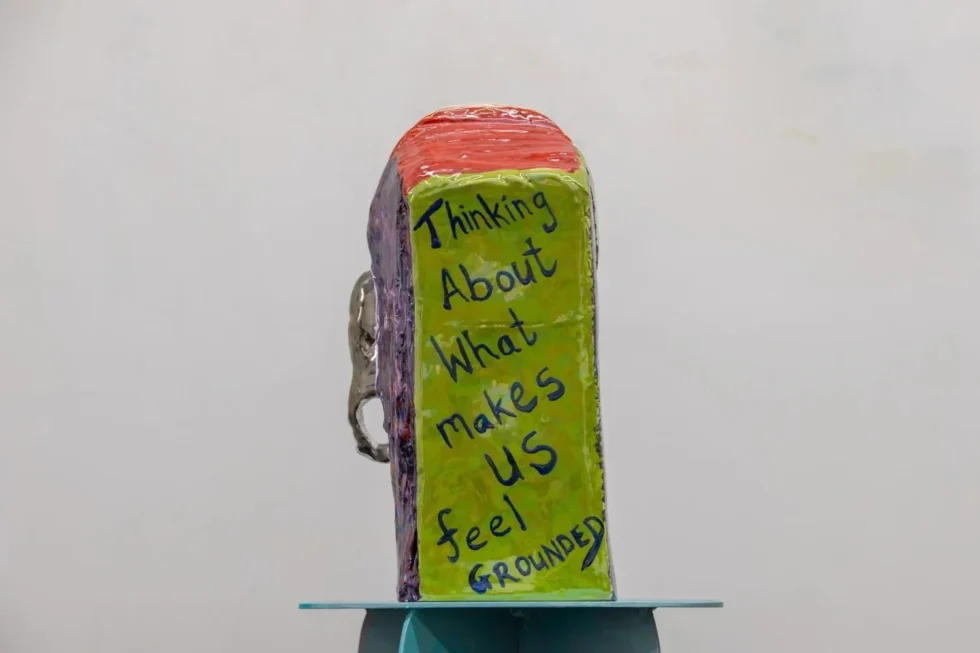
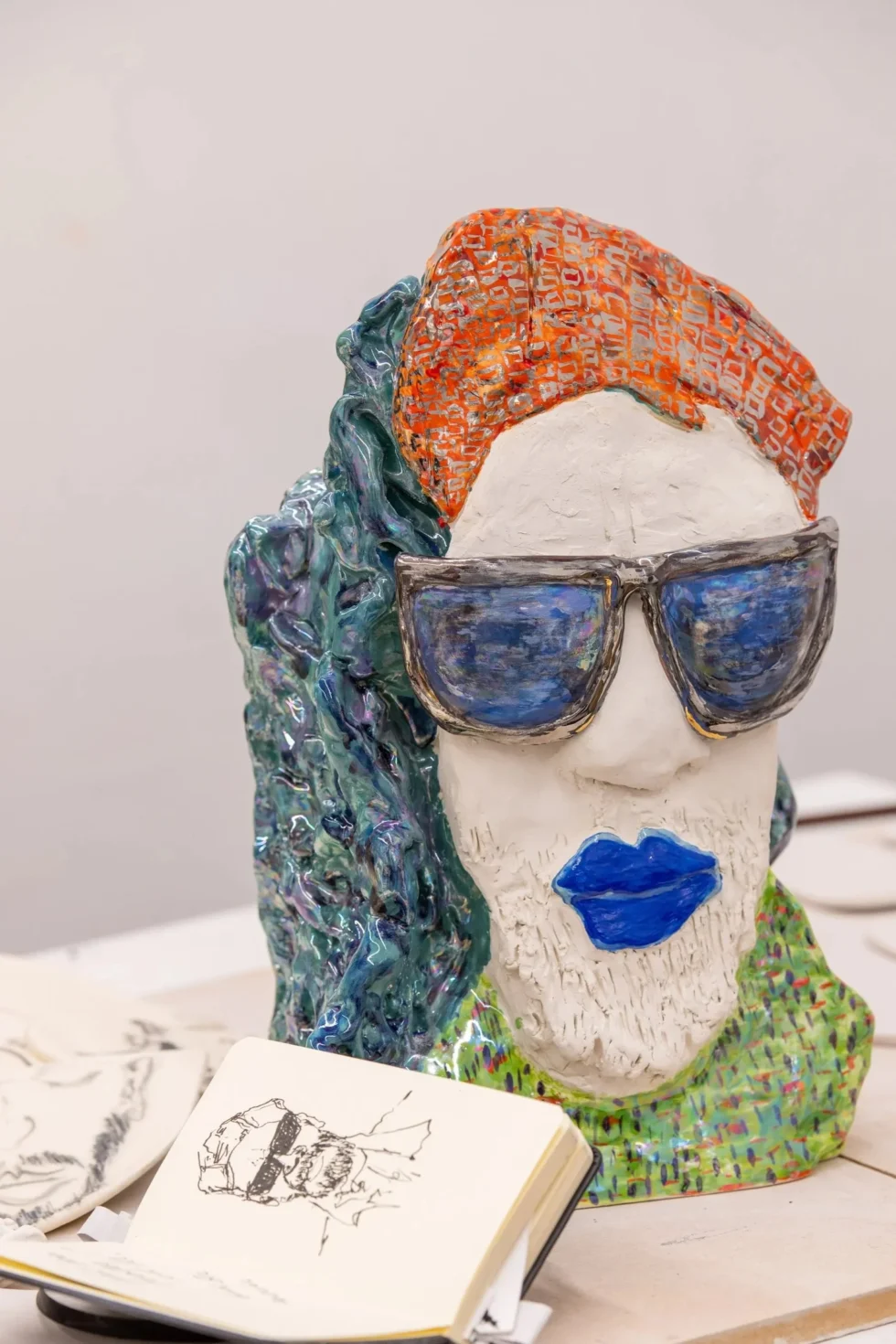
- Ceramic sculptures (2025)
Hand-built, glazed portrait forms. They present recognisable faces while suggesting internal states that remain unresolved. - Works on paper (pastel, graphite, gouache, collage)
Immediate and observational. These works retain the speed of sketching and function both as studies and independent pieces. - Painted fibreglass and metal chairs
Objects positioned between sculpture and design. They introduce a physical relationship between viewer and work.
Titles such as We all seek meaning in our lives and Sometimes we somersault through the day define the exhibition’s focus: emotional navigation rather than narrative storytelling.
From London commuters to inner life: how the works are constructed
At the centre of Kimberley Gundle’s practice is a precise shift: from what is seen to what is inferred. Her figures originate in real encounters — commuters observed on the Tube, passengers passing through shared space — but they are not portraits in any documentary sense. They are reconstructions. Each work operates across two simultaneous registers:
- external: posture, gesture, facial structure — the readable surface of a person in public
- internal: implied thought, emotional instability, private narrative — what cannot be seen but is suggested
This dual structure is consistent with her ongoing series How is the Weather in Your Head?, where the question itself functions as a method. It reframes the subject not as a fixed identity, but as a changing condition. Gundle has described her interest in “the interior life of strangers glimpsed in passing” — a formulation that underpins the translation from sketch to sculpture. The movement from paper to ceramic is not a change of medium alone, but a shift in time: from fleeting observation to fixed form. The fairground metaphor introduced in the exhibition extends this logic with clarity. It is not illustrative. It provides a structural model:
- rotation (repetition of daily routines)
- acceleration (emotional fluctuation)
- suspension (moments of pause or clarity)
In this sense, the works do not depict London life; they replicate its rhythm.
Free London art exhibitions in Pimlico: how the gallery model works
The exhibition also sits within a specific urban framework. Pimlico has, over time, developed into a concentrated gallery district, where independent spaces operate outside the institutional museum system. Long & Ryle Gallery is part of this network, with a programme focused on figurative and sculptural practices. Exhibitions are typically open without admission fees, reflecting a model that combines commercial representation with public accessibility. For visitors, this produces a distinct viewing condition:
- no ticket barrier — entry is immediate
- close-range encounter — works are viewed without physical distance
- time flexibility — exhibitions can be experienced in short, concentrated visits
For artists, it allows work to be presented without the scale or framing required by larger institutions, while maintaining visibility within London’s art circuit.
After 2020: routine, instability and the role of colour
While the exhibition is not framed as a direct response to recent events, its structure reflects a period shaped by disruption and recalibration. During 2020–2021, Gundle produced a daily visual diary, later published as Navigating the Maze. The project recorded incremental shifts in perception during periods of restriction and isolation. That method — repetition, accumulation, attention to small variations — continues in the present work.
Three elements remain consistent:
- repetition of forms — heads, figures, recurring structures
- routine observation — drawing as a daily act
- colour as stabilisation — applied not decoratively, but functionally
Gundle has noted that in periods of uncertainty, “it is harder to hold onto joy”. Within the exhibition, colour operates as a response to that condition — not as optimism, but as a controlled visual counterweight.
How to read “My Head Is a Fairground”
The exhibition does not present a linear narrative. It is structured as a sequence of encounters that require duration and proximity. The works resist immediate classification:
- figurative, but not descriptive
- personal, but not autobiographical
- accessible, but not simplified
Meaning is not located in individual pieces alone. It emerges through:
- repetition — similar forms across different works
- variation — shifts in expression, scale and colour
- accumulation — the effect of viewing multiple works in sequence
The result is cumulative rather than declarative.
Exhibition details: Kimberley Gundle in London
- Exhibition: My Head Is a Fairground
- Artist: Kimberley Gundle
- Dates: 16 April – 15 May 2026
- Location: Long & Ryle Gallery
- Admission: Free
London art in 2026: a shift towards access and proximity
What this exhibition reflects is not an isolated development, but a broader shift within London’s contemporary art landscape:
- a growing role for independent galleries
- increased emphasis on psychological and social themes
- expansion of free, publicly accessible exhibitions
Within this context, Gundle’s work occupies a defined position — materially direct, observationally grounded and structured around the conditions of everyday urban life.
Read about the life of Westminster and Pimlico district, London and the world. 24/7 news with fresh and useful updates on culture, business, technology and city life: Which new London restaurants open in April 2026 including Padella Soho and Theo James' Ornella