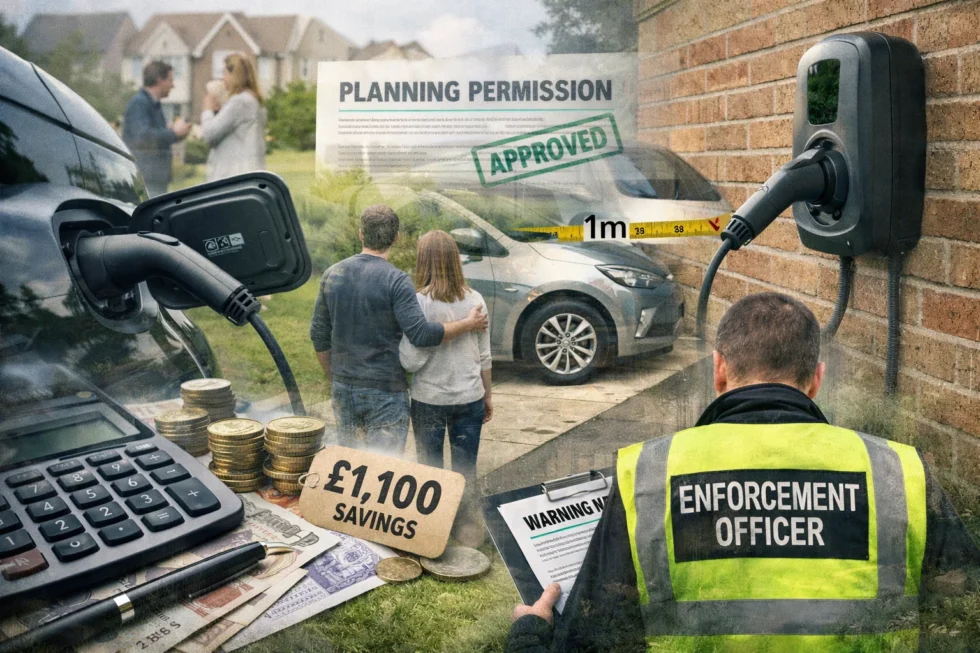
New driveway rules, EV charger planning permission England: what changed, who qualifies and what homeowners need to know in 2026? England’s rules on installing electric vehicle (EV) chargers on private driveways were significantly eased between 2024 and 2025, removing the need for planning permission in most standard cases and making home charging faster and cheaper for households.
Under changes to planning law confirmed by the UK government, most homeowners in England no longer need to apply for householder planning permission to install a single domestic EV charger on a private driveway, provided specific conditions on size, placement and safety are met. The reform applies to houses with off-street parking and does not generally extend to flats, listed buildings or properties in areas with additional planning controls.
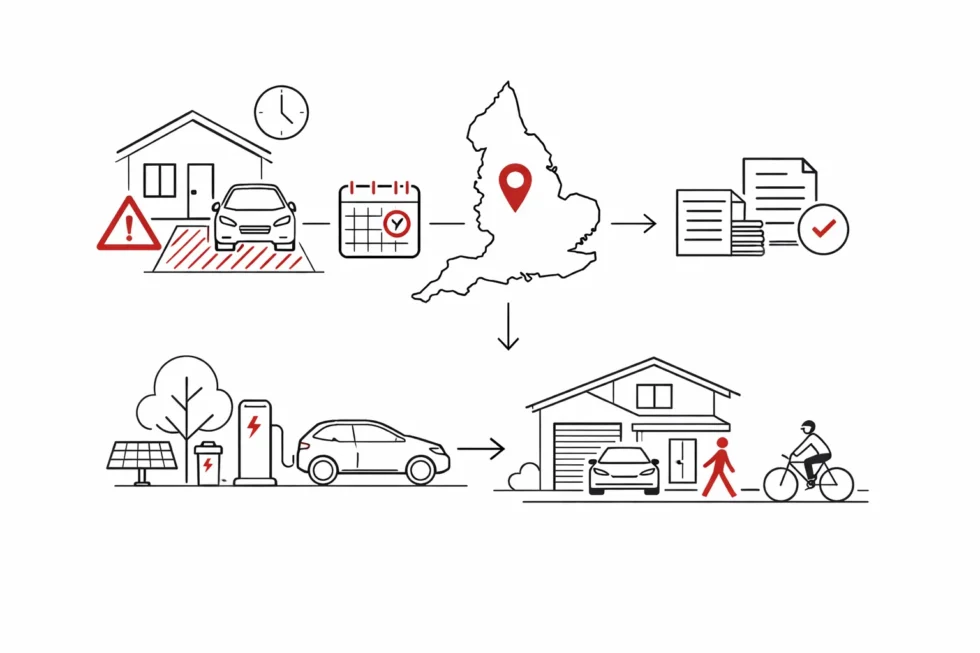
The updated EV charger planning permission rules came into legal force in June 2025 and remain fully in effect in 2026, with no expiry date announced. According to government briefings and coverage in national media, the measure was introduced to remove administrative barriers, reduce installation delays and support the rapid expansion of home EV charging infrastructure as electric car ownership rises. The WP Times reports, citing official planning guidance and policy statements.
Ministers have linked the reform directly to growing pressure on public charging networks, arguing that simpler planning rules for driveway chargers are essential if the UK is to meet its transport decarbonisation targets and avoid bottlenecks as EV uptake accelerates.
England’s rules governing the installation of electric vehicle (EV) chargers on private driveways were significantly eased between 2024 and 2025, as part of a wider government push to accelerate the transition to electric transport.
Under changes to planning law confirmed by the government, most homeowners in England no longer need to apply for householder planning permission to install a single domestic EV chargepoint on a private driveway, provided specific size, location and safety conditions are met. The reform came into legal force in June 2025 and remains fully in effect in 2026, with no announced expiry date. Ministers said the measure was designed to remove administrative barriers, reduce installation delays and support the expansion of home charging infrastructure, according to government briefings cited by national media.
When were the new driveway rules introduced
The new driveway rules for EV charger installations were first set out in 2024, when the government announced a package of planning and infrastructure reforms designed to accelerate electric vehicle uptake and reduce reliance on public charging networks.
The changes were implemented through amendments to permitted development rights, updating secondary legislation under England’s planning framework. These amendments came into legal force in June 2025, after which most standard domestic EV charger installations on private driveways no longer required individual planning permission.
Key milestones in the introduction of the rules include:
- 2024 – Government confirms its intention to relax planning controls for home EV chargers as part of wider transport decarbonisation policy.
- Late 2024 – Draft amendments to permitted development rights are laid, clarifying which domestic installations qualify for exemption from planning approval.
- June 2025 – Updated rules formally take effect in law, removing the need for planning permission for most single EV chargers on private driveways.
- 2026 – The regime remains fully in force, with no expiry date or review clause announced.
Importantly, the reforms did not include retrospective or transitional provisions. EV chargers installed unlawfully before June 2025 remain subject to the planning and enforcement rules in force at the time of installation, and local authorities retain the power to take action where breaches occurred.

What exactly changed under planning law
The reform is narrowly focused on planning permission and does not alter building regulations, electrical safety rules or wider property law obligations. Before June 2025, installing an electric vehicle (EV) charger on a residential driveway could, in certain cases, require an application to the local planning authority, particularly where visual impact or siting issues were raised. Under the revised framework, a single domestic EV charger is now classified as permitted development in standard circumstances, removing the need for individual planning approval.
The planning exemption applies where all of the following conditions are met:
- one EV charger only is installed per dwelling
- the charger is wall-mounted or pedestal-mounted
- the installation is located on a private residential driveway
- the property is a house, rather than a flat or subdivided building
Where these conditions are satisfied, homeowners can proceed without submitting a householder planning application. Crucially, all other legal requirements remain unchanged. Installations must still comply with building regulations, electrical safety standards and any applicable restrictions affecting listed buildings, conservation areas or land subject to special planning controls.
What rules apply in 2026
As of 2026, planning permission is not required for a domestic EV charger installation only where all statutory conditions are met. The exemption applies narrowly and is tied to the physical characteristics, location and use of the charging unit. Under the current framework, a driveway EV charger qualifies as permitted development if:
- the charging unit does not exceed 0.2 cubic metres in volume, ensuring limited visual and spatial impact
- it is installed at least two metres from a public highway, including footways and roads
- the unit is used solely for charging electric vehicles and not for any ancillary or commercial purpose
- the installation complies with all applicable electrical safety and installation standards, including building regulations
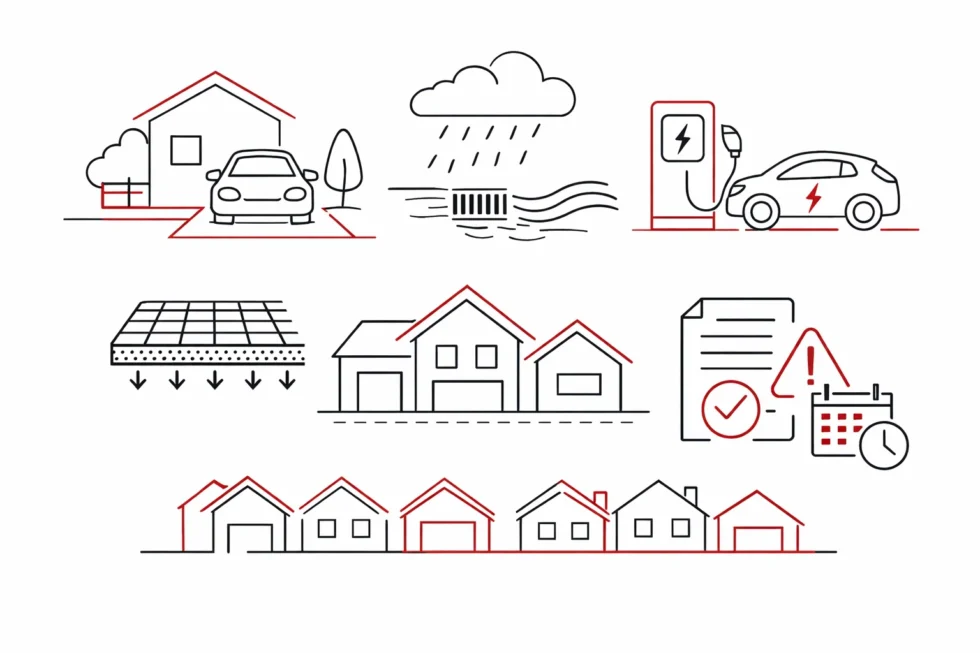
Where any one of these conditions is not met, the permitted development exemption does not apply and planning permission may be required. Local planning authorities retain full enforcement powers in 2026. Councils can investigate, require remedial action or take enforcement steps where EV chargers fall outside the permitted development criteria, breach siting rules or are installed unlawfully.
Who is covered — and who is not
The permitted development rules for EV chargers apply to residential properties in England, but their scope is strictly limited and often misunderstood. The exemption removes the need for planning permission only in qualifying cases and does not override other legal controls affecting property use. In practical terms, the rules do not:
- override leasehold agreements or lease conditions
- remove the requirement to obtain freeholder or managing agent consent
- cancel or weaken restrictive covenants contained in title deeds
- grant rights to install equipment on shared, communal or third-party land
- apply automatically to listed buildings or properties located in conservation areas, where additional permissions may still be required
As a result, many leaseholders and owners of flats may still face legal barriers even where planning permission is not required. Homeowners remain responsible for ensuring that all non-planning permissions and property law obligations are satisfied before installation.
Failure to do so can expose occupiers to enforcement action, contractual disputes or demands for removal, regardless of the planning status of the charger.Leaseholders, residents with shared driveways, or homeowners in protected areas may still require separate legal permissions even where planning permission is not required.
What is the estimated financial impact
Government and industry estimates indicate that households charging an electric vehicle (EV) at home can save up to £1,100 per year compared with running a comparable petrol or diesel car, depending on mileage, energy tariffs and charging behaviour. These projected savings are primarily driven by:
- lower per-mile electricity costs compared with petrol and diesel fuel
- access to off-peak domestic charging tariffs, which significantly reduce overnight charging costs
- reduced reliance on public rapid charging networks, where prices are typically higher
Industry analysis suggests that home charging can cost three to four times less per mile than refuelling a conventional vehicle, particularly for drivers able to shift charging to off-peak hours. By removing the requirement for a planning application in standard cases, the government has also reduced upfront administrative and professional costs, shortened installation timelines and lowered the risk of delays that previously discouraged some households from installing a home charger.

Ministers have argued that these combined savings — both operational and administrative — are intended to make EV ownership more financially viable for households with off-street parking, while easing pressure on public charging infrastructure as EV adoption continues to rise.so cuts upfront costs, eliminating planning fees and related professional expenses.
Why did the government make the change
Ministers said the reform was designed to tackle delays, inconsistency and administrative friction in local planning decisions, which had been repeatedly identified as barriers to the rapid rollout of home EV charging across England. Before the change, identical charger installations could face very different outcomes depending on the local authority, leading to prolonged approval timelines, higher professional fees and uncertainty for homeowners and installers. Government briefings indicated that these planning bottlenecks were increasingly at odds with rising EV ownership and national decarbonisation targets.
Industry figures broadly welcomed the move, arguing that removing planning permission from standard driveway installations would reduce both cost and time pressures. Osprey Charging Network said the reform would help normalise home charging as the default option for EV drivers. Lewis Gardiner, Operations Director at Osprey Charging Network, said the change had a direct operational impact:
“Removing the need for planning permission will save months of delays and reduce costs for installers and homeowners”
(Gardiner, London, January 2026)
Ministers have framed the reform as a practical intervention rather than a deregulation exercise, arguing that standardised national rules are necessary to ensure that planning systems do not slow the wider transition to electric transport.
How does this relate to EV uptake in 2026
The planning rule change coincides with continued growth in electric vehicle ownership across the UK, reinforcing the government’s view that home charging infrastructure is central to sustained EV uptake. As of early 2026, there are an estimated 1.75 million fully electric vehicles (BEVs) registered nationwide. Data published by the Society of Motor Manufacturers and Traders shows that EV registrations increased by around 8% in 2025 compared with the previous year, despite broader pressures on household spending and car finance.
Policy papers and market research consistently identify access to reliable home charging as one of the strongest determinants of whether households choose to switch to an electric vehicle. For drivers with off-street parking, the ability to install a charger quickly, cheaply and without planning delays significantly reduces both upfront friction and long-term running costs.
Ministers have argued that simplifying driveway installation rules directly supports this trend by removing one of the final non-financial barriers to EV ownership. The reform is therefore widely seen as a structural measure aimed at sustaining adoption rates in 2026 and beyond, rather than a short-term stimulus.
Does the rule apply outside England
No. Planning policy is devolved, and the driveway EV charger rule change applies only in England. Scotland, Wales and Northern Ireland operate under separate planning systems with their own permitted development frameworks.As of January 2026, none of the devolved administrations had introduced identical nationwide exemptions removing the need for planning permission for standard domestic EV chargers on private driveways. Homeowners in those jurisdictions must therefore continue to follow local planning rules and guidance issued by the relevant authorities.
As a result, installation requirements — including whether planning permission is needed — can differ significantly depending on where a property is located within the UK.
What should homeowners check in 2026
Before installing a domestic EV charger, homeowners are advised to carry out a series of basic legal and technical checks to ensure the installation qualifies as permitted development and does not trigger enforcement action. In practice, this means confirming that:

- legal ownership of the driveway is clear and uncontested
- lease terms, freeholder consent or title deed restrictions do not prohibit installations
- the charger complies with size and distance limits, including volume and highway setback rules
- the property has sufficient electrical capacity and the installation meets all safety and building regulation standards
- documentation is retained to demonstrate compliance with permitted development rules, including installation specifications and siting details
Failure to meet any of these requirements can still result in planning enforcement, contractual disputes or removal orders, even where planning permission itself is not required. In legal terms, the driveway reform represents a narrow but durable change rather than a wholesale deregulation. Since June 2025, most standard domestic EV chargers installed on private driveways in England have been treated as permitted development, removing the need for routine planning applications in qualifying cases.
However, the reform leaves wider legal safeguards fully intact, including property law restrictions, building regulations, electrical safety rules and local authority enforcement powers. For homeowners, the key distinction in 2026 is that planning permission may no longer be the main hurdle — but legal and technical compliance remains essential.
Read about the life of Westminster and Pimlico district, London and the world. 24/7 news with fresh and useful updates on culture, business, technology and city life: What happens to UK drivers after Zipcar closes? 650,000 users face refunds and disruption