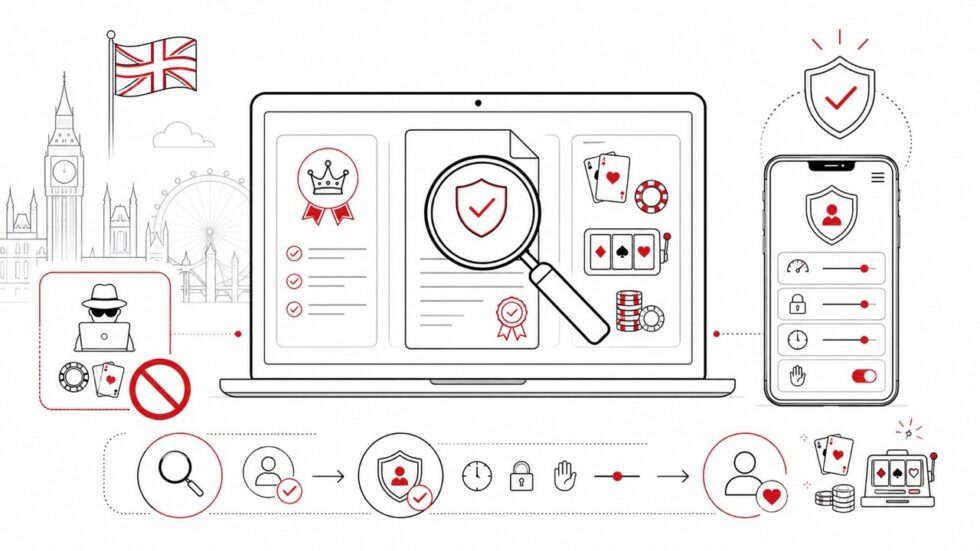
Online casinos in 2026 are no longer just a question of entertainment, welcome bonuses or fast digital payments. In Britain, they now sit inside a tougher public-policy debate about UK gambling reform, player protection, financial vulnerability and the difference between licensed operators and illegal casino sites. The UK Gambling Commission regulates commercial gambling in Great Britain under the Gambling Act 2005 and the Licence Conditions and Codes of Practice, while the reform programme following the 2023 government white paper has added sharper controls around online products. By 2026, players are dealing with concrete rules: online slot stake limits of £5 for adults aged 25 and over and £2 for 18 to 24-year-olds, financial vulnerability checks linked to net deposits above £150 in a rolling 30-day period, and stricter expectations on customer interaction, advertising and safer gambling tools. The issue matters directly in London because online gambling reaches users through phones, search results, football advertising, affiliate articles, payment apps and social media offers that may look legitimate even when the operator is not authorised, Westminster Pimlico News reports.
The practical warning for players is clear: a legal-looking casino website is not always a legal operator for British consumers. A glossy homepage, live chat, foreign licence badge or “internationally regulated” claim does not prove that a company is allowed to offer remote casino products in Great Britain. Before registration or deposit, the first question should be whether the business is licensed by the UK Gambling Commission and whether there is real protection if withdrawals, bonus terms or gambling behaviour become a problem. Poland shows why this distinction matters across Europe: its online casino market is more restrictive, with casino-style online games largely tied to the state-controlled model, while Britain allows private operators only under UKGC licensing. For readers comparing markets, a responsible news guide or legal gambling catalogue should point users towards verification through a register of licensed operators, not towards blind registration, because the safest decision is made before the first deposit.
Why online casinos are under closer scrutiny in Britain in 2026
The UK gambling system is built around the Gambling Act 2005, the UK Gambling Commission’s licensing regime and the Licence Conditions and Codes of Practice, known as the LCCP. These rules do not make gambling risk-free, but they create a legal framework that licensed operators must follow. That framework covers age verification, customer identity checks, anti-money-laundering controls, responsible gambling tools, fair terms, advertising standards, technical game rules, complaints procedures and intervention when a customer appears to be at risk.
The reform agenda became sharper after the government published the 2023 white paper, High stakes: gambling reform for the digital age. The document set out a broad package of measures for a market that had moved rapidly from betting shops and physical casinos to phones, apps and high-speed online products. The central argument was not that every adult should be stopped from gambling. It was that operators should not be allowed to place commercial objectives ahead of customer wellbeing.
That distinction matters for Westminster and Pimlico readers because online gambling is now part of the same digital consumer environment as banking apps, food delivery, streaming platforms and social media. A person can sign up from a sofa, deposit late at night and continue playing without the social friction that exists in a physical venue. That is why 2026 regulation is focused less on slogans and more on systems: limits, checks, safer design, better intervention and clearer licence verification.
The core change: player protection is becoming operational
For many years, “responsible gambling” often appeared as a small message at the bottom of a website. In 2026, that is no longer enough. Licensed operators are expected to have working systems that identify risk, act on harm indicators and make safer gambling tools available before problems escalate.
Player protection now means more than telling customers to be careful. It includes deposit limits, reality checks, time-outs, self-exclusion, customer interaction, clear bonus terms, age controls and financial-risk safeguards. Where operators fail to meet those duties, the Gambling Commission can review licences, impose financial penalties, suspend operations or take other regulatory action.
For players, this means legality is not a technical detail. It is the foundation of protection. If an operator is outside the UK licensing system, a player may lose access to the safeguards that matter most when withdrawals are delayed, bonus rules are disputed or gambling begins to feel out of control.
What changed for online slots
Online slots have received special attention because they can involve rapid, repetitive play. From 9 April 2025, a £5 maximum stake limit came into force for all adults playing online slots. From 21 May 2025, a lower £2 limit applied to adults aged 18 to 24. These limits apply to online slots, not to every casino product such as roulette or blackjack.
This is one of the clearest examples of the new regulatory direction. The state is not only relying on warning messages. It is changing the conditions of play for products considered higher-risk because of speed, repetition and potential loss escalation.
What the UK Gambling Commission actually does
The UK Gambling Commission licenses and regulates gambling businesses that provide gambling facilities to consumers in Great Britain. It also regulates the National Lottery across the UK. For online casinos, the key point is that a business offering remote casino games to British consumers must hold the correct operating licence.
A UKGC licence is not just a decorative logo. It is a legal permission attached to duties. Licensed operators must comply with the LCCP, technical standards and wider consumer-protection expectations. They must verify customers, prevent underage gambling, manage financial crime risks, publish fair terms, provide safer gambling tools and follow advertising rules.
The Commission also publishes public registers. These allow users to search gambling businesses, personal licence holders, premises and regulatory actions. This is important because a player should not rely only on what the casino says about itself. The licence should be independently verifiable.
What a licensed operator must show
A properly licensed online gambling business should make key information easy to find. This normally includes the operating company name, licence details, trading names, terms and conditions, safer gambling information, complaints routes and contact details.
Players should understand that the brand name and the legal operator name may be different. A casino brand may be owned or operated by a company with another name. The legal entity is the detail that matters when checking the Gambling Commission register.
A licensed operator may also have multiple domains, white-label arrangements or trading names. That is why the safest check is not simply “does the brand look familiar?” but “does the company and domain match an active UKGC-licensed business?”
Why the public register matters
The Gambling Commission’s public register is the main official source for checking whether a gambling business is licensed. It can show licensed businesses, regulatory action and other relevant licence information. In consumer terms, it is the difference between taking a website’s word for it and checking the regulator’s record.
If a reader wants to understand the checking process before using any gambling website, an independent guide to a register of licensed operators can be useful as a practical reminder of what to verify: the company name, licence status, domain, product type, withdrawal rules, responsible gambling tools and warning signs linked to offshore or illegal platforms.
The key rule is simple: check before depositing, not after winning or losing. Once money has moved to an illegal operator, the practical options for recovery may become limited.
Financial vulnerability checks: what players should know in 2026
One of the most debated parts of UK gambling reform is financial risk and vulnerability checking. The debate is often described in headlines as “affordability checks”, but the Gambling Commission has been careful to distinguish between different measures. There are already financial vulnerability checks in force, while separate financial risk assessments have been piloted and analysed.
Under Social Responsibility Code 3.4.4, remote operators covered by the rule must carry out a financial vulnerability check when a customer reaches the relevant threshold. From 28 February 2025, that threshold is where deposits minus withdrawals exceed £150 in a rolling 30-day period. Before that, between 30 August 2024 and 27 February 2025, the threshold was £500 in a rolling 30-day period.
The minimum check is based on customer-specific public-record information for significant indicators of potential financial vulnerability. These indicators include bankruptcy orders, county court judgments, individual voluntary arrangements, high court judgments, debt relief orders and similar records. Operators must consider the information with what they already know about the customer and take proportionate action when risk is identified.
Financial vulnerability checks are not the same as spending caps
This point is important because the public debate can become confused. Financial vulnerability checks are not a universal ban on gambling after a fixed amount. They are a regulatory mechanism designed to identify signs of serious financial vulnerability and require operators to act proportionately.
The Gambling Commission has also been examining financial risk assessments for high-spending remote gambling customers. In April 2026, the Commission said it was continuing to analyse pilot data and stressed that proposed financial risk assessments were not live for consumers. It also stated that the proposal was not to introduce spending limits or caps, but to identify high-spending customers who may be in current financial difficulties.
For players, the practical message is this: licensed operators may ask questions or run checks because the regulatory system requires them to identify risk. That does not mean every request is automatically intrusive or unfair. But the process should be proportionate, clear and connected to safer gambling or legal obligations.
What proportionate action can mean
If a check identifies risk, an operator may need to take action. That could include reviewing the account, restricting activity, asking for information, directing the customer to safer gambling tools, limiting deposits or stopping gambling where there is serious concern.
The important word is “proportionate”. A check should not be used as a vague excuse to mistreat customers, delay withdrawals without reason or demand irrelevant documents. Equally, players should understand that a licensed operator has a duty to act when clear signs of financial vulnerability appear.
How to check whether an online casino is legal for UK players
The safest way to check an online casino is to start with the legal operator, not the bonus. Before opening an account, scroll to the footer and terms. Find the company name, licence number if displayed, registered address, product type and responsible gambling information. Then compare those details with the Gambling Commission’s public register.
Do not rely on phrases such as “fully licensed”, “internationally regulated”, “trusted worldwide” or “licensed offshore”. Those words may be true in another context but irrelevant for a British consumer. The question is whether the business holds the correct UKGC licence to offer remote gambling services to customers in Great Britain.
A foreign licence does not automatically authorise a casino to serve UK players. Some operators may hold licences in other jurisdictions, but that does not replace the UK requirement where British consumers are targeted or accepted.
A practical licence-checking list
Before depositing money, check:
- The legal company name behind the casino brand.
- Whether the business appears in the Gambling Commission public register.
- Whether the licence is active.
- Whether remote casino activity is covered.
- Whether the domain or trading name is connected to the licensed business.
- Whether regulatory actions are listed.
- Whether safer gambling tools are visible and functional.
- Whether withdrawal and bonus terms are clear.
- Whether the site is part of GAMSTOP if it serves Great Britain.
- Whether the operator avoids language such as “not on GamStop”.
This list is deliberately strict because illegal operators often look convincing. A player should not treat a professional design as evidence of legal status.
Red flags that should stop a deposit
A player should stop immediately if the site hides its operator identity, gives only a vague offshore licence, promotes itself as “not on GamStop”, offers unrealistic bonuses, makes withdrawal rules hard to find or pressures the user to deposit quickly.
Another warning sign is inconsistent information. If the footer names one company, the terms name another and the payment descriptor shows a third entity, the risk increases. A legal operator should not require detective work from the consumer.
Player protection tools: what should be visible on a licensed site
Player protection should be easy to find before gambling begins. A licensed online casino should not hide safer gambling tools behind customer-service requests or obscure account menus. The player should be able to set limits, take a break, review transaction history and access self-exclusion information without friction.
The most useful tools are those that work before the player is in distress. Deposit limits are more effective when set before the first deposit. Time-outs are more effective before a session becomes emotional. Reality checks are more useful when they show time and money clearly. Account history is more valuable when it is simple enough to understand at a glance.
A serious operator should also monitor behaviour. Repeated deposits, long sessions, failed deposit attempts, rapid play and signs of chasing losses can indicate risk. The LCCP requires customer interaction policies, and licensed operators are expected to act when harm indicators appear.
What players should expect from a safer platform
A safer licensed platform should provide:
- age and identity verification;
- clear deposit limits;
- time-outs and self-exclusion options;
- access to GAMSTOP information;
- transaction history;
- reality checks or session reminders;
- clear bonus and withdrawal terms;
- visible support links;
- a complaints route;
- customer interaction where gambling behaviour suggests risk.
These tools do not guarantee safety, but their absence is a serious warning. If a platform makes it easy to deposit but hard to limit, pause or close an account, the player should treat that as a consumer-protection problem.
Why GAMSTOP matters
GAMSTOP is the national online self-exclusion scheme for gambling websites and apps run by companies licensed in Great Britain. For people who feel they are losing control, self-exclusion can create a stronger barrier than willpower alone.
The most dangerous illegal operators often use the opposite message. They market themselves as “not on GamStop” to attract people who are already trying to stop gambling. That phrase should be understood as a risk signal, not a benefit. If someone has self-excluded, the answer is not to find another site. The answer is to protect the exclusion and seek support if urges continue.
Bonuses, advertising and affiliate content: where regulation meets consumer risk
Casino advertising in Britain is not a free-for-all. Gambling marketing must be socially responsible and comply with the UK Advertising Codes issued by the Committees of Advertising Practice and administered by the Advertising Standards Authority. The Gambling Commission also points operators to advertising and marketing rules through the LCCP.
This matters because online casino advertising can shape behaviour long before a person registers. A bonus headline can make risk feel smaller than it is. A “free spins” offer can hide wagering conditions. A VIP invitation can encourage repeated play. A countdown timer can push a rushed decision.
For publishers and affiliates, responsibility is also important. Gambling content should not present casino play as income, a solution to debt or a shortcut to status. It should not target children, young people or vulnerable audiences. It should not hide material conditions or make misleading claims about winning.
How to read a casino bonus safely
Before accepting any bonus, ask:
- What is the wagering requirement?
- Does wagering apply to the bonus only or to deposit plus bonus?
- Which games count towards wagering?
- Is there a maximum bet while the bonus is active?
- Is there a maximum withdrawal from bonus winnings?
- When does the bonus expire?
- Can the operator cancel winnings for a breach of terms?
- Can the player withdraw the cash deposit without completing the bonus?
If these answers are unclear, the safest choice is to reject the bonus. A large offer with unclear terms is not consumer value; it is a risk.
Why plain English is part of protection
Terms and conditions are not a side issue. They are part of player protection. A customer cannot make an informed decision if the key conditions are buried in dense language or scattered across multiple pages.
A licensed operator should make important rules easy to understand. If a bonus depends on complex restrictions, the platform should explain those restrictions clearly before the player opts in.
Legal operator versus risky operator: a practical comparison
| What to check | Safer sign | Warning sign |
|---|---|---|
| Licence | Active UKGC licence can be checked in the public register | Only vague claims such as “internationally licensed” |
| Operator identity | Company name, licence and terms are clear | Ownership details are hidden or inconsistent |
| Product permission | Remote casino activity is covered | Licence does not match the product offered |
| GAMSTOP | Self-exclusion information is visible | Site promotes itself as “not on GamStop” |
| Slot stakes | Online slot limits follow UK rules | No clear limits or offshore rules presented |
| Financial checks | Vulnerability checks are explained proportionately | Documents demanded with no clear reason |
| Bonuses | Wagering and withdrawal terms are readable | Large offers with confusing restrictions |
| Advertising | Socially responsible, no pressure language | “Easy money”, urgency or lifestyle promises |
| Complaints | Clear complaints process and ADR route where relevant | No serious complaint route |
| Withdrawals | Rules are published before deposit | Delays, extra fees or changing excuses |
This table is not a substitute for checking the official register, but it gives players a fast risk filter. If several warning signs appear together, the safest action is not to deposit.
What to do if something goes wrong with an online casino
If a problem occurs with a licensed operator, start with a written complaint to the company. Keep it factual. Include the account email, dates, transaction amounts, screenshots, bonus terms, chat transcripts and any withdrawal or verification messages. Do not rely on live chat alone. A written record matters.
If the operator does not resolve the complaint, the customer may be able to use the operator’s approved alternative dispute resolution process for certain disputes. The Gambling Commission does not usually resolve individual complaints in the same way as an ombudsman, but it does use information about operator conduct for regulatory purposes.
If the problem involves an illegal operator, the situation becomes harder. The player may not have access to UK dispute mechanisms, and recovery may be difficult. That is why licence checking before deposit is so important.
Evidence to keep
Players should keep:
- screenshots of the licence claim;
- the operator name and domain;
- deposit and withdrawal records;
- bonus terms at the time of acceptance;
- live-chat transcripts;
- emails from customer service;
- proof of self-exclusion or account closure;
- payment descriptors shown by the bank;
- any advertising that influenced registration.
Good records do not guarantee recovery, but they improve the chance of a structured complaint and help regulators or advisers understand what happened.
When the issue is gambling harm
If the real problem is not a withdrawal but loss of control, the priority should shift from complaint handling to protection. Stop depositing. Use time-outs or self-exclusion. Consider bank gambling blocks. Speak to a trusted person. Contact gambling-harm support.
In England and Scotland, the National Gambling Helpline number listed by the Gambling Commission is 0808 8020 133. In Wales, the listed number is 0808 2819 265. Help is available 24 hours a day, seven days a week.
Why this is a Westminster story, not just a casino story
Online gambling reform is a national policy issue because it sits at the intersection of law, technology, public health, advertising, financial services and consumer rights. Westminster sets the political direction. Regulators turn that direction into enforceable rules. Operators adapt their platforms. Consumers feel the consequences when protections work — or when they fail.
The 2026 market is more tightly regulated than it was before the reform programme, but regulation alone cannot remove every risk. Illegal operators still try to reach British users. Offshore sites still use search and social channels. Bonus-led marketing still encourages rushed decisions. Some vulnerable players still look for ways around self-exclusion.
That is why the most useful journalism on gambling is not promotional. It is practical. It tells readers how to check a licence, what the law says, which numbers matter, what tools should exist and when to walk away.
The safest rule for readers
The safest rule is: no licence check, no deposit. If the operator cannot be verified through the Gambling Commission register, do not send money. If the site promotes itself as outside GAMSTOP, do not use it. If the bonus terms are unclear, reject the bonus. If gambling feels necessary rather than optional, stop and seek support.
Responsible gambling is a boundary, not a mood
Responsible gambling is not about feeling confident. It is about setting boundaries before emotion takes over. A player who decides a limit in advance is safer than a player who negotiates with themselves after losses begin.
FAQ: online casinos, UKGC rules and player protection in 2026
Are online casinos legal in the UK in 2026?
Yes, online casinos can be legal for adults in Great Britain if the operator holds the correct UK Gambling Commission licence. The important point is that legality depends on the operator’s licence status, not on whether the website is accessible online.
What is the legal age for online casino gambling in Britain?
The minimum age for casino gambling in Great Britain is 18. Licensed online operators must verify age and identity to prevent underage gambling.
How can I check if an online casino is licensed?
Use the Gambling Commission public register and search for the gambling business, trading name or licence details. Compare the official record with the company name and domain shown on the casino website.
What are the online slot stake limits in Britain?
For online slots, the £5 maximum stake limit for all adults went live on 9 April 2025. A lower £2 limit for adults aged 18 to 24 went live on 21 May 2025. These limits apply to online slots, not to every casino game.
What are financial vulnerability checks?
Financial vulnerability checks are checks that remote operators must carry out when a customer reaches a relevant net-deposit threshold. From 28 February 2025, the threshold is deposits minus withdrawals exceeding £150 in a rolling 30-day period. The check looks for significant public-record indicators such as bankruptcy or county court judgments.
Is a casino safe if it says it is “not on GamStop”?
No. For British consumers, “not on GamStop” should be treated as a warning sign. Licensed operators serving Great Britain are expected to participate in the self-exclusion framework. Sites marketing themselves as a way around self-exclusion can expose vulnerable players to serious harm.
How Britain and Poland regulate online casinos differently
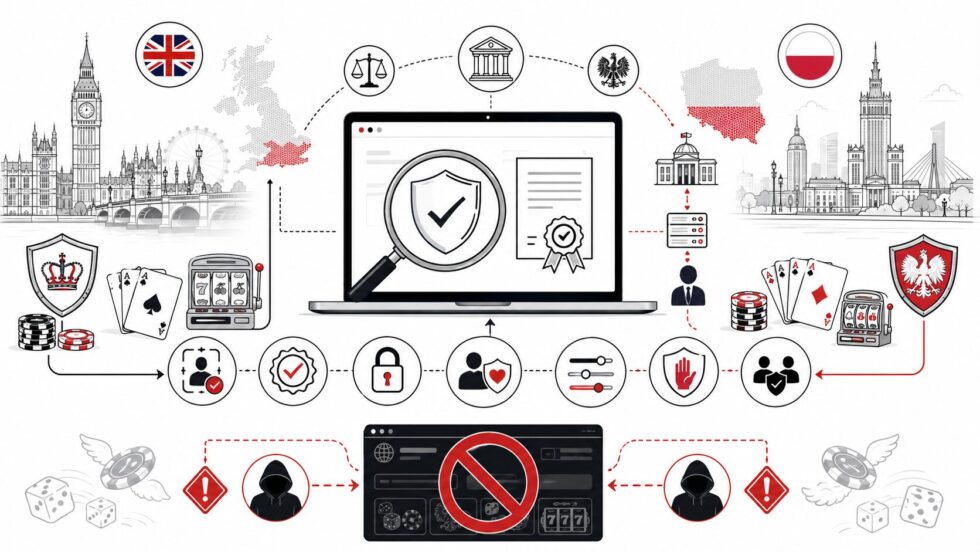
Britain and Poland show two very different models of online gambling regulation, but the consumer lesson is the same: legality must be checked before a player deposits money. In Great Britain, private online casino operators can legally serve customers if they hold the correct licence from the UK Gambling Commission and comply with rules on identity checks, customer interaction, financial vulnerability, advertising, safer gambling tools and complaint handling. The UK system is built around a regulated private market, where the public register helps users confirm whether a business is authorised to offer remote casino products. Poland is more restrictive: online casino games are largely reserved for the state-controlled operator Totalizator Sportowy, while private companies may receive authorisation mainly in other gambling areas, such as sports betting, under domestic rules. That means a casino website that appears online, accepts foreign players or claims to be “European licensed” may still be illegal for Polish users if it does not fit the national licensing framework.
Why a UKGC licence and a Polish authorisation are not the same thing
A UKGC licence is specific to the British market and gives an operator legal permission to offer regulated gambling services to consumers in Great Britain. It also brings the operator under UK rules on player protection, technical standards, anti-money-laundering controls, advertising, complaints and safer gambling interventions. In Poland, the legal structure is narrower and more state-controlled, particularly for online casino games. This means that a licence from another jurisdiction, even inside Europe, should not be treated as automatic permission to target Polish players. The key consumer point is that gambling law is national, not simply “European”. A site may use international wording, foreign licence badges or English-language terms, but the player still needs to ask whether the operator is legal in the country where the gambling takes place.
How readers should check legality before registering
For British users, the first step is to check the UK Gambling Commission public register and compare the operator name, brand, domain and gambling activity with the licence record. The check should happen before registration, not after a deposit or withdrawal problem. For Polish users, the question is different: because the online casino market is more restrictive, players should be especially careful with private casino brands that present themselves as available from abroad. A responsible news guide or legal gambling catalogue can also help readers understand what to verify in a register of licensed operators, from the company name and licence status to the national rules, safer gambling tools and warning signs around unclear offshore platforms. The safest decision in both countries is made before the first deposit: check the operator, read the terms, confirm the protection tools, reject unclear bonuses and walk away if the licence is vague, foreign-only or impossible to verify.
Read about the life of Westminster and Pimlico district, London and the world. 24/7 news with fresh and useful updates on culture, business, technology and city life: GRAI Licences Go Live 1 July 2026: Ireland's New Era
Sources used in preparing this article
This article was prepared using official and regulatory information from the UK Gambling Commission, the Gambling Commission public register, the Licence Conditions and Codes of Practice, the UK government white paper High stakes: gambling reform for the digital age, official UKGC guidance on online slot stake limits, UKGC information on financial vulnerability checks, UKGC updates on financial risk assessments, CAP and ASA gambling advertising rules, GAMSTOP and UK gambling-harm support resources.