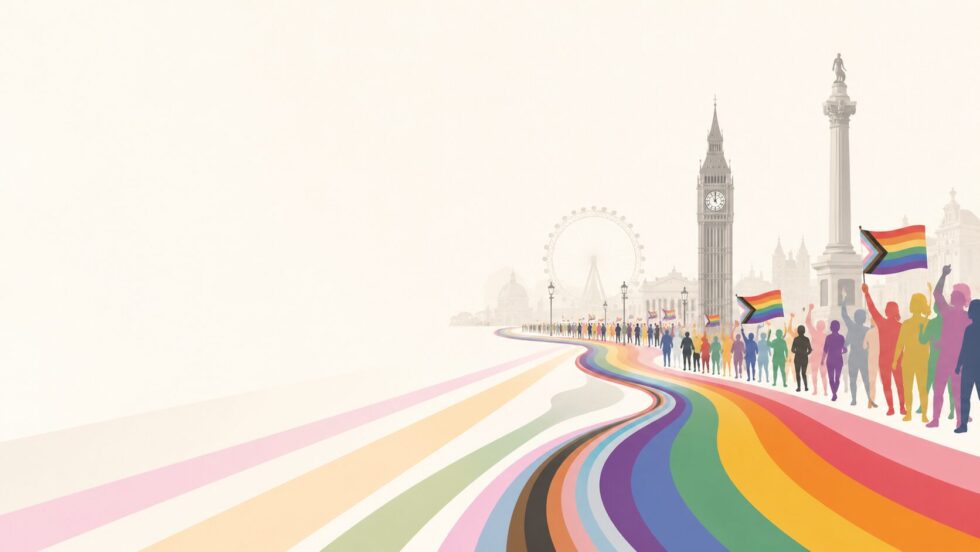
Pride in London 2026 takes place on Saturday 4 July, with the parade setting off at 12:00 from Hyde Park Cornerbefore following Piccadilly, Piccadilly Circus, Haymarket, Trafalgar Square and Whitehall, finishing near Westminster by early evening. The event is free to attend, with more than 1.5 million spectators and around 30,000–35,000 participants across roughly 600 groups expected. Central London road closures begin during the morning and remain in place into the evening, there is no public parking for spectators, and Transport for London advises arriving early and travelling by Tube. Alongside the parade, six performance stages will operate across central London, including the free main stage in Trafalgar Square. Here's everything you need to know before heading into central London.
This is one of the great set-pieces of the European summer: a procession through some of the most iconic streets in the world, watched by well over a million people, that is at once a celebration and a protest. The 2026 campaign, "Many Voices. One Front," puts intergenerational unity at its heart — from the very first London march in 1972 through to newcomers in 2026 — while organisers spotlight four pressing issues: trans healthcare rights, Black and Brown queer visibility, chosen family rights and ending hate crime. In this guide, The WP Times sets out the exact route and timings, every road closure and travel diversion you need to know, the best (and worst) viewing spots, the six stages, and the practical detail — from parking suspensions to phone signal — that makes the difference between a brilliant day and a frustrating one.
What time does Pride in London 2026 start?
The Pride in London 2026 parade steps off at midday — 12:00 — on Saturday 4 July 2026. That start time is confirmed across the official sources, from Pride in London itself to the Mayor of London's events listings.
A few timing realities worth knowing. The parade is enormous, so while it begins at noon at Hyde Park Corner, it takes several hours to pass any given point and for the full procession to complete the route. In practice the march typically finishes by around 18:00, though the surrounding stages, street parties and Soho celebrations run well into the night. If you want to see the front of the parade at a specific spot, factor in how far along the route you are — the closer to Whitehall, the later it arrives.
The WP Times's first piece of advice is blunt but useful: do not aim to arrive "for noon" expecting to stroll to a kerbside view. With over 1.5 million people expected, the best viewing spots fill long before the parade starts. Arrive early — well before midday — if you want a clear view.
The full Pride in London 2026 parade route
The official 2026 route, as confirmed by Pride in London and London City Hall, runs through the heart of the West End and down to Westminster. It begins at Hyde Park Corner, moves along Piccadilly towards Piccadilly Circus, then heads south down Haymarket, passes the grand backdrop of Trafalgar Square, and finishes on Whitehall, near the Houses of Parliament.
This is a deliberately symbolic line: it ends within sight of the seat of government, underlining Pride's dual identity as celebration and political statement. Along the way it threads past some of London's most recognisable landmarks, giving spectators a procession of floats, music, placards, costumes and community groups against a backdrop of Regency architecture and famous squares.
Table: the route, point by point
| Stage of route | Location | Notes |
|---|---|---|
| Start | Hyde Park Corner | Step-off at 12:00; near Green Park |
| Along | Piccadilly | First major stretch, towards Piccadilly Circus |
| Turn | Piccadilly Circus | Busy junction, big atmosphere |
| South | Haymarket | Grandstand seating located here |
| Past | Trafalgar Square | Free main stage; key viewing point |
| Finish | Whitehall | Ends near Westminster / Parliament |
Note: London Trans+ Pride is a separate march, taking place later in July (Saturday 25 July 2026), and follows a different route. Don't confuse the two when planning.
Which roads are closed for Pride in London 2026
This is the detail that matters for drivers, residents, businesses and anyone trying to move through the West End on the day — and the picture, confirmed via Westminster City Council, is one of extensive central-London road closures from the morning through to the evening.
The closures follow the parade footprint and the surrounding event area, covering Piccadilly, the streets around Piccadilly Circus, Haymarket, the Trafalgar Square area, Whitehall and a web of connected roads across Mayfair, St James's and Soho. Crucially, once Piccadilly is closed to traffic, access to the area around St James's Square and south of Piccadilly is only possible via Marlborough Road and St James's Park. The Royal Parks help here: unlike a normal Saturday, St James's Park roads are kept open during Pride to allow local access into that pocket, and there are pedestrian crossing points across Piccadilly running in both directions.
Parking suspensions and resident arrangements
Westminster suspends parking bays across the affected area for the event. To support residents, the council has confirmed a temporary arrangement: Zone G resident permit holders may park in resident bays in Zones E (Mayfair) and F (north of Oxford Street), in place from 18:30 on Friday 3 July 2026 until 08:30 on Monday 6 July 2026. If you live in the footprint, plan your vehicle around those windows.
Advice for businesses
Businesses inside the footprint should arrange deliveries and waste collections outside the road-closure times, and commercial waste must not be left on the street during the event — it should be stored on the premises or collected before closures begin. Licensed premises must follow their licence conditions, and anything that spills onto the highway or pavement beyond normal operation requires permission, which the crowded footprint may not always allow.
Table: road and access essentials
| Item | Detail |
|---|---|
| Road closures | Central London / Westminster, morning to evening on 4 July |
| Key access note | South of Piccadilly only via Marlborough Road & St James's Park |
| St James's Park roads | Kept open (unusually) for local access |
| Parking | Bays suspended; Zone G permits valid in Zones E & F (Fri 18:30–Mon 08:30) |
| Buses | Many routes diverted or shortened |
| Resident/business liaison (on the day) | 0204 576 9744 |
How to get to Pride in London 2026: Tube and travel
With roads closed and no spectator parking, the Tube is the way in — but the right station depends on whether you're marching, watching, or sitting in the grandstand. Pride in London and Transport for London have issued clear guidance.
- Parade participants (marchers): use Marble Arch or Bond Street.
- Grandstand ticket holders: Piccadilly Circus is closest.
- Spectators heading for Trafalgar Square or Soho: use Bond Street, Tottenham Court Road, Waterloo or Embankment.
A few practical warnings from the official advice. Many bus routes will be diverted or shortened due to the closures, so don't rely on a bus crossing the centre. Phone signal is expected to be patchy in the densest areas because of the sheer crowd size — so screenshot your plans, agree meeting points in advance, and check the TfL website or TfL Go app for live updates before you travel. Stations near the route also operate crowd-control measures, which can mean queues and temporary entry or exit restrictions. Plan your journey home before you leave, The WP Times advises. Phone-free, in a crowd of a million-plus, with buses on diversion, is not the moment to work out your route. Pick your exit station and a back-up in advance.
Where to watch: the best viewing spots
Choosing the right spot makes a real difference, because crowds stretch along the entire route. Based on the official guidance and the character of each location, here's how the main viewing points compare.
- Piccadilly Circus: one of the biggest-atmosphere spots, right where the parade turns. Expect dense crowds and a brilliant buzz.
- Trafalgar Square: widely regarded as the best balance of atmosphere and accessibility, and home to the free main stage — a strong all-round choice.
- Haymarket: where the grandstand seating is located, for those who want a guaranteed, comfortable, unimpeded view (ticketed; sold separately).
- Piccadilly (wider stretches): more manageable than the tightest junctions, good for arriving early along a broader pavement.
- Whitehall: the finish, quieter at the start but where the parade arrives later.
For families or anyone who prefers to avoid the densest crush, The WP Times suggests staying away from the tightest junctions (Piccadilly Circus in particular) and arriving early along a wider stretch of the route. There is also a dedicated family area at Victoria Embankment Gardens, with activities including a large LEGO zone, performances and food, open to the public from 12:00 to 18:00 on the day.
Grandstand seating
If you'd like to watch from a comfortable seat with a clear view, grandstand tickets on Haymarket typically go on sale shortly before the event via Pride in London. Everything else — the parade and all official stages — is free.
The six stages and 2026 line-up
Pride day does not stop with the parade. Pride in London 2026 runs six performance stages across central London, each spotlighting a different part of the community:
- Main stage (Trafalgar Square): headliners and speakers — free to all.
- Women's and non-binary stage: musicians, performers and DJs.
- A stage celebrating Black, Brown, Asian, dual-heritage and Indigenous LGBTQ+ talent.
- Cabaret and drag stage in Soho.
- A trans-led space: speeches and performances.
- The family-friendly area for adults with children.
The finalised line-up features a star-studded mix of headliners, speakers and drag performers, with names such as MNEKand Beth Ditto among those announced across the stages. Food and drink stalls are dotted around Leicester Square, Golden Square and Soho Square, and Soho itself becomes an outdoor party from midday.
A brief history and why Pride still matters
London's Pride has deep roots: the earliest march traces back to 1970, with the first official UK Gay Pride Rally in 1972. More than half a century on, it has grown into the UK's largest free Pride event and one of the world's great Pride gatherings. The 2026 "Many Voices. One Front" campaign deliberately links that long history to the present, stressing intergenerational unity.
Organisers are clear that Pride remains as much protest as party. The four issues they have chosen to spotlight in 2026 — trans healthcare rights, Black and Brown queer visibility, chosen family rights and ending hate crime — are a reminder that, for all the colour and music, the march carries a serious purpose. As interim CEO Rebecca Paisis put it, the aim is for 2026 to be "the most inclusive Pride in London event yet."
Practical checklist for Pride in London 2026
The WP Times has boiled the planning down to a quick list:
- Date and time: Saturday 4 July 2026, parade steps off at 12:00 from Hyde Park Corner.
- Arrive early — well before noon for a good viewing spot; crowds build fast.
- Travel by Tube, not car — no spectator parking, roads closed, buses diverted.
- Pick your station by role: marchers (Marble Arch/Bond Street), grandstand (Piccadilly Circus), spectators (Bond Street, Tottenham Court Road, Waterloo, Embankment).
- Plan your route home in advance — phone signal will be patchy.
- Agree meeting points with your group before you set off.
- Stay hydrated and sun-safe — early July, large crowds, little shade on the route.
- Check TfL (website or TfL Go app) on the day for live diversions and station controls.
- Residents/businesses: note the parking and waste-collection arrangements and the liaison line (0204 576 9744).
The bottom line
Pride in London 2026 lands on Saturday 4 July, with the parade stepping off at midday from Hyde Park Corner and running via Piccadilly, Piccadilly Circus, Haymarket and Trafalgar Square to finish on Whitehall. It's free, it's vast, and it's both a celebration and a statement. The show is easy; the logistics are the hard part — extensive road closures, diverted buses, no parking, patchy phone signal and crowds well over a million. Arrive early, travel by Tube, pick your viewing spot and plan your exit, and you'll have one of the best days London's summer offers.
Frequently asked questions
What time does Pride in London 2026 start? The parade steps off at midday (12:00) on Saturday 4 July 2026 from Hyde Park Corner. The full procession takes several hours to complete, typically finishing by around 18:00.
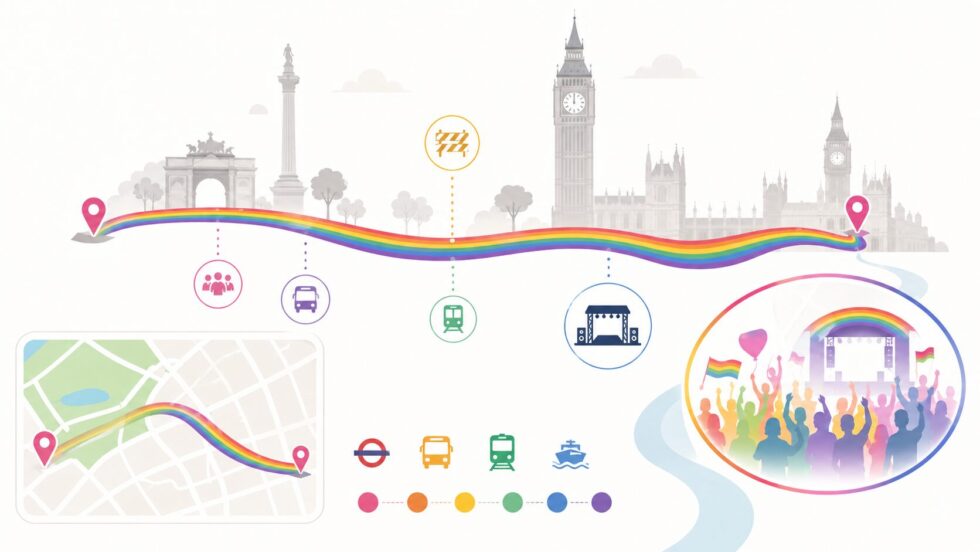
What is the parade route? Hyde Park Corner → Piccadilly → Piccadilly Circus → Haymarket → past Trafalgar Square → Whitehall.
Which roads are closed? Extensive closures across central London and Westminster, following the parade footprint, from the morning through to the evening. South of Piccadilly is reachable only via Marlborough Road and St James's Park once Piccadilly closes.
Do I need a ticket? No. The parade and all official stages, including Trafalgar Square, are free and unticketed. Only the Haymarket grandstand requires a paid ticket.
How do I get there? By Tube. Marchers: Marble Arch or Bond Street. Grandstand: Piccadilly Circus. Spectators: Bond Street, Tottenham Court Road, Waterloo or Embankment. There is no spectator parking and many buses are diverted.
Where's the best place to watch? Trafalgar Square offers the best balance of atmosphere and accessibility. Piccadilly Circus has the biggest buzz but densest crowds. Families may prefer wider stretches of Piccadilly or the Victoria Embankment Gardens family area.
Is there parking? No spectator parking. Westminster suspends bays; Zone G resident permit holders may use Zones E and F from 18:30 Friday 3 July to 08:30 Monday 6 July.
Who's performing in 2026? Six stages with a line-up including MNEK and Beth Ditto among headliners, plus speakers and drag performers across community-focused stages.
Read about the life of Westminster and Pimlico district, London and the world. 24/7 news with fresh and useful updates on culture, business, technology and city life: Who's Playing BST Hyde Park 2026 and When Do Roads Close? Full Line-Up, Dates, Tickets and Travel