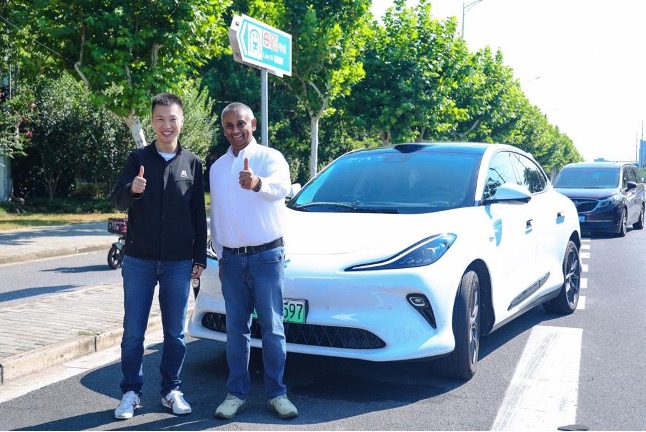
The announcement that Uber and Chinese autonomous vehicle developer Momenta will launch Level 4 Robotaxis in Munich from 2026 marks a turning point for Europe’s urban mobility landscape – and highlights the growing gap between Germany and the UK.This report is published by The WP Times, based on the official press release issued by Momenta.
For the first time, fully autonomous vehicles will operate on public roads in a major European city without a safety driver behind the wheel. The pilot, backed by Germany’s advanced legal framework for autonomous driving (AFGBV), positions Munich as a live testing ground for scalable, AI-driven public transport.
The UK, meanwhile, is still running limited AV trials under provisional rules. Despite several years of research, consultation, and isolated pilots in Oxford, Cambridge, and East London, there is no confirmed roadmap for commercial Robotaxi operations in Britain.
Why Munich, not London
Germany’s decision to move forward is grounded in policy readiness. The AFGBV regulation, in force since 2022, enables companies to operate Level 4 vehicles within approved urban zones (Operational Design Domains, or ODDs). In contrast, the UK’s regulatory framework remains in draft form, awaiting further parliamentary debate.
Moreover, Munich offers a combination of technical infrastructure, political backing, and proximity to automotive giants like BMW and Mercedes-Benz – both existing partners of Momenta in the ADAS sector. London has technological capability but lacks a unified regulatory and public strategy to match.
How the Robotaxi system works
Under the Uber-Momenta partnership, autonomous vehicles will operate in digitally mapped urban zones, with passengers booking rides via the standard Uber app. The vehicles, equipped with AI-driven navigation, lidar, radar, and camera arrays, will make all driving decisions independently.
Initially, a safety operator will be present in the vehicle, but the long-term aim is fully driverless operation, supervised remotely by a central control centre. Vehicles will communicate with city infrastructure via V2X protocols and comply with real-time oversight requirements.
Strategic implications for the UK
London, often seen as Europe’s innovation capital, now faces a reputational risk. Without regulatory clarity or a national rollout plan, the UK may fall behind not just Germany, but also France, the Netherlands, and Nordic countries, all of which are preparing their own autonomous mobility strategies.
Robotaxis offer long-term potential for cities under pressure: reduced emissions, 24/7 service availability, improved transport access for disabled and elderly citizens, and eventually, lower operational costs compared to human-driven fleets.
Will Britain catch up
The UK Government has expressed support for autonomous mobility, and the Law Commission’s recommendations on self-driving vehicles were published in 2022. Yet progress towards implementation remains slow. Legal uncertainty, unclear liability rules, and a lack of commercial pilot projects continue to delay adoption.
If Uber’s pilot in Munich proves successful, pressure will grow for Transport for London (TfL) and the Department for Transport to act. The alternative is that future AV deployments, investment, and innovation will concentrate elsewhere.
Uber and Momenta’s decision is more than a test. It is a signal that Europe is ready to move beyond the lab. Whether the UK chooses to lead, follow or stand still will define its place in the global mobility transition.
Read about the life of Westminster and Pimlico district, London and the world. 24/7 news with fresh and useful updates on culture, business, technology and city life: DeepSeek Prepares AI Agent to Compete With OpenAI by End of 2025.