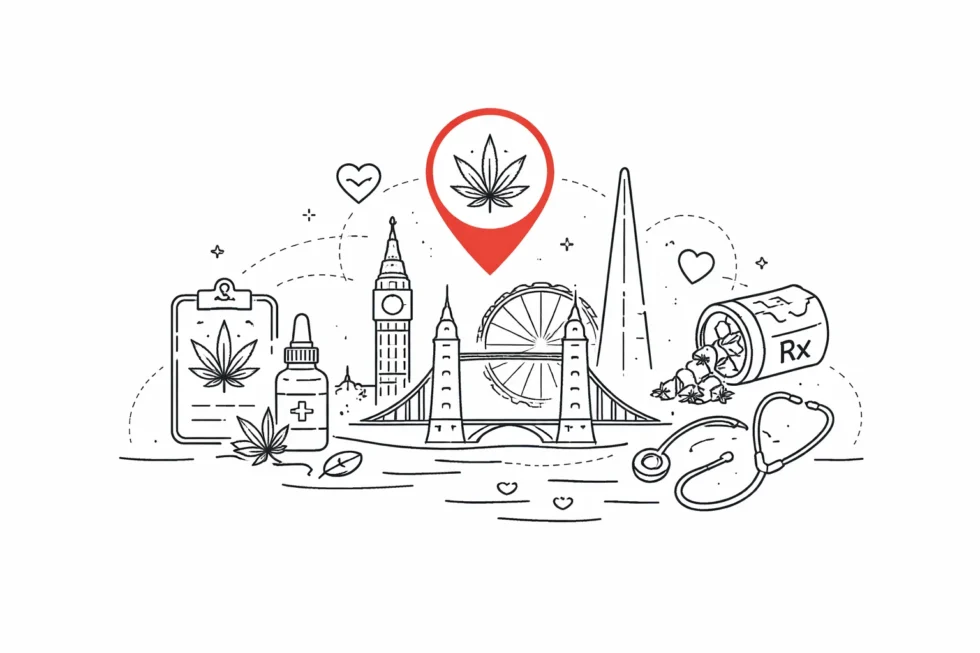
Medical cannabis is legal in the UK — but only through a narrow statutory gateway that most patients never reach. In London, Scotland and Northern Ireland, cannabis remains a Class B drug under criminal law, even as certain cannabis-based products for medicinal use (CBPMs) can now be prescribed by specialists. That legal contradiction has produced one of the widest treatment gaps in modern British healthcare: while fewer than 10,000 patients receive cannabis on the NHS, more than 140,000 are treated privately, and an estimated 1.8 to 2.3 million people continue to self-medicate outside the law.
That means the vast majority of patients using cannabis for pain, neurological disorders, anxiety or cancer symptoms remain technically criminalised despite Parliament’s reform. As The WP Times reports, the central question for Britain at the end of 2025 is no longer whether medical cannabis exists in law, but why the legal system and the NHS have left so many patients stranded between prescription medicine and illegal supply.
The law that controls everything
Britain’s approach to medical cannabis is shaped not by health policy but by drug-control law. The rules that determine who can use cannabis, in what form and under what conditions are written into the Misuse of Drugs Act 1971 and its supporting regulations — a legal framework designed to restrict drugs first and permit medical use only as a tightly controlled exception.
Britain’s cannabis regime is built on two pillars:
A. Misuse of Drugs Act 1971 (MDA 1971)
This is the primary criminal statute. Cannabis is a Class B controlled drug. Possession, supply, cultivation and import are criminal offences unless a lawful exemption applies.
B. Misuse of Drugs Regulations 2001 + SI 2018/1055
The medical exemption was created by The Misuse of Drugs (Amendments) (Cannabis and Licence Fees) Regulations 2018 (SI 2018/1055). It amended the 2001 Regulations to introduce CBPMs and allow them to be prescribed and supplied as Schedule 2 medicines.
Crucially, the regulations define who can open the legal door: a “specialist medical practitioner” (a doctor on the GMC Specialist Register) must initiate CBPM prescriptions. That single line explains why access remains limited in 2025.
What is actually legal — and what is not
In the United Kingdom, the legality of medical cannabis does not depend on a person’s illness, but on how the product is authorised, prescribed and supplied. The law draws a sharp line between regulated cannabis-based medicinal products (CBPMs) and all other forms of cannabis — a distinction that determines whether a patient is treated as a lawful user or a criminal offender.
Legal (inside the “medical corridor”)
You are lawful only if all of these are true:
- You hold a CBPM prescription initiated by a GMC-registered specialist.
- The product is supplied via the lawful medicines supply chain (usually a pharmacy).
- You possess and use exactly what is prescribed (form, quantity, instructions).
Still illegal (even if you are ill)
- Possessing cannabis without a valid CBPM prescription.
- Buying “medical cannabis” from social media, Telegram, or a friend.
- Importing cannabis products without authorisation.
- Growing cannabis at home.
- Sharing or supplying cannabis to anyone else.
The UK does not recognise “medical need” as a defence. It recognises authorised supply and prescription.
Which illnesses qualify
NHS reality (end-2025): the NHS prescribes medical cannabis only in a small number of cases, mainly:
- rare, severe epilepsies,
- chemotherapy-related nausea/vomiting,
- multiple-sclerosis spasticity.
For most other conditions (chronic pain, PTSD, anxiety, insomnia, migraines, ADHD), patients must use private specialist clinics. These clinics can assess a wider range of conditions — but the legal gateway remains the same: specialist initiation + CBPM supply.
How the system works in practice
In theory, the UK has a clear medical pathway for cannabis. In reality, it operates as a specialist-led, tightly regulated process that sits alongside the criminal law. For most patients in 2025, gaining lawful access means navigating medical records, consultant approval and controlled-drug dispensing — not simply asking a GP or a pharmacy.
Typical lawful pathway
- Medical records showing diagnosis and treatments tried.
- Specialist consultation (often remote).
- If approved → CBPM prescription.
- Pharmacy dispenses and ships the medicine.
- Follow-ups to adjust dose/product.
What to carry
- Original pharmacy-labelled packaging.
- A copy of the prescription or clinic letter.
These are what turn a stop by police or security into a quick check instead of a seizure.
London, Scotland, Northern Ireland — what differs on the ground
Although the law on medical cannabis is written in Westminster and applies across the United Kingdom, how it is experienced by patients varies sharply by region. Differences in NHS structures, policing practices, border controls and the availability of specialist clinics mean that a lawful prescription in London, Edinburgh or Belfast can lead to very different day-to-day realities — even under the same national statute.
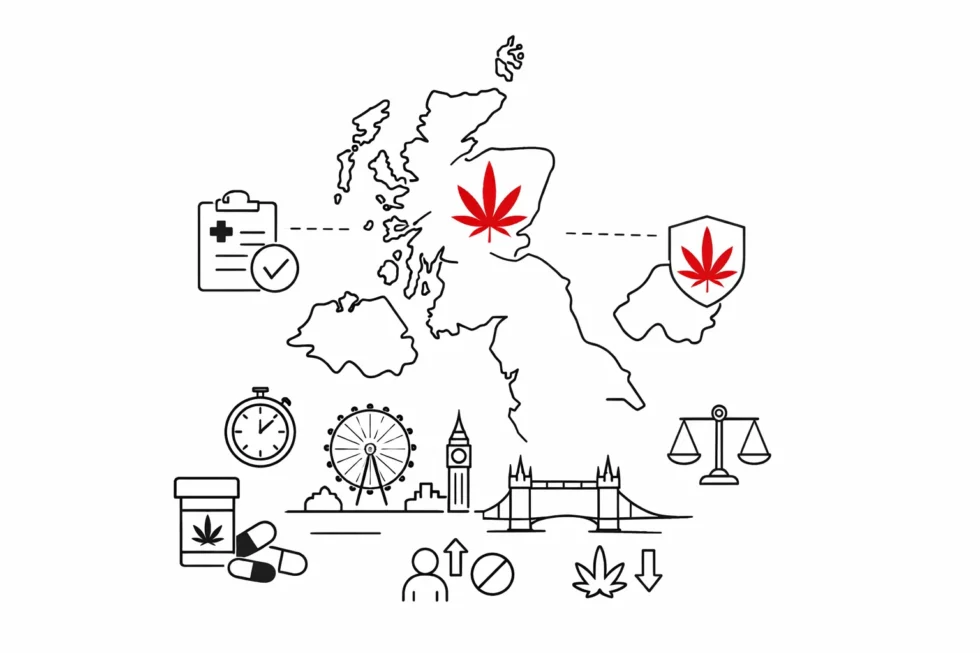
London (England)
Same law as the rest of England, but higher friction: airports, stations, arenas and clubs often default to criminal-law caution. Lawful patients are protected — if they can prove it on the spot.
Scotland
Same UK drug law; different NHS organisation. Fewer local specialists and clinics mean longer waits and more reliance on English providers shipping medicine north.
Northern Ireland
Same “prohibited unless authorised” model — plus border risk. A UK CBPM can become illegal the moment a patient crosses into Ireland. Documentation and route planning matter.
Home growing: absolutely not legal
In the United Kingdom, patients are not allowed to grow their own cannabis under any circumstances. The cultivation of a cannabis plant is treated in law as drug production, the same category used for commercial growing operations, and carries a maximum sentence of up to 14 years’ imprisonment.
While a court may take a person’s medical situation into account when deciding a sentence, medical need does not create a legal right to grow cannabis. Only cannabis supplied through the regulated CBPM prescription system is lawful.
Example:
A patient grows two plants “for personal pain relief”. If discovered, police can charge cultivation. The case enters the same sentencing framework as other production offences.
Penalties that still apply
Because cannabis remains a Class B drug under the Misuse of Drugs Act 1971, the introduction of medical cannabis did not remove it from the criminal law. Instead, it created a tightly defined medical exemption. Anyone who falls outside that exemption — whether through how the cannabis was obtained, stored or shared — remains subject to the same penalties that apply to non-medical use.
| Offence | Maximum penalty |
|---|---|
| Possession | Up to 5 years + unlimited fine |
| Supply or cultivation | Up to 14 years + unlimited fine |
Even small-scale “sharing” can be treated as supply.
What you can and cannot do (quick legal clarity)
You can (if prescribed):
- Possess and use your CBPM as prescribed.
- Travel within the UK with it (carry proof).
- Use approved forms (often vaporisation).
You cannot (even if prescribed):
- Grow cannabis at home.
- Buy extra cannabis from illicit sources.
- Share or give it to anyone else.
- Assume venues must allow it.
Expanded compliance table (publication-ready)
| Area | What UK law requires | Common mistake | Legal risk |
|---|---|---|---|
| Prescriber | GMC Specialist must initiate | Relying on GP | Product becomes unlawful |
| Product | Must be a CBPM | Buying “medical weed” online | Possession offence |
| NHS access | Limited indications | Assuming universal NHS cover | Forced into illicit market |
| Proof | Original labelled packaging | Carrying loose cannabis | Seizure / questioning |
| Home grow | Never allowed | “Just a few plants” | Cultivation charge (14 yrs max) |
| Sharing | Never allowed | Giving to partner | Supply charge |
| Travel | Controlled-drug rules | Crossing borders casually | Import/export offences |
Why the confusion persists in 2025
Britain did not legalise cannabis — it legalised a pharmaceutical category. Under the Misuse of Drugs Act 1971, the cannabis plant remains a Class B drug, criminal to possess, grow or supply. Only a narrow subset of cannabis — CBPMs (cannabis-based products for medicinal use) — was carved out of that ban through the 2018 amendment to the Misuse of Drugs Regulations.
That means the law does not ask “Are you sick?”
It asks “Is this specific product authorised, prescribed by a specialist and dispensed through the medicines system?”
A patient with chronic pain who buys cannabis from a dealer is committing a criminal offence.
A patient with the same pain who holds a specialist CBPM prescription is lawfully medicated — even if the substance looks identical. This is why police, airports and courts do not evaluate medical need. They evaluate documentation, packaging and supply chain. A jar of cannabis without a pharmacy label is illegal, even if it comes from a legal grower. A legally dispensed CBPM is protected, even if it contains the same THC.
Until Parliament reforms the 1971 Act itself, Britain will continue to run two parallel systems:
- healthcare for those inside the CBPM framework
- criminal law for everyone else
That is why, in 2025, British patients still live between prescriptions and prosecutions. Read about the life of Westminster and Pimlico district, London and the world. 24/7 news with fresh and useful updates on culture, business, technology and city life: Pimlico private doctors: same-day GP, blood tests and private medical clinics near Westminster