UK new 76 number plates are being issued from 1 September 2026 to newly registered vehicles in England, Scotland and Wales, replacing the 26 age identifier used since March. Ahead of the September change, the Driver and Vehicle Licensing Agency withheld more than 500 registration combinations that could be interpreted as offensive, obscene or connected with sensitive subjects including war, terrorism, race, religion and current conflicts. The DVLA disclosure covers the 76 series specifically, while the agency's normal legal requirements on plate colour, font, spacing and visibility remain unchanged. A plate displayed incorrectly can still bring a fine of up to £1,000 and an MOT failure, making the September change relevant not only to buyers collecting new cars but also to anyone ordering replacement or personalised plates, The WP Times reports.
The change itself is straightforward. Cars first registered in the first registration period of 2026 use 26; cars entering the system from 1 September use 76, following the long-standing practice of adding 50 for the second registration period of the year. A current-format registration still contains two regional letters, a two-digit age identifier and three final letters, for example AB76 XYZ. What makes this release more conspicuous is the volume and nature of combinations removed before motorists ever had the chance to receive them.
What do UK new 76 number plates mean from September 2026
The UK new 76 number plates identify vehicles first registered during the second registration period of 2026 in Great Britain. The current registration format has been in use since 2001 and follows a fixed structure: the first two letters relate to the registration area, the following two numbers indicate when the registration was issued, and the final three letters distinguish the individual registration. GOV.UK confirms that the standard modern format remains two letters, two numbers and three letters.
For 2026, the sequence works like this:
| Registration period | Age identifier | Example | Meaning |
|---|---|---|---|
| 1 March to 31 August 2026 | 26 | AB26 XYZ | First 2026 registration period |
| From 1 September 2026 | 76 | AB76 XYZ | Second 2026 registration period |
| September 2025 comparison | 75 | AB75 XYZ | Second 2025 registration period |
| March 2027 comparison | 27 | AB27 XYZ | First 2027 registration period |
The September identifier is therefore not an arbitrary number. March registrations use the final two digits of the year, while the autumn series adds 50, turning 26 into 76.
The 76 identifier dates the registration period of the vehicle; it does not represent a new design or a separate class of number plate.
A motorist also cannot use a newer current-style registration to make an older car appear younger. The age identifier places a limit on which vehicles can legally carry a particular current-format personalised mark.
The system discussed here applies to Great Britain. Northern Ireland operates a different registration format and does not use the same March and September age identifiers, so the arrival of 76 plates primarily concerns vehicles registered in England, Scotland and Wales.
Which 76 number plates has DVLA withheld
The DVLA banned plates list is prepared before each new registration release. An official DVLA Freedom of Information disclosure log confirms that request FOIR13179 asked for registration numbers and character combinations being withheld, withdrawn or banned from the 2026 release of 76 registrations. The request was recorded as fully met on 27 February 2026. The supplied list contains hundreds of individual combinations. Some can be interpreted as crude words once 7 or 6 is treated visually as part of the surrounding letters. Others resemble racial or religious abuse, references to violence, extremist terminology or current wars.
“The vast majority of registration numbers are made available, but DVLA withholds any combinations that may cause offence, embarrassment, or are in poor taste.” (DVLA spokesperson, August 2026.)
The important distinction is that DVLA does not publish an individual explanation beside every withheld registration. The table below therefore shows registrations confirmed as appearing in the supplied 76-series list and groups them by the type of wording they appear capable of producing; it does not attribute a specific motive to DVLA where the agency has not publicly provided one.
| Withheld 76 registration | What makes it notable |
|---|---|
| AA76 RSE | Can visually form an offensive word |
| AR76 RSE | Can visually form an offensive word |
| UD76 RSE | Can visually form an offensive word |
| UP76 RSE | Can visually form an offensive word |
| EA76 DCK | Crude sexual reading |
| BU76 DCK | Crude sexual reading |
| EA76 NOB | Insult/crude reading |
| FA76 NOB | Insult/crude reading |
| BU76 NOB | Insult/crude reading |
| PE76 NOB | Insult/crude reading |
| WE76 NOB | Insult/crude reading |
| EA76 POO | Crude bodily reference |
| EA76 BUT | Crude bodily reference |
| WE76 BUT | Crude bodily reference |
| EA76 COX | Crude phonetic reading |
| HO76 COX | Crude phonetic reading |
| WE76 COX | Crude phonetic reading |
| CU76 VAG | Sexual/anatomical reading |
| EA76 VAG | Sexual/anatomical reading |
| FA76 VAG | Sexual/anatomical reading |
| HO76 VAG | Sexual/anatomical reading |
| PE76 VAG | Sexual/anatomical reading |
| RO76 VAG | Sexual/anatomical reading |
| WO76 VAG | Sexual/anatomical reading |
| CU76 VAJ | Sexual/anatomical reading |
| EA76 VAJ | Sexual/anatomical reading |
| FA76 VAJ | Sexual/anatomical reading |
| FK76 VAJ | Sexual/anatomical reading |
| GU76 VAJ | Sexual/anatomical reading |
| HO76 VAJ | Sexual/anatomical reading |
| PE76 VAJ | Sexual/anatomical reading |
| RR76 VAJ | Sexual/anatomical reading |
| WW76 VAJ | Sexual/anatomical reading |
| GE76 GUN | Weapon reference |
| MP76 GUN | Weapon reference |
| PM76 GUN | Weapon reference |
| GE76 BOM | Possible bomb reference |
| GO76 BOM | Possible bomb reference |
| GU76 WAR | War reference |
| HO76 WAR | War reference |
| UR76 WAR | War reference |
| UW76 WAR | War reference |
| GB76 UKR | Ukraine-related wording |
| GO76 UKR | Ukraine-related wording |
| NU76 UKR | Ukraine-related wording |
| SE76 UKR | Ukraine-related wording |
| UN76 UKR | Ukraine-related wording |
| UP76 UKR | Ukraine-related wording |
| UR76 UKR | Ukraine-related wording |
| UW76 UKR | Ukraine-related wording |
| WA76 UKR | Ukraine-related wording |
| WE76 UKR | Ukraine-related wording |
| YW76 UKR | Ukraine-related wording |
| GB76 RUS | Russia-related wording |
| EU76 RUS | Russia-related wording |
| FK76 RUS | Russia-related wording |
| GO76 RUS | Russia-related wording |
| NO76 RUS | Russia-related wording |
| RU76 RUS | Russia-related wording |
| UN76 RUS | Russia-related wording |
| UP76 RUS | Russia-related wording |
| US76 RUS | Russia-related wording |
| VO76 RUS | Russia-related wording |
| WA76 RUS | Russia-related wording |
| YE76 RUS | Russia-related wording |
| GB76 AZA | Gaza-related visual reading |
| AC76 AZA | Gaza-related visual reading |
| CU76 AZA | Gaza-related visual reading |
| FK76 AZA | Gaza-related visual reading |
| GE76 AZA | Gaza-related visual reading |
| GO76 AZA | Gaza-related visual reading |
| GU76 AZA | Gaza-related visual reading |
| NO76 AZA | Gaza-related visual reading |
| OU76 AZA | Gaza-related visual reading |
| RA76 AZA | Gaza-related visual reading |
| RO76 AZA | Gaza-related visual reading |
| UK76 AZA | Gaza-related visual reading |
| UP76 AZA | Gaza-related visual reading |
| US76 AZA | Gaza-related visual reading |
| YE76 AZA | Gaza-related visual reading |
| GB76 HAD | Sensitive phonetic/political reading |
| JE76 HAD | Sensitive phonetic/political reading |
| JG76 HAD | Sensitive phonetic/political reading |
| JJ76 HAD | Sensitive phonetic/political reading |
| XH76 HAD | Sensitive phonetic/political reading |
| XS76 HAD | Sensitive phonetic/political reading |
| YE76 MEN | Yemen-related visual reading |
| HH76 NAZ | Nazi-related visual reading |
| JU76 NAZ | Nazi-related visual reading |
| NA76 ZEE | Nazi-related phonetic reading |
| NE76 ZZE | Nazi-related phonetic reading |
| SP76 ZEE | Nazi-related phonetic reading |
| GE76 NGR | Racially offensive reading |
| GO76 NGR | Racially offensive reading |
| GU76 NGR | Racially offensive reading |
| CU76 PAK | Ethnic slur-related reading |
| GE76 PAK | Ethnic slur-related reading |
| GO76 PAK | Ethnic slur-related reading |
| GU76 PAK | Ethnic slur-related reading |
| CU76 PKY | Ethnic slur-related reading |
| GE76 PKY | Ethnic slur-related reading |
| GO76 PKY | Ethnic slur-related reading |
| GU76 PKY | Ethnic slur-related reading |
| CU76 JUW | Antisemitic phonetic reading |
| EA76 JUW | Antisemitic phonetic reading |
| FA76 JUW | Antisemitic phonetic reading |
| GE76 JUW | Antisemitic phonetic reading |
| GO76 JUW | Antisemitic phonetic reading |
| GU76 JUW | Antisemitic phonetic reading |
| CU76 LEZ | Homophobic/sexual slur reading |
| EA76 LEZ | Homophobic/sexual slur reading |
| GE76 LEZ | Homophobic/sexual slur reading |
| GU76 LEZ | Homophobic/sexual slur reading |
| NO76 LEZ | Homophobic/sexual slur reading |
| BU76 GAY | Sexual-orientation reference |
| GU76 GAY | Sexual-orientation reference |
The complete supplied material runs well beyond the examples above and also contains wildcard entries such as BJ76 AG*, GU76 AY*, NE76 RO* and UR76 AY*. A wildcard means several combinations can be captured by one listed pattern, which helps explain why published totals for the 76 blacklist do not always match precisely when different reports count patterns and individual registrations differently.
One widely reported count puts the list at 511 combinations. The safest description is therefore that DVLA withheld more than 500 combinations from the September 2026 series, while the official disclosure confirms the existence of the 76-registration blacklist without providing a simple headline total in its public log.
Why 76 creates unusual words on number plates
The middle digits can alter how surrounding letters are read. A 7 can resemble a T in certain visual combinations, while the complete 76 sequence can bridge letters on either side and create a word that is not obvious when each character is read literally.
That is why combinations including EA76 DCK, FA76 NOB or AR76 RSE can attract attention despite technically containing two ordinary registration digits. The screening process is based on the likely visual reading of the whole mark, not simply on a dictionary search for offensive three-letter endings.
DVLA can prevent a registration from entering circulation before it is issued, but motorists cannot create their own acceptable version by changing the spacing or appearance of the characters.
The blacklist also extends beyond rude jokes. The supplied 76 list contains combinations resembling references to Russia, Ukraine, Gaza and Yemen, alongside terms associated with race, religion, Nazism, weapons and violence. That reflects the agency's broader practice of withholding combinations considered capable of causing offence, embarrassment or being in poor taste.
What number plate rules apply to cars carrying a 76 registration
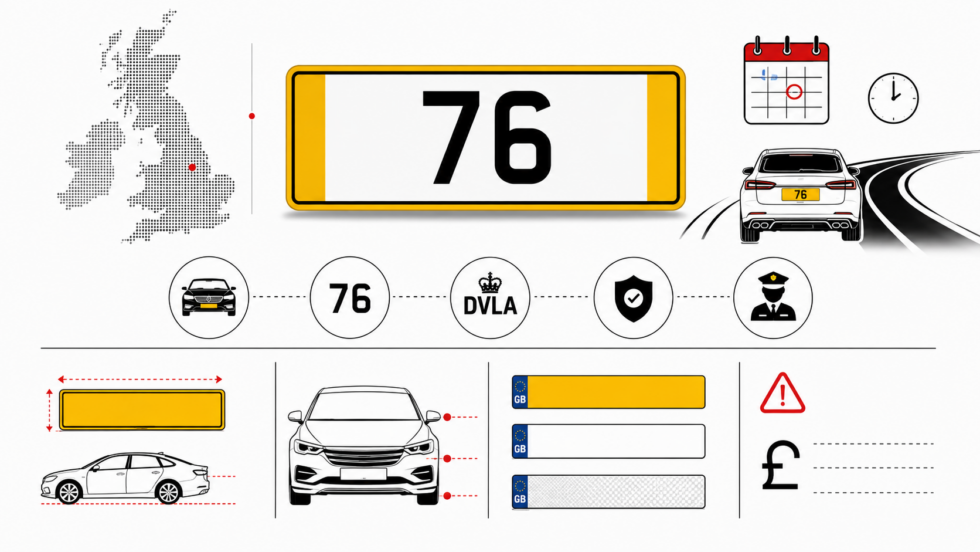
A legal 76 registration plate must follow exactly the same display rules as any other current number plate. GOV.UK says registration numbers must be shown correctly and motorists cannot rearrange the letters or numbers or modify them so that they become difficult to read. Driving with an incorrectly displayed plate can result in a fine of up to £1,000 and an MOT failure.
For standard modern vehicles, the government's number plate rules require plates to:
- be made from reflective material;
- show black characters on a white background at the front;
- show black characters on a yellow background at the rear;
- have no background pattern;
- carry the details of the number plate supplier;
- carry the relevant British Standard number;
- use characters that are not removable or reflective.
For plates fitted after 1 September 2021, the applicable standard is BS AU 145e and the characters must be a single shade of black. Raised 3D characters are permitted provided the finished plate still complies with the regulations.
“You cannot rearrange letters or numbers, or alter them so that they’re hard to read.” (GOV.UK, Displaying number plates.)
That rule matters particularly for personalised registrations. Moving a character, narrowing a gap or positioning a fixing so that a letter resembles another character can turn an otherwise valid registration into an illegally displayed one.
The current DVSA MOT manual also requires registration plates to remain legible and correctly formed. Its identification section covers character format, visibility and defects, while the manual was updated on 1 June 2026. A registration obscured by tinting, deterioration, fixings or other features can therefore create an MOT problem as well as an enforcement issue on the road.
| Plate feature | Legal requirement |
|---|---|
| Front background | White |
| Rear background | Yellow |
| Characters | Black |
| Material | Reflective |
| Background pattern | Not permitted |
| New/replacement plates after 1 September 2021 | BS AU 145e |
| Raised 3D characters | Permitted if otherwise compliant |
| Rearranged letters or numbers | Not permitted |
| Altered spacing to create another word | Not permitted |
| Features making characters difficult to read | Not permitted |
| Maximum fine for incorrect display | Up to £1,000 |
| MOT consequence | Vehicle can fail |
The September launch therefore creates no exemption for buyers who want a distinctive-looking plate. A newly registered vehicle can legitimately display AB76 XYZ, but its owner cannot compress, split or reshape that registration to force a different reading.
What should drivers check when collecting a car with a 76 plate?
Most motorists collecting a factory-new vehicle from 1 September will receive correctly manufactured plates from the supplying dealer. The useful checks concern accuracy and subsequent modifications rather than the presence of 76 itself.
- Match the registration on both plates with the vehicle documents.
- Check that the front plate is white and the rear plate yellow.
- Make sure the characters are black, clear and correctly spaced.
- Check that decorative screws, caps or films do not change how any character appears.
- Use a registered supplier if a damaged or personalised plate needs to be replaced.
- Do not alter a registration in an attempt to spell a name, word or phrase.
GOV.UK states that registered number plate suppliers require documentation proving identity and entitlement to use the registration. The system is designed to ensure that the physical plate corresponds to a registration legally assigned to the vehicle.
The most useful distinction for motorists is between the registration number issued by DVLA and the physical plate displaying it: both must be legitimate.
The DVLA 76 plates release therefore brings two separate issues together on 1 September 2026. New vehicles move from the 26 identifier to 76, while hundreds of possible registrations have already been removed before issue because of how their letters and numbers could be interpreted. Once an acceptable registration reaches the road, the normal display rules still apply in full, including the £1,000 maximum fine and the possibility of MOT failure for a non-compliant plate.
Materials used: Driver and Vehicle Licensing Agency, GOV.UK, Driver and Vehicle Standards Agency, Carwow, Telegraph & Argus.
Read about the life of Westminster and Pimlico district, London and the world. 24/7 news with fresh and useful updates on culture, business, technology and city life: Why was Heritage Live cancelled and what is known about the Sandringham concerts, line-ups and refunds