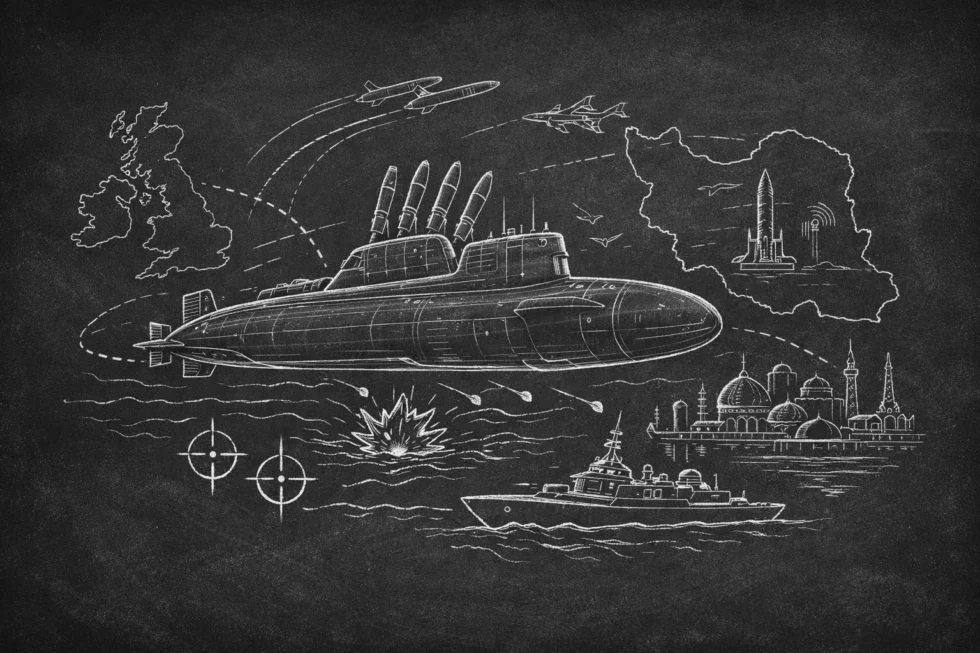
A British Royal Navy nuclear-powered submarine equipped with Tomahawk cruise missiles has moved into position in the Arabian Sea, potentially giving the United Kingdom the capability to carry out strikes against Iran if the situation in the region escalates. This is reported by The WP Times, citing Daily Mail, with reference to sources familiar with the deployment.
According to those sources, HMS Anson departed from a naval facility in Perth on 6 March and has since reached the northern part of the Arabian Sea. The positioning of the submarine places it within operational range of potential targets, while maintaining the strategic ambiguity typical of submarine deployments. Officials cited in the report indicate that the UK military now has a direct and flexible strike option available in the region. The presence of a submarine platform allows for covert positioning and rapid response, without the visibility associated with surface vessels or air deployments.
“Anson will remain concealed. The Prime Minister and the Commander of Maritime Operations will be informed of her position, as will the Submarine Service, but her location will not be widely known,” a source said, describing standard operational secrecy procedures. The same source noted that Royal Navy forces are capable of placing submarines in designated areas quickly, where they can remain on station for extended periods. Submarines of this class are designed for prolonged deployments, allowing them to operate discreetly over weeks without detection.
The UK Ministry of Defence declined to comment on the specific location or operational status of HMS Anson, stating that it does not provide details regarding ongoing missions or deployments. Such responses are consistent with long-standing policy on submarine operations.
According to media reports, HMS Anson periodically approaches communication depth in order to establish secure contact with command structures at the Permanent Joint Headquarters (PJHQ) in Northwood, London. This enables coordination while preserving operational security. In the event of a decision to carry out a strike, the order would be issued through the UK’s chain of command, with the head of joint operations acting following approval from the Prime Minister. The deployment comes amid a broader shift in UK and allied military posture in the Middle East. Prime Minister Keir Starmer has authorised the United States to use British military bases for potential operations targeting Iranian facilities, particularly in the context of securing maritime routes in the Strait of Hormuz, a key global energy corridor.
What is known about HMS Anson
HMS Anson is an Astute-class nuclear-powered attack submarine of the Royal Navy, designed for intelligence gathering, surveillance, and precision strike missions. It is equipped with Tomahawk Block IV cruise missiles, which have a range of up to approximately 1,000 miles, allowing for long-distance precision targeting, as well as Spearfish heavyweight torpedoes for anti-ship and anti-submarine warfare. The vessel operates with a crew of around 98 personnel and is capable of remaining deployed at sea for up to three months without resupply. Its nuclear propulsion system provides sustained power and endurance, with the reactor designed to operate for up to 25 years without refuelling.
Earlier, Prime Minister Keir Starmer confirmed that the United States had formally requested permission to use UK bases for potential strikes on Iran. The British government agreed to this request, citing concerns related to Iran’s actions and regional stability. At the same time, amid rising tensions, the United States is reinforcing its military presence in the Middle East, deploying thousands of additional personnel. Some units are reportedly being moved earlier than planned, indicating an accelerated response to developments in the region.
Read about the life of Westminster and Pimlico district, London and the world. 24/7 news with fresh and useful updates on culture, business, technology and city life: Robert Mueller dies at 81: former FBI director, special counsel and central figure in Trump-era investigations