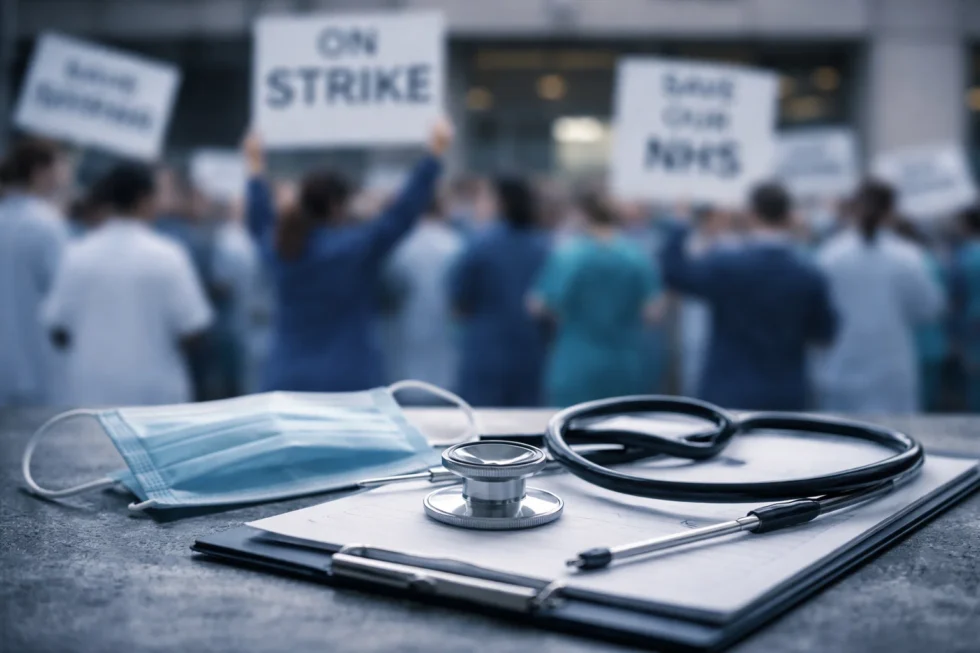
Today, 8 April 2026, doctors strike UK enters a critical phase as resident doctors continue coordinated industrial action across England from 7 to 13 April, marking the 15th strike since March 2023 and sharply intensifying the NHS strike 2026 crisis over pay, staffing shortages and system resilience, reports The WP Times, citing statements from the British Medical Association and official government briefings via Department of Health and Social Care. The walkout follows the collapse of negotiations in March, with the BMA demanding around 26% pay restoration and ministers refusing to meet full terms, warning that continued disruption risks delaying NHS recovery and increasing operational pressure across hospitals.
According to union communications and reporting from BBC, the dispute reflects a widening gap between workforce expectations and government policy, with both sides now framing the NHS strike 2026 as a structural issue rather than a temporary disagreement. Officials argue recent pay increases and reforms represent a fair offer, while doctors maintain that more than a decade of real-terms pay erosion and worsening working conditions require a materially stronger settlement, leaving the conflict unresolved at a critical moment for NHS capacity.
Why doctors are striking this week: pay dispute, staffing pressure and failed talks
The current doctors strike UK is driven by a combination of long-term pay erosion and immediate system pressure, which together have pushed negotiations beyond recovery in their current form. Resident doctors maintain that salaries have failed to keep pace with inflation for over a decade, effectively reducing real income despite recent increases. At the same time, working conditions have deteriorated due to staffing shortages and rising patient demand, increasing both workload and burnout risk. The collapse of talks in March 2026 removed the last buffer between negotiation and escalation. As a result, the NHS strike 2026 now reflects a deeper breakdown in trust between government and workforce.
Key drivers behind the strike
- Real pay decline since 2008 despite nominal increases
- Demand for approximately 26% pay restoration
- Breakdown of negotiations in March 2026
- Persistent NHS staffing shortages
- Bottlenecks in specialist training access
Taken together, these factors create a system where doctors face both financial and professional constraints. This dual pressure explains why the dispute has hardened, with increasing willingness among doctors to sustain prolonged industrial action.
What the government offered — and why it failed
The government’s proposal focused on incremental pay increases combined with structural reforms aimed at improving long-term workforce dynamics. Officials argued that the package would deliver meaningful financial improvement while expanding training capacity and reducing career bottlenecks. However, the offer did not directly address historical pay erosion, which remains the central demand of the British Medical Association. Concerns over timing and credibility of reforms further weakened the proposal’s acceptance. As a result, the gap between both sides remains unresolved.
Government offer vs union expectations
| Element | Government proposal | BMA position |
|---|---|---|
| Pay increase | ~4.9% average | ~26% restoration required |
| Career progression | Faster structured pathways | Secondary to pay restoration |
| Training posts | +4,000–4,500 over three years | Insufficient vs demand |
| Immediate expansion | +1,000 posts in 2026 | Does not remove bottleneck |
| Additional support | Exam and professional fees covered | Not core issue |
For the union, the structure of the offer fails to resolve accumulated losses over time. Without a clear mechanism to restore real earnings, additional benefits are seen as marginal rather than transformative.
What the NHS strike 2026 means now for patients and services
The immediate impact of the doctors strike UK is visible across NHS England through service disruption and delayed care pathways. Hospitals are prioritising urgent and emergency treatment while postponing elective procedures and routine appointments. This creates a backlog that typically extends beyond the duration of the strike itself, affecting patient flow in subsequent weeks. At the same time, non-striking staff face increased workload, amplifying operational strain. The system continues to function, but with reduced flexibility and higher risk exposure.
Immediate impact on services
- Postponement of non-urgent surgeries and procedures
- Longer waiting times for consultations
- Increased pressure on emergency departments
- Redistribution of workload to remaining staff
Even short disruptions can produce long-term delays, as rescheduling capacity is limited. This highlights how tightly balanced the NHS system has become.
Structural pressure: staffing, costs and system stability
Beyond immediate disruption, the strike exposes structural vulnerabilities within the NHS workforce model. Demand for medical training significantly exceeds available positions, creating both shortages and progression bottlenecks simultaneously. Financial pressure is also increasing, with estimated strike-related costs reaching up to £300 million. Meanwhile, hospitals continue to operate near capacity, leaving minimal room for disruption. These combined pressures make the system highly sensitive to workforce withdrawal. System pressure indicators
- Over 30,000 applicants for around 10,000 training posts
- Estimated strike cost up to £300 million
- High reliance on resident doctors in daily operations
- Limited reserve capacity across NHS services
This imbalance between demand, staffing and funding is what turns industrial action into a system-wide stress event rather than an isolated labour dispute.
What happens next: three realistic scenarios
The direction of the NHS strike 2026 will depend on whether both sides can return to negotiations under revised conditions. Political and operational pressure is increasing, but positions remain significantly apart. Even if talks resume, a full resolution may require phased implementation over time. The risk of continued disruption remains elevated in the short term. Three scenarios now define the likely trajectory. Possible scenarios
- Negotiation restart — partial agreement and temporary suspension of strikes
- Further escalation — additional strike rounds and deeper system disruption
- Limited compromise — short-term relief without resolving core issues
The underlying issue remains structural. Without addressing workforce sustainability and real pay dynamics, the conditions that led to the doctors strike UK are likely to persist.
Read about the life of Westminster and Pimlico district, London and the world. 24/7 news with fresh and useful updates on culture, business, technology and city life: Fuel prices surge: what is the jet fuel price impact airlines and what happens next for travellers