
The England school mobile phones legislation move is set to introduce a statutory ban on smartphones in classrooms, marking a significant shift in how schools across England regulate digital devices during the school day. The government says the change will formalise existing practices already widely adopted by headteachers, while strengthening enforcement through law and inspections, as education officials argue that mobile phones have no place in learning environments. Reporting from Westminster confirms that the proposal will be attached to the Children’s Wellbeing and Schools Bill, with ministers stating it will provide “clear legal force” to school policies already in operation, reports The WP Times via BBC.
The decision follows months of political pressure, cross-party debate, and ongoing concerns from educators about disruption, safeguarding risks, and declining attention in classrooms linked to smartphone use among pupils.
Government plan to enforce a legal phone ban in schools
The England school mobile phones legislation proposal will amend the Children’s Wellbeing and Schools Bill to make smartphone restrictions legally binding across all schools in England. Education minister Baroness Jacqui Smith confirmed in the House of Lords that the amendment will “create a clear legal requirement for schools” to enforce phone-free environments during the school day. The Department for Education (DfE) maintains that most schools already restrict phone use, meaning the law is intended to formalise rather than radically change existing practice.
Education Secretary Bridget Phillipson previously urged schools to adopt a full-day phone-free approach, reinforcing earlier guidance issued in January.
Officials argue that the legislation strengthens safeguarding frameworks and aligns school policy with broader child welfare objectives. The government also plans to integrate compliance monitoring into Ofsted inspections from April, adding a regulatory enforcement mechanism.
Key policy elements:
- Legal requirement for phone restrictions in schools
- Integration into Children’s Wellbeing and Schools Bill
- Ofsted monitoring of mobile phone policies
- Reinforcement of existing school-level bans
Political reaction and parliamentary debate
The announcement has triggered mixed political responses, reflecting broader divisions over education governance and child wellbeing policy.
Conservative shadow education secretary Laura Trott described the move as “fantastic news for headteachers, parents and pupils across the country,” arguing that it validates long-standing Conservative proposals. She also criticised the government for initially dismissing the policy as unnecessary before adopting it.
Liberal Democrats welcomed the direction of travel but warned that implementation must be supported with adequate funding. Caroline Voaden said ministers must ensure schools are properly equipped to manage enforcement without placing additional financial pressure on already stretched budgets.
“This is fantastic news for headteachers, parents and pupils across the country.” — Laura Trott, Conservative shadow education secretary (UK Parliament, Westminster)
Schools, enforcement and inspection framework
The England school mobile phones legislation will not only formalise bans but also embed enforcement into school accountability systems. According to the Department for Education, mobile phone policies will become part of Ofsted inspection criteria, meaning schools will be assessed on how effectively they enforce restrictions.
Officials say the majority of schools already operate phone bans, but consistency remains an issue across different regions and school types.
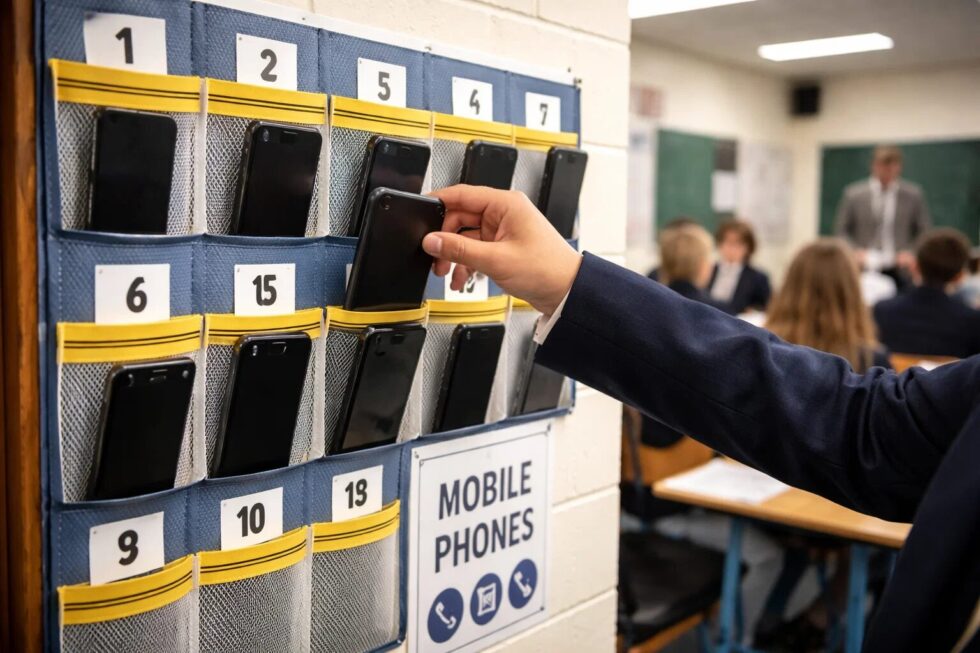
The aim is to ensure uniform standards and reduce variation in enforcement. Schools will retain flexibility in how they implement the rules, including confiscation policies, storage systems, and disciplinary measures.
However, education leaders argue that enforcement alone will not solve operational challenges. Some headteachers have warned that without additional funding, schools may struggle to implement secure storage systems such as lockers or locked pouches.
Key enforcement tools:
- Ofsted inspection monitoring
- School-level policy autonomy
- Mandatory compliance expectations
- Behaviour management integration
Union response and operational concerns
Education sector unions have expressed cautious support for the principle of the ban but raised concerns about implementation costs and effectiveness.
Pepe Di’Iasio, general secretary of the Association of School and College Leaders, argued that the legislation “doesn’t really change very much” because most schools already enforce bans. He stressed that the more urgent issue is funding infrastructure for safe phone storage and stronger regulation of social media platforms outside school hours.
There is also concern that the policy does not address the broader digital ecosystem influencing student behaviour beyond school grounds. Educators highlight that smartphone-related distractions extend into homework time and social interactions.
Key concerns raised:
- Lack of funding for storage infrastructure
- Limited impact on existing school practices
- Need for stronger social media regulation
- Enforcement burden on school staff
Devolved education systems across the UK
The England school mobile phones legislation applies specifically to England, as education policy is devolved across the United Kingdom. This means different approaches are already in place across Scotland, Wales, and Northern Ireland.
In Scotland, updated guidance introduced in 2024 allows headteachers to implement phone bans at their discretion, giving schools flexibility rather than imposing a national law. Wales currently has no national ban, but individual school leaders can restrict phone use independently. In Northern Ireland, a pilot programme involving phone-free schools has recently concluded, with findings expected to be published later this year.
Comparison overview:
- England: Legal statutory ban under proposed legislation
- Scotland: School-led bans under national guidance
- Wales: No national policy, school discretion applies
- Northern Ireland: Pilot scheme completed, report pending
Policy context and wider educational debate
The England school mobile phones legislation is being framed by the government as part of a broader child safeguarding agenda. Officials argue that reducing smartphone use during school hours improves concentration, classroom behaviour, and academic outcomes.
The DfE has stated that mobile phones “have no place in schools,” reinforcing a shift toward stricter digital discipline policies.
At the same time, critics highlight that behavioural issues linked to smartphones often originate outside school environments, particularly through social media exposure and unsupervised screen time. This raises questions about whether school-based bans alone are sufficient to address wider digital risks facing teenagers.
The introduction of the England school mobile phones legislation marks a significant policy shift toward formalising smartphone restrictions in education law. While most schools already operate bans, the move introduces legal consistency, inspection oversight, and political accountability. However, debates continue over funding, enforcement capacity, and whether legislation inside schools can effectively address broader digital behaviour challenges across society.
Read about the life of Westminster and Pimlico district, London and the world. 24/7 news with fresh and useful updates on culture, business, technology and city life: RSV vaccine pregnancy rollout shows how timing and coverage cut infant hospital risk across England