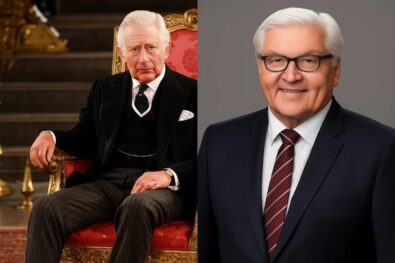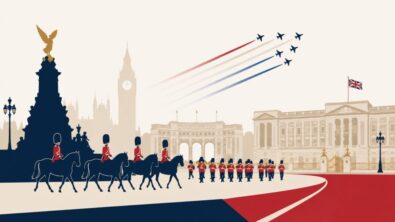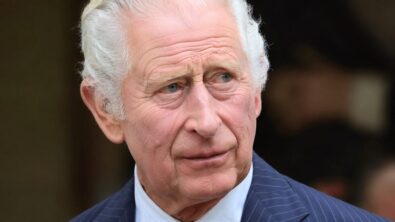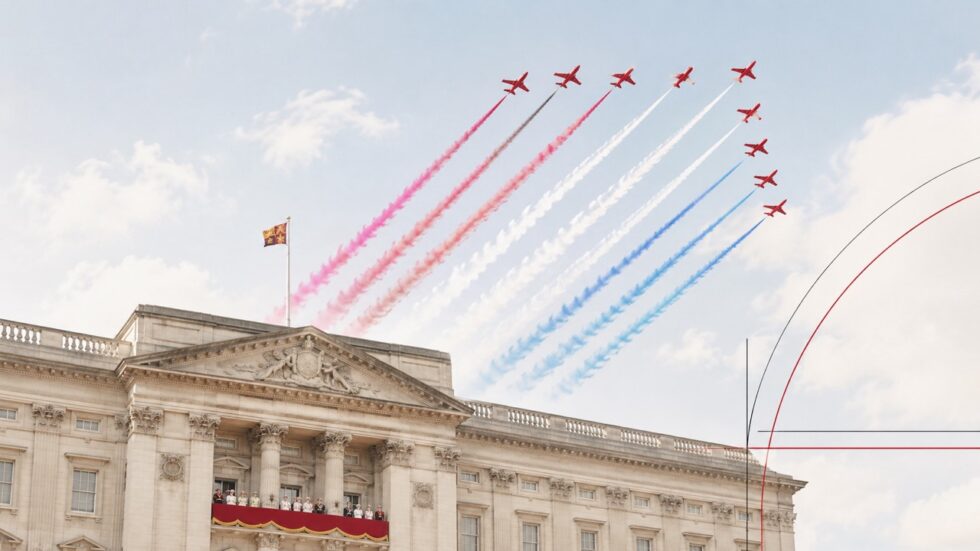
Trooping the Colour 2026 brought King Charles, Queen Camilla and senior members of the Royal Family to the Buckingham Palace balcony on Saturday 13 June, ending the King’s Birthday parade with the familiar spectacle of the Red Arrows above central London. The ceremony combined military precision, royal tradition and a highly managed public display at Horse Guards Parade and Buckingham Palace, where thousands gathered to watch the Trooping the Colour flypast and the royal balcony appearance, The WP Times reports.
For readers searching Trooping the Colour, Trooping of the Colour 2026, King Charles, King’s Birthday 2026, Red Arrows today, flypast today or what time is the flypast today, the essential facts were clear. The annual parade marking the sovereign’s official birthday ended with a flypast over Buckingham Palace, a 41-gun salute in honour of the King, and a balcony appearance by the working Royal Family, including the Prince and Princess of Wales and their children.
The day followed the traditional structure of the King’s Birthday Parade. Earlier in the ceremony, the colour of the Grenadier Guards was carried through the ranks of the Foot Guards and marched past the King. The public focus then shifted to Buckingham Palace, where the final balcony moment and the Red Arrows display created the image most closely associated with Trooping the Colour 2026. For the monarchy, this was a carefully choreographed state occasion. For the crowd lining The Mall and Whitehall, it was a day of pageantry and visibility. For many online readers, however, the practical questions were simpler: what is Trooping the Colour, when is King Charles birthday, what time is Trooping the Colour 2026, what time is flypast today, and what exactly did the Red Arrows do over Buckingham Palace? Those questions are at the centre of this report.
Trooping the Colour 2026: what happened at Buckingham Palace and Horse Guards Parade
Trooping the Colour 2026 began as the annual King’s Birthday parade in central London, with military units, mounted escorts, royal carriages and ceremonial music moving through one of the most closely watched events in the royal calendar. King Charles took part in the ceremony as sovereign, while Queen Camilla joined the public-facing elements of the day and later appeared with him on the Buckingham Palace balcony. The Princess of Wales travelled with Prince George, Princess Charlotte and Prince Louis, while the Prince of Wales, the Princess Royal and the Duke of Edinburgh were among those taking part in mounted formation. The colour being trooped this year was the King’s Colour of the Grenadier Guards. That matters because Trooping the Colour is not merely a royal appearance. At its core, it is a military ceremony in which the regimental colour, or flag, is carried through the ranks so it can be seen and honoured. In 2026, that ceremony again formed the central act before the day moved back toward Buckingham Palace for the balcony appearance and the Trooping the Colour flypast.
The public rhythm of the event was familiar. Crowds lined the route, senior royals took their places, the parade unfolded at Horse Guards Parade, and the day closed with the Royal Family assembled above the forecourt of Buckingham Palace. The climax came when the national anthem was played and the Red Arrows passed overhead trailing red, white and blue smoke across the London sky. For anyone searching Trooping the Colour 2026 photos, those were the defining images: the royal balcony, the Red Arrows above Buckingham Palace, the scarlet tunics of the guards, and Prince Louis again drawing attention as he watched the flypast with visible excitement. That combination of ceremony, family theatre and military display is why the event remains such a strong visual fixture of the British summer calendar.
Key moments from Trooping the Colour 2026
| Moment | What happened |
|---|---|
| Parade at Horse Guards Parade | Troops, bands and mounted units carried out the King’s Birthday ceremony |
| Trooping of the Colour | The King’s Colour of the Grenadier Guards was carried through the ranks |
| 41-gun salute | Fired in honour of King Charles |
| Return to Buckingham Palace | The royal procession moved back toward the palace |
| Buckingham Palace balcony | King Charles, Queen Camilla and senior royals appeared together |
| Trooping the Colour 2026 flypast | The Red Arrows and other aircraft closed the event over London |
What is Trooping the Colour and why does it mark the King’s Birthday
For those asking what is Trooping the Colour or what is the Trooping of the Colour, the answer begins with the army rather than the palace balcony. The ceremony comes from the tradition of showing, or “trooping”, a regiment’s colour through the ranks. Historically, the colour was a crucial battlefield marker, allowing soldiers to identify their unit. Over time, that military act developed into a state ceremonial parade marking the official birthday of the British sovereign. That is why the event is formally tied to the monarch’s public birthday rather than the monarch’s actual date of birth. Readers searching when is King Charles birthday should note the distinction clearly. King Charles III was born on 14 November, but his official birthday is celebrated in June through Trooping the Colour, as summer weather gives the best chance of staging the parade, procession and flypast outdoors.
This distinction also explains why online searches often spike around King’s Birthday 2026, Trooping the Colour 2026 time, and what time is Trooping the Colour 2026. The ceremonial day in London is the public birthday observance; the private or actual birthday is separate. In practical terms, Trooping the Colour is the royal state ceremony, while 14 November remains the King’s calendar birthday. The ceremony also serves a broader constitutional purpose. It presents the monarch at the centre of a national military ritual, surrounded by the institutions of state, the armed forces and the working Royal Family. The Buckingham Palace balcony appearance may be what many viewers remember, but the deeper meaning of Trooping the Colour remains rooted in continuity, ceremony and the public role of the Crown.
What Trooping the Colour means in practice
- It marks the sovereign’s official birthday, not always the sovereign’s actual birthday.
- It is a military parade centred on the regimental colour.
- It usually takes place in June in central London.
- It includes the royal procession, the parade, the balcony appearance and the flypast.
- It ends with one of the most recognisable images of the year: the Royal Family at Buckingham Palace.
Red Arrows flypast today: what time was the flypast and what did the public see?
The most common service questions around the event were practical ones: what time is the flypast today, what time is flypast today, fly past today, flypast today, Red Arrows today, Red Arrows flight path today, Red Arrows route today, Red Arrows schedule 2026, and King’s flypast 2026. While much of the day is built around ceremonial timing, the answer in simple terms is that the flypast came at the end of the public ceremony, once the Royal Family had gathered on the Buckingham Palace balcony.
The Red Arrows did not perform in isolation. Reports from the day made clear that multiple aircraft were part of the flypast, with the Red Arrows forming the most recognisable closing element. Their coloured vapour trails above Buckingham Palace provided the ceremonial finale, while other military aircraft crossed over central London as part of the wider display. That is why many searches combined broad terms such as flypast and flypast today with highly specific ones such as Trooping the Colour flypast 2026 and Trooping the Colour flypast. As for what time is Trooping the Colour 2026 and what time is the flypast today, the public answer is that the balcony appearance and flypast came shortly after the main parade sequence had concluded and the royals had returned to Buckingham Palace. In effect, the flypast is the closing act, not the opening one. The palace balcony appearance is the cue most viewers associate with the approach of the Red Arrows.
The question of Red Arrows flight path today 2026 or Red Arrows route today is harder to reduce to a single line because the flypast involves aircraft approaching London in formation before crossing over the ceremonial zone above The Mall and Buckingham Palace. What matters for viewers on the ground is the final approach over central London and the overhead pass above the palace. The visual focus is the same every year: the aircraft, the royal balcony and the crowd below.
The practical answer for readers searching flypast details
| Search query | Useful answer |
|---|---|
| What time is the flypast today? | It followed the Trooping the Colour ceremony and Buckingham Palace balcony appearance |
| What time is Trooping the Colour 2026? | The ceremony ran through late morning into early afternoon, with the flypast at the end |
| Red Arrows today | The Red Arrows formed the closing element of the King’s Birthday flypast |
| Red Arrows route today | The aircraft crossed central London and passed over Buckingham Palace |
| Red Arrows flight path today 2026 | Viewers focused on the final approach over The Mall and Buckingham Palace |
| Red Arrows schedule 2026 | The Trooping the Colour flypast was one of the major public ceremonial appearances |
Who appeared on the Buckingham Palace balcony with King Charles and Queen Camilla?
The Buckingham Palace balcony remains one of the most scrutinised moments of any major royal ceremony because it shows, in one frame, who is being presented as central to the monarchy’s public life. At Trooping the Colour 2026, King Charles and Queen Camilla stood at the centre of the balcony scene, joined by the Prince and Princess of Wales, Prince George, Princess Charlotte and Prince Louis. Other senior royals also appeared, including the Princess Royal and Vice Admiral Sir Tim Laurence, the Duke and Duchess of Edinburgh, the Duke and Duchess of Gloucester, and the Duke of Kent. The group was consistent with the narrower balcony model seen in recent years, which gives priority to working royals and close family members rather than a wider extended family display.
This matters because the balcony is no longer a neutral photo opportunity. It is a controlled constitutional image. By placing King Charles, Queen Camilla, William, Catherine and the Wales children at the centre of the scene, the palace presented both the current working monarchy and its line of succession. That is one reason Buckingham Palace and Trooping the Colour 2026 photos became such prominent search terms around the ceremony. The children also drew public attention in the way they often do at these occasions. Prince Louis, in particular, again became a focal point during the flypast, leaning and reacting as the aircraft passed overhead. That does not alter the constitutional meaning of the occasion, but it does explain why the balcony moment carries both formal and human interest value in media coverage.
Balcony line-up at Trooping the Colour 2026
- King Charles III
- Queen Camilla
- The Prince of Wales
- The Princess of Wales
- Prince George
- Princess Charlotte
- Prince Louis
- The Princess Royal
- Vice Admiral Sir Tim Laurence
- The Duke of Edinburgh
- The Duchess of Edinburgh
- The Duke of Gloucester
- The Duchess of Gloucester
- The Duke of Kent
Protesters, pageantry and the wider public picture
Although the dominant image of the day was ceremonial, Trooping the Colour 2026 was not entirely free of dissent. Anti-monarchy protesters were present near Buckingham Palace and The Mall, and a small protest was visible during the national anthem. That element did not overwhelm the ceremony, but it formed part of the public atmosphere and showed that royal events are now covered not only as spectacle but also as moments of political and civic expression.
At the same time, the public mood across most of the ceremonial route was focused on the traditional attractions of the event: cavalry, uniforms, royal carriages, marching precision, balcony appearances and the Red Arrows. The crowd had gathered for a familiar national ritual, and the organisers delivered that format largely as expected. In that sense, Trooping the Colour 2026 was a story of continuity rather than surprise.
There was also a broader political backdrop. The ceremony took place amid renewed discussion about the armed forces, military funding and the public role of ceremonial institutions. Yet the parade itself remained tightly focused on presentation and protocol. It was the kind of day on which the monarchy seeks to occupy a carefully managed visual centre: not by speaking at length, but by staging presence, order and continuity. That is why the event continues to attract both traditional broadcast audiences and highly practical online searches. One public follows the monarchy through ritual; another arrives via search terms such as what is Trooping the Colour, when is King Charles birthday, Red Arrows today, or what time is the flypast today. The coverage has to serve both.
Trooping the Colour 2026 photos, key facts and what readers needed to know
For readers coming to this story through search, the essential facts can be reduced clearly. Trooping the Colour 2026took place on Saturday 13 June in central London. It marked the King’s Birthday in its official public form, not the King’s actual date of birth. King Charles and Queen Camilla appeared on the Buckingham Palace balcony with other senior royals, and the day ended with the Red Arrows and a wider flypast over London.
For those searching what is the Trooping of the Colour, it is a military and royal ceremony in which the regimental colour is carried through the ranks and the sovereign’s official birthday is marked publicly. For those asking when is King Charles birthday, the factual answer is that he was born on 14 November, while his official birthday parade is held in June. For those looking up Trooping the Colour 2026 time, what time is the flypast today, or Red Arrows route today, the practical answer is that the flypast comes at the close of the ceremony, above Buckingham Palace, after the balcony appearance. And for those searching Trooping the Colour 2026 photos, the defining frames were unmistakable: the Royal Family on the balcony, the Red Arrows above the palace, red, white and blue smoke over London, and the visual language of monarchy and military ceremony brought together once again in the centre of the capital.
A quote that framed the military side of the day
Before the parade, King Charles had addressed the King’s Company of the Grenadier Guards and referred to their preparation for the ceremony.
“Since Easter you’ve been practising rigidly and I can hear from Buckingham Palace the sound of the drums thumping away regularly so I know you’re all marching up and down trying to get ready for the parade.”
(King Charles, speaking to the King’s Company ahead of Trooping the Colour)
The quote matters because it locates the day within military preparation rather than pure theatre. Trooping the Colour may be watched as a public royal event, but it depends on weeks of rehearsal, layered security, formal command structures and an exact sequence that links Horse Guards Parade to Buckingham Palace and finally to the flypast above London.
Trooping the Colour 2026 showed how the monarchy continues to use ceremonial precision and visual familiarity to project continuity under King Charles. The event connected the sovereign, the armed forces, Buckingham Palace and the public in a format Britain knows well. It also showed how much of modern royal coverage now depends on service information: time, route, participants, balcony line-up and aircraft sequence.
In the end, the public image was the one most viewers had come to see. King Charles and Queen Camilla stood on the balcony, the Wales family joined them, and the Red Arrows cut across the sky above Buckingham Palace. That was the closing frame of Trooping the Colour 2026, and it answered, in one image, most of the questions people had been asking all day.
In writing this article, the following media and sources were used: BBC News, ITV News, The Independent, PA Media, Reuters, The Household Division, RAF Red Arrows.