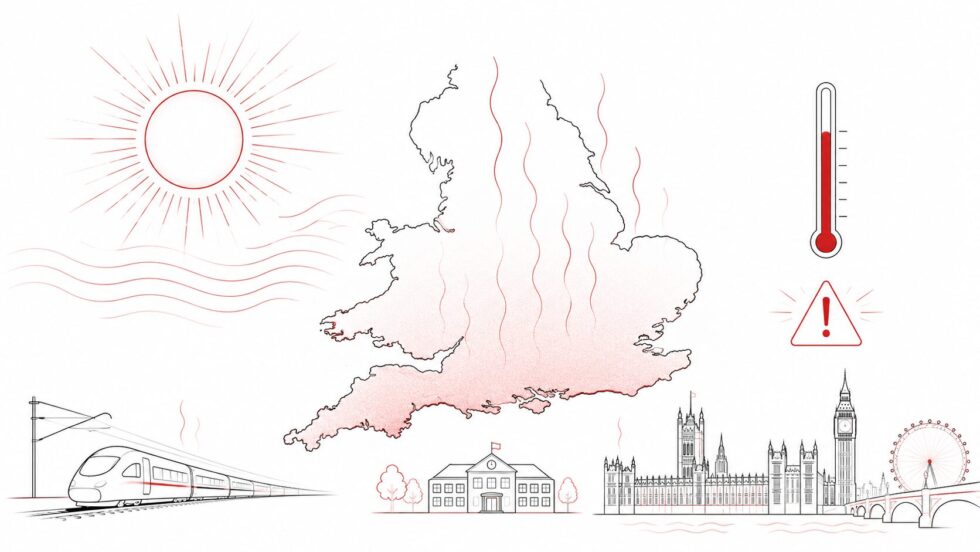
Red weather warning alerts have been issued for parts of England and Wales as Britain prepares for an exceptional spell of hot and humid weather on Wednesday and Thursday, with the Met Office warning that impacts on the general population are highly likely and that temperatures could climb towards 38C or higher in some areas. The warning covers central, southern and south-east England, parts of the Midlands, London, the South West and parts of Wales, placing schools, rail operators, health services, employers and families under pressure to adjust routines before the peak of the heat arrives, The WP Times reports.
The alert is serious because a red warning is not simply a forecast of uncomfortable summer weather. It means dangerous conditions are expected, with a risk to life, disruption to travel and possible pressure on energy, water and communications infrastructure. The UK Health Security Agency has also escalated heat-health alerts to red across large parts of England, a level designed to warn health and care systems that even healthy people may be at risk if they are exposed to prolonged heat, humid nights and poorly cooled buildings.
UK weather this week: red heat warning turns Monday’s hot spell into a national disruption risk
The UK enters the week of 22 June under an escalating extreme heat threat, with England and Wales moving from a hot start on Monday into a rare red weather warning by midweek. The Met Office expects the most dangerous conditions on Wednesday and Thursday, when parts of central and southern England and Wales could see temperatures above 37C and locally close to 38–40C.
The warning is not only about heat on a thermometer. Schools, rail operators, roads, hospitals and care services are preparing for disruption because the heat is expected to last through the day and night, with humidity making recovery harder for vulnerable people and for those working, travelling or studying in poorly cooled buildings.
| Date | UK weather picture | Highest risk areas | Expected peak temperature | Likely disruption |
|---|---|---|---|---|
| Monday, 22 June | Hot spell builds, amber heat conditions in parts of England and Wales | South and central England, parts of Wales | 30–35C | Schools review routines, travel discomfort, health pressure begins |
| Tuesday, 23 June | Very hot and humid, heat becoming more widespread | London, Midlands, south-east, south Wales | 35–37C | Rail and road delays possible, outdoor work and school sports affected |
| Wednesday, 24 June | Red heat warning begins in the worst-hit areas | England and Wales warning zone | 37–40C locally | Serious health risk, timetable changes, possible cancellations |
| Thursday, 25 June | Peak heat continues, very warm night adds pressure | Central/southern England, Wales | 38–40C locally | High risk for hospitals, care homes, railways and roads |
| Friday, 26 June | Heat starts to ease from the west, still hot in the east | Eastern and south-eastern England | Up to 33C | Disruption may continue, but pressure should begin to reduce |
| Saturday, 27 June | Less extreme, still warm or hot in places | South and east | 27–31C | Lower risk, but heat fatigue remains possible |
| Sunday, 28 June | Warm, more settled for many but no longer peak heat | England and Wales | 25–29C | Mostly reduced disruption, local health caution still needed |
Red weather warning UK: what the Met Office alert means this week
The Met Office uses a red warning when dangerous weather is expected and when the impact is likely to be severe enough to affect daily life. In this case, the concern is not only the daytime maximum temperature but also the combination of heat, humidity and warm nights. When overnight temperatures remain high, the body has less time to recover, and that increases the risk of heat exhaustion, heatstroke and pressure on vulnerable people. The warning therefore applies to a wider social picture: homes without air conditioning, crowded trains, classrooms, hospitals, care homes and outdoor workplaces.
The red warning is expected to be in force from Wednesday morning through Thursday evening, while amber warnings cover a broader period and a wider area. Forecasters have said that parts of southern and central England could approach or exceed the long-standing June temperature record. That record matters because Britain’s housing, transport and school buildings are not generally designed for repeated 35C-plus days. The result is a heat event that affects infrastructure as much as comfort.
Key points for readers:
- A red Met Office warning means dangerous weather is expected.
- The main risk is prolonged extreme heat, high humidity and warm nights.
- The warning covers parts of England and Wales, including London and parts of the South East, South West, Midlands and Wales.
- Temperatures could reach around 38C, with some forecasts discussing the possibility of 40C in the hottest spots.
- People are being advised to avoid unnecessary travel where possible during the red warning period.
- The risk is not limited to elderly or vulnerable people; healthy people can also be affected in red-alert conditions.
UKHSA red heat-health alert: why hospitals, care homes and families are on notice
The UKHSA heat-health alert is different from the Met Office weather warning, but the two are closely linked. The Met Office warning describes the weather hazard and the likely wider disruption. The UKHSA alert focuses on health impacts, especially for the NHS, social care, local authorities and emergency planning. A red heat-health alert means a significant risk to life is possible even among the healthy population, not only among people already medically vulnerable.
The practical health concern is that heat exhaustion can develop quickly, especially in people who are active, dehydrated, living in hot flats or working outdoors. Early symptoms include tiredness, dizziness, headache, nausea, heavy sweating, cramps, thirst and irritability. Heatstroke is more dangerous and can involve a very high body temperature, hot skin, rapid breathing, confusion, seizures or loss of consciousness. That is why public health advice is focused on prevention rather than waiting until symptoms become severe.
What households should do during the red warning:
| Risk area | What to do now | Why it matters |
|---|---|---|
| Hydration | Drink water regularly and reduce alcohol | Alcohol and dehydration increase heat risk |
| Home heat | Close curtains on sunny windows and ventilate during cooler hours | Indoor temperatures can remain high overnight |
| Outdoor activity | Avoid intense exercise between 11am and 3pm | Peak sun and heat raise heatstroke risk |
| Vulnerable people | Check older relatives, neighbours and people with health conditions | Some people may not realise they are overheating |
| Children | Keep them shaded, hydrated and in lighter clothing | Children can become tired and overheated faster |
| Pets | Never leave animals in parked cars | Car interiors can become dangerously hot within minutes |
Will schools close because of the red weather warning?
School closures because of heat are still unusual in England, but the decision ultimately sits with school leaders rather than a single automatic national rule. There is no legal maximum classroom temperature in England, which means headteachers must make decisions through risk assessments, building conditions, pupil needs and local circumstances. That creates a difficult situation: one modern building with shaded rooms may be able to operate safely, while another with poor ventilation and south-facing classrooms may struggle.
Schools are already adapting by relaxing uniform rules, moving lessons to cooler rooms, reducing outdoor activity and ensuring pupils have access to water. Some may shorten days or change timetables if buildings become unsafe or if vulnerable pupils cannot be protected. Special schools face an especially difficult challenge because some pupils may have additional medical needs, sensory needs or communication barriers that make heat stress harder to detect. The most important point for parents is that closures are likely to be local decisions, not a blanket national shutdown.
Parents should expect schools to communicate directly if they alter arrangements. A sensible school plan during this week’s warning may include:
- relaxed uniform rules, including no blazers or ties;
- PE and vigorous outdoor activity cancelled or moved indoors;
- lessons moved away from the hottest rooms;
- extra water breaks;
- shaded break areas;
- earlier collection or partial closure only if risk assessments support it;
- special arrangements for pupils with asthma, heart conditions, neurodivergent needs or other vulnerabilities.
Rail, roads and public transport face heatwave disruption
The red weather warning also matters for transport because extreme heat can damage infrastructure. Steel rails can become much hotter than the air temperature, and when rails expand there is a risk of buckling. Train operators may therefore run services at lower speeds to keep passengers safe, which can create delays and cancellations even before any visible incident occurs. Great Western Railway and other operators have warned passengers to check journeys before travelling, especially on routes through affected regions.
Roads can also be affected. In extreme heat, some road surfaces may soften, become tacky or uneven, particularly under heavy traffic. That can reduce grip and affect braking or steering, with motorcyclists and cyclists facing particular risks from loose or uneven material. The AA has advised drivers to slow down, avoid harsh braking and never leave passengers or animals in parked cars. The warning is clear: this is not just a beach-day heatwave but a system-wide stress test for Britain’s transport network.
Travel advice during the red warning:
| Traveller | Practical advice |
|---|---|
| Rail passengers | Check live updates before leaving, carry water, expect slower journeys |
| Drivers | Check tyres, coolant and water supplies before longer trips |
| Cyclists | Avoid peak heat and watch for softened road surfaces |
| Commuters | Consider working from home if possible during the red warning |
| Parents | Do not leave children in parked cars, even briefly |
| Pet owners | Avoid car journeys with animals during the hottest hours |
Extreme heat in Europe: France school closures show wider risk
The British heatwave is part of a wider European episode, not an isolated UK event. France has reported heat-related deaths during the current spell, while thousands of schools have either closed or changed timetables because of high temperatures. Some French regions are forecast to reach around 42C, and red heat alerts have been issued across large parts of the country. Spain and other parts of western Europe are also experiencing unusually severe heat for the season.
This matters for Britain because it shows how quickly heat can move from inconvenience to public safety crisis. The UK has historically treated very hot weather as brief and manageable, but repeated extreme heat events are changing that assumption. Schools, transport networks, hospitals, care homes and employers now face decisions that were once considered exceptional. The red warning therefore has a broader meaning: Britain is being forced to prepare for heat as a serious weather hazard, not only as a summer discomfort.
What workers are entitled to during the UK heatwave
There is no fixed legal maximum working temperature in the UK, but employers still have a legal duty to manage health and safety risks. That means they cannot ignore extreme heat simply because there is no single number at which work must stop. Workplaces should assess ventilation, hydration, rest breaks, protective clothing, physical workload and the needs of staff who are pregnant, disabled, older or medically vulnerable. Outdoor workers, warehouse staff, kitchens, care workers and delivery drivers may face higher risks than office workers with air conditioning.
In practical terms, employers should make reasonable adjustments during the red warning. These may include flexible hours, remote work, more frequent breaks, moving tasks away from the hottest parts of the day, providing water and reducing physically demanding work. Staff should report symptoms early and should not be expected to continue heavy labour if heat illness is developing. The key legal principle is not comfort but reasonable protection from foreseeable harm.
Useful workplace measures:
- allow home working where roles permit;
- move outdoor or physical tasks to early morning;
- provide cool drinking water;
- relax dress codes where safe;
- increase rest breaks;
- monitor staff working alone;
- reduce heat-generating equipment where possible;
- review risks for pregnant workers and staff with health conditions.
Heat exhaustion and heatstroke: symptoms people should not ignore
Heat exhaustion is the warning stage. It can involve dizziness, headache, nausea, cramps, heavy sweating, thirst and fatigue. The person should be moved to a cool place, unnecessary clothing should be removed, and they should be given water or an oral rehydration drink. Cooling the skin with water, fans or cold packs wrapped in cloth can help. If symptoms do not improve, medical advice is needed.
Heatstroke is different because it is a medical emergency. Warning signs include confusion, very hot skin, rapid breathing, a fast heartbeat, seizures or loss of consciousness. In those cases, emergency help should be sought immediately. The risk is higher when people are trapped in hot indoor environments, exercising in peak heat, drinking alcohol, taking certain medicines or caring for young children in poorly ventilated rooms.
Why this red weather warning is a serious test for Britain
The red weather warning is a test of how Britain handles heat when it becomes a public safety issue. The immediate message is simple: check forecasts, avoid unnecessary travel during the highest-risk hours, protect vulnerable people and treat heat illness seriously. The deeper issue is that schools, railways, hospitals, homes and workplaces are now having to plan for temperatures that were once rare in the UK. That makes this week’s warning more than a weather story.
For readers, the safest approach is to plan before Wednesday rather than react after the heat peaks. Parents should watch school messages, commuters should check train services, employers should adjust work patterns, and families should check on older relatives or neighbours. The Met Office red warning is designed to trigger exactly that kind of early action. In a week when Britain may challenge June temperature records, preparation is no longer optional; it is the practical line between discomfort, disruption and danger.
FAQ: red weather warning UK
What does a red weather warning mean?
A red weather warning means dangerous weather is expected and there is a likely risk to life. For extreme heat, it also means major disruption to daily routines, transport and infrastructure is possible.
Will all schools close during the heatwave?
No. There is no automatic national closure rule for heat. Headteachers and school leaders decide based on risk assessments, building conditions and pupil safety.
Is there a legal maximum classroom temperature?
No. England does not have a fixed legal maximum temperature for classrooms, although schools must manage health and safety risks.
Can trains be cancelled because of heat?
Yes. Extreme heat can make rails expand and increase the risk of buckling, so operators may impose speed restrictions or cancel services for safety.
What is the main health risk?
The main risks are heat exhaustion and heatstroke. Heatstroke is a medical emergency and can affect healthy people as well as vulnerable groups during red-alert conditions.
Read about the life of Westminster and Pimlico district, London and the world. 24/7 news with fresh and useful updates on culture, business, technology and city life: Will Schools Close If Too Hot? What Parents Need To Know As Britain Faces 38C June Heatwave