27 June 2026 — Elon Musk's brief arrival as the world's first trillionaire has become less a victory lap than a live market test of how far investors are willing to stretch the price of future technology earnings. SpaceX's record public debut on 12 June turned the rocket and satellite company into one of the most valuable names on Wall Street, but the days since the listing have been defined not only by euphoria, but by volatility, debt-market nerves and a sharper question for British investors: is this the start of a new industrial era, or another example of markets paying tomorrow's price for profits that have not yet arrived, reports The WP Times.
SpaceX priced its IPO at $135 a share and opened at $150 on the Nasdaq under the ticker SPCX on 12 June, raising a record $75 billion — the largest public offering in history, surpassing Saudi Aramco's 2019 debut — and valuing the company at roughly $1.77 trillion at listing. The stock then surged to an all-time high of $225.64 on 16 June, lifting Musk's fortune, on a stake of about 42%, to a peak near $1.32 trillion. But by late June the story had already moved on. Shares fell more than 30% from that peak, including a 16% drop on 22 June that wiped some $240 billion from Musk's net worth, pulling it back below the trillion-dollar mark to around $950 billion and turning a historic IPO into a broader examination of risk appetite across global markets. For the City of London, the most important point is not whether Musk is personally worth $950 billion, $1 trillion or more. Those numbers are spectacular, but they are also highly sensitive to daily share moves. The more serious issue is what SpaceX now represents inside portfolios. It is no longer a private-market legend available mainly to venture funds, sovereign wealth vehicles and ultra-rich backers. It is becoming a public-market force, and its expected inclusion in major indices means ordinary pension savers and passive fund investors may gain exposure whether they actively chose the stock or not.
Why investors are prepared to assign such a premium to SpaceX:
- dominant position in global commercial launch services, with roughly 85% of US orbital launches in 2025;
- rapidly expanding Starlink satellite broadband network, now past 10 million subscribers and contributing about 61% of revenue;
- growing exposure to defence and government space contracts, worth some $5.9 billion from the US government in 2025;
- long-term AI and data infrastructure opportunities, reinforced by the February 2026 xAI merger;
- potential inclusion in major equity indices, increasing passive investment flows;
- strategic importance of space infrastructure for governments and businesses;
- expectations of future rather than current profitability.
Taken together, these factors explain why SpaceX is not being valued like a conventional aerospace manufacturer. Investors are paying for what they believe could become critical infrastructure for communications, defence, artificial intelligence and the commercial space economy over the coming decades. That investment case has attracted enormous capital, but it also leaves little room for operational disappointment.
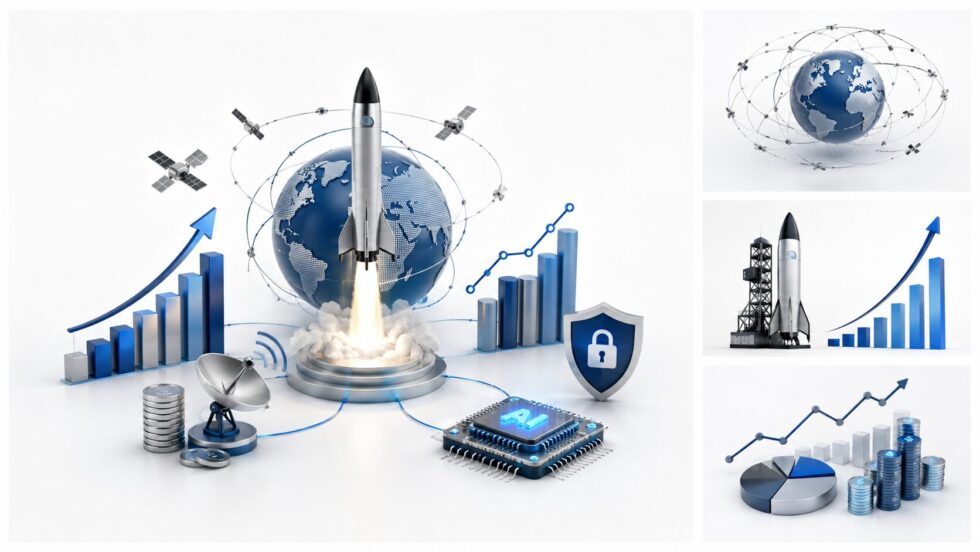
The company's reported revenue growth is impressive — 2025 revenue reached about $18.7 billion, up 33% year-on-year, with adjusted EBITDA near $6.6 billion — but the valuation implies expectations far beyond current earnings. SpaceX remains loss-making, posting a GAAP net loss of nearly $4.9 billion in 2025, driven largely by heavy investment in Starship, satellite networks and AI-related infrastructure following the xAI acquisition. For equity investors, losses can be tolerated if they believe a company is building a dominant platform. For bond investors, the calculation is colder. Debt markets care less about charisma and more about cash flow, repayment capacity and governance.
That is why the bond-market reaction after the IPO is important. SpaceX's planned multibillion-dollar debt financing — a bond offering of around $25 billion — was meant to support its next stage of expansion, but the early sell-off in its bonds and the slip in its shares suggested that some investors were uncomfortable with the scale of the company's ambitions. The contrast is striking: equity buyers have been willing to treat SpaceX as a once-in-a-generation growth asset, while credit investors have been quicker to ask how much capital the company will consume before its most speculative projects generate reliable returns. This split between equity enthusiasm and credit caution is familiar from earlier technology cycles. In public stock markets, investors often reward vision before earnings. In debt markets, vision is not enough. A company can dominate headlines and still face pressure if its cash burn, borrowing needs and corporate control structure become too aggressive. That does not mean SpaceX is weak. It means the public market will now judge it every day, in real time, with less patience than private investors often showed.
The UK angle is also significant. British retail investors joined the IPO through international platforms, while UK pension and fund exposure may grow as SpaceX enters large indices. That creates a new kind of imported market risk. A US technology company, led by one of the world's most controversial entrepreneurs, can now affect British portfolios not only through active stock-picking but through passive index ownership. For savers who hold global equity funds, the SpaceX story may soon become part of their retirement exposure. The valuation debate is therefore not academic. If SpaceX continues to rise, it could reinforce the dominance of US mega-cap technology and pull even more global capital towards Wall Street. If it falls sharply, it could pressure sentiment across AI, defence technology, satellite infrastructure and other high-growth sectors. Either way, the IPO is no longer a single-company event. It is a market signal.
Supporters argue that traditional valuation methods are too narrow for SpaceX. They say the company has already transformed launch economics, built Starlink into a global satellite broadband network and positioned itself at the centre of strategic technologies that governments and companies will increasingly need. In that view, SpaceX is not just another tech float. It is infrastructure for a new economy, and investors are paying for scarcity: there is no direct equivalent listed on public markets at the same scale. Sceptics answer that scarcity can become dangerous when it removes discipline. A company can be exceptional and still overpriced. At a valuation around $2 trillion — close to 100 times 2025 revenue — SpaceX must eventually show that Starlink, launch services, defence contracts, AI ventures and future space infrastructure can produce enough durable cash flow to support the market's expectations. If those businesses develop more slowly than promised, the shares could struggle even if the company remains operationally impressive.
Musk's role adds another layer. Investors have repeatedly paid a premium for his ability to create markets, attract capital and force technological acceleration. Tesla showed how powerful that premium can become. But Musk also brings governance risk, key-person risk and political risk. His influence is part of the valuation, yet his unpredictability is also part of the discount investors may eventually demand. The first two weeks of trading have already shown how fragile the trillionaire headline was. Musk's wealth rose because SpaceX shares rose. It fell when SpaceX and Tesla weakened. That is not a contradiction; it is how paper wealth works. But it is a reminder that the "first trillionaire" label is less a fixed status than a market snapshot. The deeper story is not the number beside Musk's name. It is the transfer of SpaceX from private myth to public scrutiny. A further structural test looms. SpaceX runs a staggered insider lockup rather than a single six-month unlock: a first tranche of insider shares could reach the market as early as late July after Q2 earnings, ahead of the standard 180-day expiry on 8 December. Whether the stock can stabilise before that first wave of selling arrives will be the next real test for both SPCX and Musk's trillionaire status. For Britain, the lesson is practical. Investors do not need to decide whether Musk is a genius or whether space is the future. They need to decide whether the price already assumes too much of that future. A company can change the world and still disappoint shareholders if expectations become excessive. The question after the SpaceX IPO is not whether the company is important. It clearly is. The question is whether public markets have priced importance as certainty.
As of 27 June, SpaceX remains one of the most consequential listings in modern financial history. It has made Musk the first trillionaire on paper, then shown how quickly that title can vanish. It has drawn retail investors, passive funds, bond buyers and sceptics into the same debate. It has also exposed the central tension of the current market: investors want exposure to the next technological frontier, but they are being asked to pay for it long before the frontier becomes profitable. That is why the SpaceX IPO is more than a Musk story. It is a test of late-cycle market psychology, of the power of passive investing, of the credibility of mega-cap technology valuations and of whether global investors can still separate innovation from price. The rockets may keep launching. The harder question is whether the valuation can stay in orbit.
Read about the life of Westminster and Pimlico district, London and the world. 24/7 news with fresh and useful updates on culture, business, technology and city life: Will Elon Musk’s Tesla Tiny House Really Reach the UK – or Is It Just Another Vision