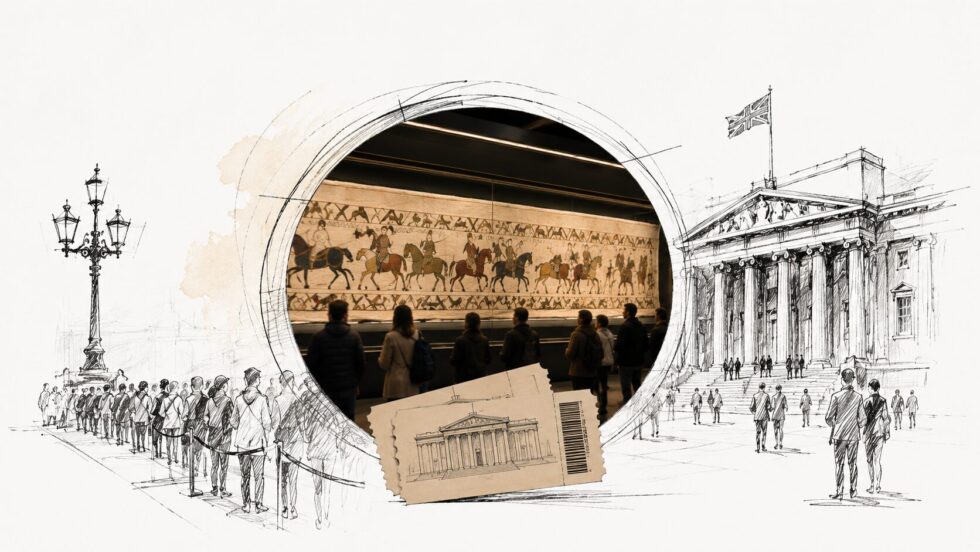
Bayeux Tapestry UK tickets went on public sale on Wednesday, 1 July 2026, triggering tens of thousands of online queue places within hours as the British Museum prepared for one of the most closely watched cultural exhibitions in London for a generation. The 11th-century embroidery, almost 70 metres long and famous for depicting the Norman Conquest of England in 1066, will be displayed on British soil for the first time since it was made nearly 1,000 years ago, with the first ticket release covering visits from September to December 2026, The WP Times reports.
The rush reflects more than museum demand. It is a rare mix of British history, French diplomacy, school curriculum relevance, conservation risk and blockbuster pricing. The tapestry is being loaned while the Bayeux Museum in Normandy undergoes renovation, and the British Museum says later ticket releases will follow in October and January for visits through July 2027.
Bayeux Tapestry UK exhibition dates, tickets and prices at the British Museum
The British Museum has confirmed that the first public booking window opened on 1 July 2026 for entry dates between September and December 2026. Two further releases are planned: one in October 2026 for January to March 2027, and another in January 2027 for April to July 2027. Adult tickets are priced up to £33 at peak times, with off-peak tickets lower. Children aged 16 and under will be able to see the exhibition free, a significant decision because the Norman Conquest is central to history teaching in UK schools.
| Detail | What visitors need to know |
|---|---|
| Exhibition | Bayeux Tapestry at the British Museum |
| Public tickets | First released 1 July 2026 |
| First booking period | September–December 2026 |
| Later releases | October 2026 and January 2027 |
| Adult peak price | Up to £33 |
| Children | Free for ages 16 and under |
| Object | 11th-century wool embroidery on linen |
| Length | About 70 metres |
| Subject | Norman Conquest and Battle of Hastings, 1066 |
Why the Bayeux Tapestry matters to Britain
The Bayeux Tapestry is not technically a tapestry but an embroidery: coloured wool threads stitched onto linen. Its scenes tell the story of the crisis after Edward the Confessor, the claim of Harold Godwinson, William of Normandy’s invasion and the Battle of Hastings in 1066.
Its power lies in the fact that it is both propaganda and historical evidence. It shows ships, armour, horses, feasting, diplomacy, violence and the famous death of Harold, traditionally associated with an arrow to the eye. For British visitors, seeing the full work in London means encountering one of the defining narratives of English state formation in a single, continuous line. The British Museum’s director Nicholas Cullinan described the loan as an “incredible event” and said the work would be shown flat and in one long line, allowing visitors to see the whole embroidery at full length. Reuters reported that the museum has built a specially designed glass case to protect it and allow close and overhead viewing.
What officials say about conservation and the journey from Normandy
The loan has raised serious conservation questions because the Bayeux Tapestry is not a robust wall hanging but an almost 1,000-year-old embroidery made with wool thread on linen. Its age, length and material make every stage of the journey sensitive: removal from storage in Normandy, packing, vibration control, temperature and humidity, security, transport through the Channel Tunnel and installation in London.
British Museum officials say the operation has been designed around conservation rather than spectacle. The embroidery is expected to travel in a specially prepared container, with handling kept to a minimum and environmental conditions controlled throughout. Reuters reported that the route will be via the Channel Tunnel, while detailed timings and security arrangements are being kept confidential. The Telegraph has also reported that test runs were carried out to measure vibration risk before the transfer.
Once in London, the tapestry will not be hung vertically. It will be displayed flat, which museum director Dr Nicholas Cullinan said is the safest way to show it from a conservation point of view. A specially manufactured glass case has been made for the exhibition, allowing visitors to see the full length of the work while keeping the fragile textile protected from light, movement, dust and physical contact. The cultural politics are also part of the story. The loan was confirmed during President Emmanuel Macron’s 2025 state visit to Britain and is being presented as a major Anglo-French cultural exchange after years of post-Brexit tension. In return, museums in France will receive British loans, including Anglo-Saxon objects linked to Sutton Hoo. Officials insist the tapestry’s stay in London is temporary and that it will return to Normandy after the British Museum exhibition ends in July 2027.
Why Bayeux Tapestry UK tickets became a once-in-a-generation rush
Demand is unusually high because this is not just another London exhibition. The Bayeux Tapestry has been in France for centuries, is rarely moved, and has never previously been displayed in the UK since its creation. For British visitors, the appeal is obvious: this is the story of 1066, Harold, William the Conqueror and the Norman Conquest returning to the country whose history it helped define.
The British Museum also has the scale to turn the loan into a national event. Its biggest exhibitions have attracted huge crowds before, with the 1972 Treasures of Tutankhamun show still remembered as the benchmark blockbuster. The Bayeux Tapestry exhibition now has the same ingredients: rarity, school-history relevance, international diplomacy, cultural controversy and a strict timed-ticket system. The pressure on tickets is also practical. The embroidery will be in London only for a limited 10-month run, and visitor numbers are expected to be carefully controlled to protect the work and manage crowds. That means the most convenient slots — weekends, school holidays and early dates after opening — are likely to disappear fastest.
Visitor guide: how to see the Bayeux Tapestry at the British Museum
| Information | Details |
|---|---|
| Venue | British Museum |
| Address | Great Russell Street, London WC1B 3DG |
| Gallery | Room 30 – The Sainsbury Exhibitions Gallery |
| Exhibition dates | 10 September 2026 – 11 July 2027 |
| Opening hours | Sunday–Wednesday: 10:00–18:00 • Thursday–Saturday: 10:00–21:00 |
| Ticket release | First public sale opened on 1 July 2026 |
| Ticket prices | Adults from £27 off-peak to £33 peak; under-16s free |
| Booking windows | Additional ticket releases in October 2026 and January 2027 |
| Nearest Tube stations | Tottenham Court Road, Holborn, Russell Square, Goodge Street |
| Visit duration | Timed-entry exhibition with allocated admission slots |
The Bayeux Tapestry will be displayed in Room 30 – The Sainsbury Exhibitions Gallery, where the nearly 70-metre embroidery will be presented flat inside a specially designed conservation-grade glass case. Visitors will be able to follow the entire length of the work in a single uninterrupted display, something rarely possible in its permanent home in Normandy.
Because demand is expected to remain exceptionally high, visitors are advised to book online as early as possible and arrive shortly before their allocated admission time. The exhibition operates with timed-entry tickets to manage visitor numbers and maintain stable environmental conditions around the nearly 1,000-year-old embroidery. Those unable to secure tickets during the first release will have further opportunities when additional booking windows open later in the exhibition period.
Bayeux Tapestry UK tickets: questions and answers

When will the Bayeux Tapestry be shown in London?
The exhibition is due to open at the British Museum in September 2026 and run until July 2027.
Why are tickets selling so quickly?
Because this is the first time the Bayeux Tapestry has been displayed in the UK, despite its direct connection to English history and the Norman Conquest of 1066.
What should visitors do if they miss the first ticket release?
They should watch the next ticket releases. The British Museum has planned further booking windows in October 2026 and January 2027.
Which tickets are likely to go first?
Weekend slots, school-holiday dates, peak-time visits and the earliest exhibition dates are expected to be the most competitive.
Why are visitor slots limited?
The tapestry is extremely fragile. Timed entry helps control crowd flow, reduce pressure inside the gallery and protect the conditions around the object.
Read about the life of Westminster and Pimlico district, London and the world. 24/7 news with fresh and useful updates on culture, business, technology and city life: What are tonight’s Lotto results and National Lottery numbers for Saturday 27 June 2026