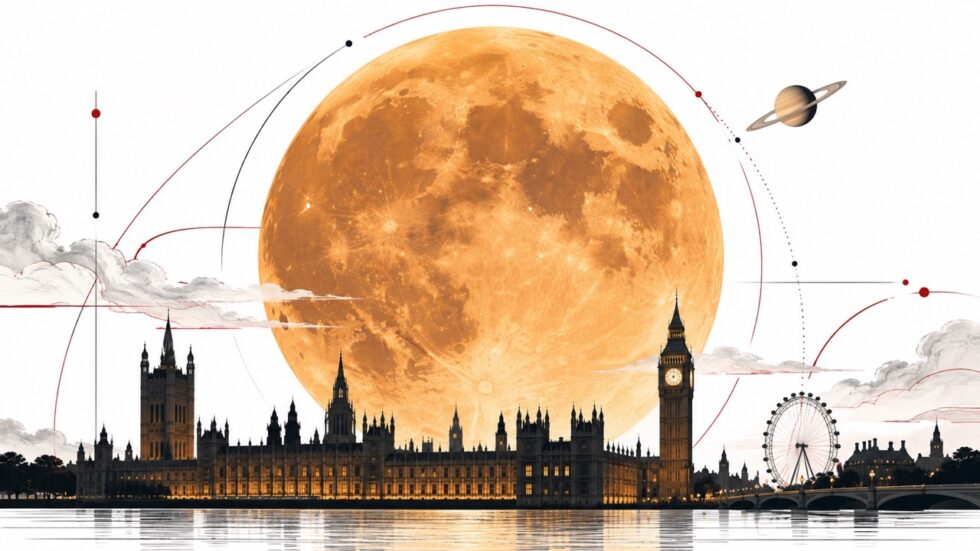
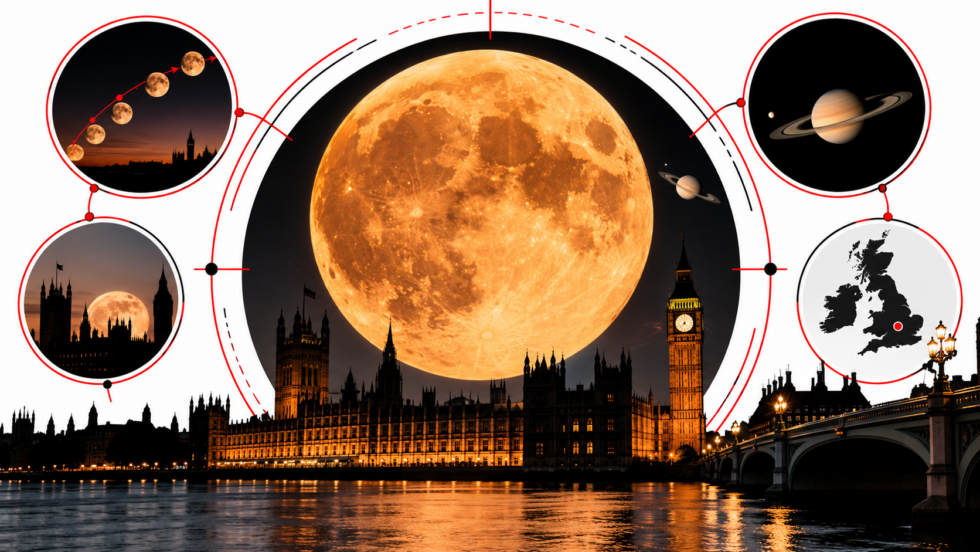
The Harvest Moon reaches full phase at 17:48 BST on Saturday 26 September and rises over London at 18:27, about 20 minutes before sunset. It will be low and orange on the eastern horizon as the day ends. Moonrise over the rest of the UK follows within minutes: Birmingham at 18:33, Manchester at 18:34, Edinburgh at 18:36, Cardiff at 18:39 and Belfast at 18:48. On Saturday and Sunday nights, Saturn will shine as a bright golden point just below and to the left of the Moon, eight days before the planet reaches opposition on 4 October, The WP Times reports.
It is the Harvest Moon because it is the full moon closest to the September equinox, which fell at 01:05 BST on Wednesday 23 September. Around the equinox the Moon rises only about 12 minutes later each evening over London, rather than the usual 50 minutes or so, giving several evenings of bright moonlight just after dusk. Saturday is the best night to watch from southern England. The Met Office expects a fine, dry day with sunny spells across central and southern parts of the UK, before rain spreads from the west on Sunday.
What time does the Harvest Moon rise in the UK
The table below gives moonrise, sunset and moonset times for six UK cities on the four evenings around the full moon. The times were calculated by The WP Times for a flat horizon and are accurate to within one or two minutes. Buildings, trees and hills will delay the moment the Moon becomes visible. The Moon is technically full at 17:48 BST on Saturday, before it has risen over the UK. That makes no visible difference: it is more than 98 per cent lit from Friday to Sunday. On each night it sets the following morning, after sunrise.
| City | Fri 25 Sep moonrise | Sat 26 Sep moonrise | Sat 26 Sep sunset | Sun 27 Sep moonrise | Mon 28 Sep moonrise |
|---|---|---|---|---|---|
| London | 18:15 | 18:27 | 18:49 | 18:40 | 18:56 |
| Birmingham | 18:23 | 18:33 | 18:56 | 18:45 | 19:00 |
| Manchester | 18:24 | 18:34 | 18:57 | 18:45 | 18:58 |
| Edinburgh | 18:29 | 18:36 | 19:01 | 18:43 | 18:52 |
| Cardiff | 18:27 | 18:39 | 19:01 | 18:53 | 19:09 |
| Belfast | 18:40 | 18:48 | 19:12 | 18:57 | 19:09 |
| London, Harvest Moon night | Time (BST) |
|---|---|
| Full moon | 17:48, Sat 26 Sep |
| Moonrise, just north of due east | 18:27 |
| Sunset | 18:49 |
| Moon and Saturn about 30 degrees up in the south-east | About 22:00 |
| Moon highest in the south | About 01:00, Sun 27 Sep |
| Moonset in the west | 07:52, Sun 27 Sep |
Why is it called the Harvest Moon?
The Harvest Moon is the name for whichever full moon falls closest to the September equinox, so it can land in September or early October. In 2026 the equinox was on 23 September and the full moon three days later. Near the equinox, the Moon's path meets the horizon at a shallow angle in the evening sky at northern latitudes. That makes the time between one moonrise and the next unusually short. Over London this weekend, moonrise moves from 18:15 on Friday to 18:27 on Saturday and 18:40 on Sunday. Before electric light, that run of bright evenings let farmers keep gathering crops after sunset. September's full moon also has older names: the corn moon in The Old Farmer's Almanac tradition, the corn maker moon among the Abenaki of the north-eastern United States, and the yellow leaf moon among the Assiniboine.
Why does the Harvest Moon look orange and larger?
A rising full moon looks orange because its light passes through a much thicker layer of atmosphere near the horizon, which scatters blue light and lets red and orange through. Any full moon looks the same when it is low. The extra size is an illusion: the Moon near the horizon appears larger next to buildings and trees, though its size in the sky barely changes. This year's Harvest Moon is not a supermoon. At full phase it is about 379,000km from Earth, slightly nearer than the average distance of about 384,400km.
How can you see Saturn next to the Harvest Moon?
Saturn is the brightest point of light close to the Moon on Saturday and Sunday nights, shining at about magnitude 0.3 with a steady, pale golden light. From London at about 22:00 on Saturday, the Moon stands around 30 degrees above the south-eastern horizon, with Saturn about eight degrees below and slightly to the left. That is roughly the width of a fist held at arm's length. By Sunday evening the Moon has moved to the other side of the planet, about 10 degrees away. Saturn reaches opposition on 4 October, when it lies directly opposite the Sun and is visible all night. Any small telescope magnifying 25 times or more will show its rings. Neptune is also in the same part of the sky but cannot be seen without binoculars or a telescope.
| Night | Where Saturn is | Distance from the Moon |
|---|---|---|
| Fri 25 Sep | Well to the left of the Moon | About 20 degrees |
| Sat 26 Sep | Below and slightly left | About 8 degrees |
| Sun 27 Sep | Above and to the right | About 10 degrees |
| Sun 4 Oct | Saturn at opposition, visible all night | — |
Where are the best places to watch the Harvest Moon in London?
The key to seeing the Harvest Moon rise is a clear view of the eastern horizon, because it comes up just north of due east over London. In Westminster, the Thames gives the longest open view east: Westminster Bridge, Victoria Embankment and Waterloo Bridge all look down the river towards the City. Higher ground helps across London. Parliament Hill on Hampstead Heath and Greenwich Park near the Royal Observatory offer wide skylines. By about 22:00 the Moon and Saturn will be high enough to see over rooftops from almost any street or park, including St James's Park and Battersea Park.
| Viewpoint | View | Nearest station |
|---|---|---|
| Westminster Bridge | East along the Thames | Westminster (Jubilee only on this weekend's District and Circle works? not this weekend: all lines) |
| Waterloo Bridge | East towards the City and Canary Wharf | Waterloo, Temple |
| Victoria Embankment | East and south-east over the river | Embankment |
| Parliament Hill, Hampstead Heath | Wide skyline view south and east | Gospel Oak |
| Greenwich Park | Views over Canary Wharf to the east | Greenwich, Cutty Sark (DLR) |
How to photograph the Harvest Moon
The best photographs are taken in the first 20 to 30 minutes after moonrise, when the Moon is low and can be framed against landmarks. A phone will overexpose the full Moon unless the exposure is turned down manually, or you use a night or telephoto mode and tap on the Moon. With a camera, a longer lens of 200mm or more, a tripod and exposures of around 1/125 to 1/250 of a second at ISO 100 to 400 keep surface detail visible once the sky has darkened. Early photographs, taken while the sky is still bright after sunset, balance the Moon with the city skyline.
What will the weather be like for the Harvest Moon?
The Met Office forecast issued this week puts Saturday as the best day of the weekend across central and southern parts of the UK, with sunny spells and largely dry conditions. Showers are expected in Scotland, Northern Ireland and north-west England and Wales. A weather front was due to push east across the UK on Sunday, with rain arriving in the south-east late in the day. That makes Saturday evening the best chance in London and the south. The Moon will still be more than 98 per cent lit on Friday and Sunday for anyone who misses Saturday.
When are the next full moons in 2026?
Three full moons remain in 2026 after the Harvest Moon. November's and December's are both supermoons, occurring close to perigee, when the Moon is nearest Earth in its orbit. December's is the closer of the two, at about 356,700km, and will look slightly larger and brighter than September's. UK times below are in GMT, after the clocks go back on Sunday 25 October.
| Full moon | UK date and time | Distance from Earth |
|---|---|---|
| Harvest Moon | Sat 26 Sep, 17:48 BST | About 379,400km |
| Hunter's Moon | Mon 26 Oct, 04:11 GMT | About 368,900km |
| Beaver Moon (supermoon) | Tue 24 Nov, 14:53 GMT | About 360,800km |
| Cold Moon (supermoon) | Thu 24 Dec, 01:28 GMT | About 356,700km |
When does the Harvest Moon rise around the world
Moonrise on Saturday 26 September falls close to local sunset in every major city, as it does at every full moon. The times below were also calculated by The WP Times for a flat horizon and are in local time.
| City | Moonrise, Sat 26 Sep | Sunset | Time zone |
|---|---|---|---|
| Dublin | 18:50 | 19:13 | IST (UTC+1) |
| Paris | 19:19 | 19:40 | CEST (UTC+2) |
| Berlin | 18:32 | 18:55 | CEST (UTC+2) |
| Madrid | 19:49 | 20:05 | CEST (UTC+2) |
| New York | 18:34 | 18:46 | EDT (UTC−4) |
| Toronto | 18:54 | 19:07 | EDT (UTC−4) |
| Los Angeles | 18:39 | 18:43 | PDT (UTC−7) |
| Dubai | 17:54 | 18:11 | GST (UTC+4) |
| New Delhi | 17:53 | 18:13 | IST (UTC+5:30) |
| Tokyo | 17:07 | 17:33 | JST (UTC+9) |
| Sydney | 17:29 | 17:54 | AEST (UTC+10) |
Frequently asked questions
What time is the Harvest Moon tonight in the UK?
The Moon is full at 17:48 BST on Saturday 26 September. It rises over London at 18:27, Edinburgh at 18:36, Cardiff at 18:39 and Belfast at 18:48.
Which direction should I look to see the Harvest Moon?
Look east, just north of due east, soon after sunset. By midnight the Moon is high in the south, and it sets in the west on Sunday morning.
Is the Harvest Moon 2026 a supermoon?
No. It is about 379,000km from Earth, close to the average distance. The next supermoons are on 24 November and 24 December.
What is the bright star next to the Moon?
It is the planet Saturn, which reaches opposition on 4 October. It sits about eight degrees below and left of the Moon on Saturday night.
Can I still see the Harvest Moon on Sunday?
Yes. It rises over London at 18:40 on Sunday and is still more than 98 per cent lit, though rain is forecast to reach the south-east late in the day.
Sources used: The WP Times calculations using the PyEphem astronomical library, BBC Sky at Night Magazine, CNN, EarthSky, NASA, The Old Farmer's Almanac, Met Office.
Read about the life of Westminster and Pimlico district, London and the world. 24/7 news with fresh and useful updates on culture, business, technology and city life: What will Ruthin School closure mean after 742 years of
teaching in North Wales