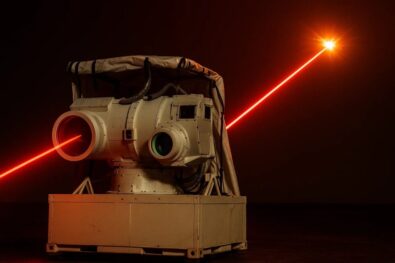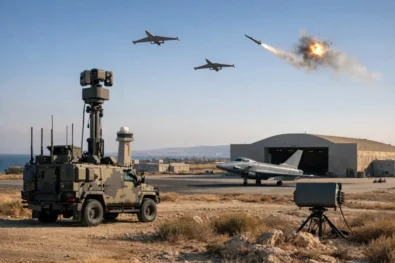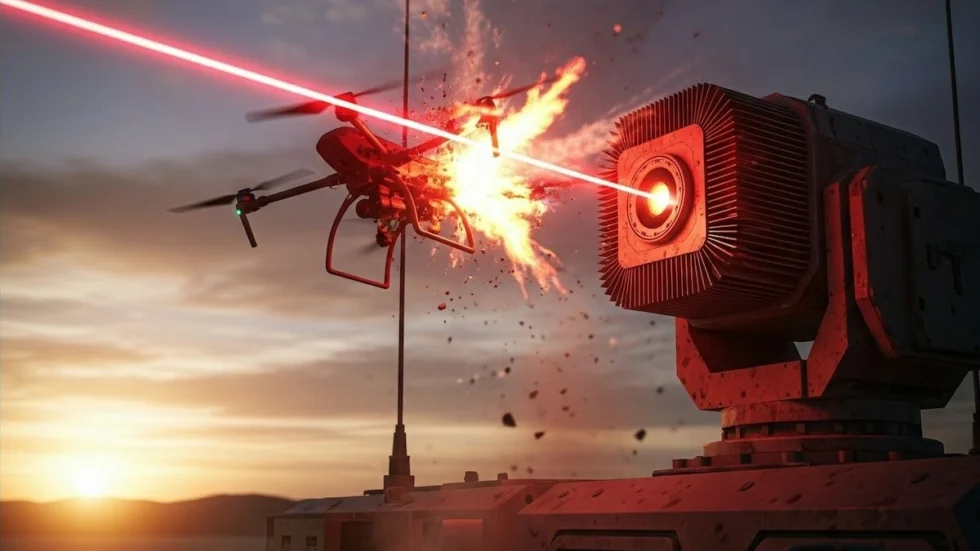
France has announced the launch of Syderal, a state-backed programme to develop high-energy laser weapons capable of neutralising drones, missiles and artillery shells. The project, revealed by the Ministry of Armed Forces in Paris, comes as Europe faces rising threats from low-cost kamikaze drones and precision-guided munitions in conflicts such as Ukraine. Officials describe Syderal as a cornerstone of France’s future short-range air defence, as reported by The WP Times.
“This technology marks a strategic leap. With lasers, we are no longer counting bullets but seconds,” said a senior official at the French Defence Innovation Agency.
Defence giants behind the project
The contract brings together a coalition of France’s leading arms manufacturers: MBDA, Safran Electronics & Defense, Thales and CILAS. Each firm contributes specialised expertise, from optical precision systems to battlefield integration. According to defence analyst Pierre Martin, “Syderal is less a single weapon and more a modular ecosystem — adaptable to vehicles, ships and even fixed-site defences.”
This structure ensures France can scale the system rapidly across different military platforms once operational.
Capabilities designed for modern warfare
Syderal is being engineered for continuous 24/7 deployment in all weather conditions. The system is expected to:
- destroy tactical drones within seconds,
- intercept rockets, artillery and mortar fire,
- disable precision-guided munitions in their terminal phase.
The economics are striking. Each laser shot could cost as little as a few euros, compared to tens of thousands for conventional missiles. Military planners emphasise that this drastically reduces logistical dependence on ammunition stockpiles, a vulnerability exposed during the war in Ukraine.
“With Syderal, France gains not just a weapon, but freedom from the tyranny of resupply,” said retired Colonel Jean-Luc Moreau, now a defence commentator in Paris.
Timeline: when will Syderal enter service
Prototypes are scheduled for testing in the late 2020s, with full deployment expected by 2030. This places France alongside the UK and Germany, which are already trialling their own directed-energy systems.
For Paris, Syderal is not simply an experiment. It is part of President Emmanuel Macron’s €413 billion military modernisation plan, which commits nearly €10 billion to future technologies, including artificial intelligence and laser weapons.
Why lasers are emerging as a global trend
The battlefield is increasingly dominated by drones — cheap to produce, difficult to intercept, and devastating in swarms. Traditional missile-based air defence is too expensive and too slow to counter this shift. Lasers promise:
- immediate strike capability
- minimal per-use cost
- virtually unlimited shots so long as power is available
American, Israeli and German systems are already showing results in live tests. France’s Syderal is now poised to become the first operational European laser defence deployed at scale.
“Whoever masters directed energy will hold the advantage in the next decade of warfare,” noted defence strategist Clara Hoffmann in Berlin.
If successful, Syderal could reshape Europe’s balance of power in short-range air defence, setting a benchmark for NATO allies and adversaries alike.
ead about the life of Westminster and Pimlico district, London and the world. 24/7 news with fresh and useful updates on culture, business, technology and city life: What is behind China’s universal 6G chip and how could it change global communication