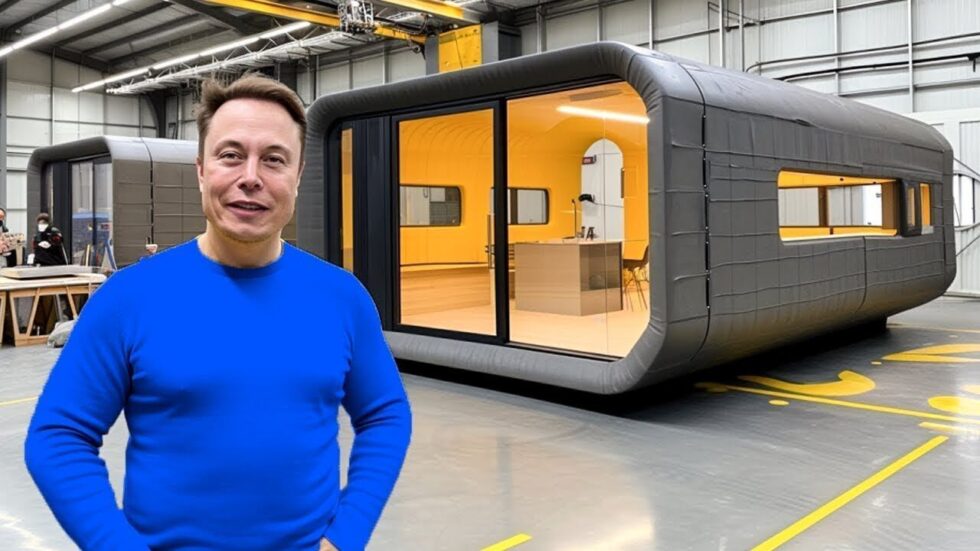
October 2025 – Elon Musk once again dominates headlines, this time not for rockets or cars but for a new vision of living itself. According to The WP Times, a series of viral YouTube videos has reignited global fascination with the so-called Tesla Tiny House — a compact, solar-powered home that promises to produce its own energy and free owners from utility bills. Presented by fans as the next great Musk innovation, the concept is hailed as “a revolution in sustainable living.” Yet behind the cinematic renderings and ambitious claims, the facts remain uncertain, and no official confirmation from Tesla has ever been issued.
What We Actually Know
- Origin of the concept: The first “Tesla Tiny House” appeared not this year, but in 2017, as a demonstration trailer touring Australia to promote Tesla’s Powerwall and Solar Roof products. It was never marketed as a retail home; it was an exhibition tool.
- 2025 viral resurgence: In October 2025, several click-driven websites (including EADaily) published unverified claims that Musk had “started selling fully autonomous homes” for $7,789 USD, quoting no official Tesla source. Tesla has not confirmed this, nor listed such a product in filings or catalogues.
- PolitiFact and Reuters Fact Check both state there is no evidence Tesla manufactures or sells a housing product.
- Tesla’s UK presence: The company operates energy divisions supplying Powerwall 2 batteries and solar systems to residential customers through certified installers. These are genuine, regulated products—unlike the “tiny house”.
How the Concept Would Work (In Theory)
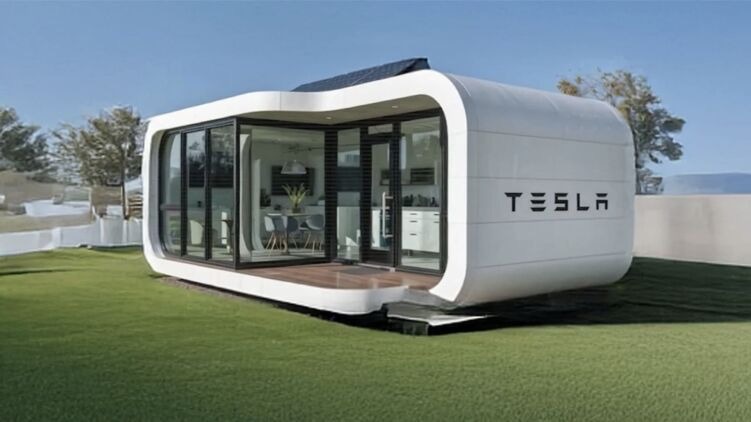
The speculative house design combines technologies Tesla already sells:
- Solar Roof: roof tiles that act as photovoltaic panels, each capable of generating about 15–20 watts per tile, built for a 30-year lifespan.
- Powerwall: a 13.5 kWh lithium-ion battery designed to store surplus solar energy, providing power at night or during outages.
- App integration: Tesla’s mobile platform already allows live monitoring of energy generation, battery levels and household consumption—features that could extend naturally to a prefabricated home.
- Sustainable construction: most renders show steel or composite frames with recycled insulation, emphasising off-grid mobility.
The UK Angle: Why It Matters
In August 2025, Tesla applied to the UK’s Ofgem for a licence to supply electricity directly to homes in England, Scotland and Wales—similar to its “Tesla Electric” service in Texas. If approved, the company could become both producer and supplier, closing the loop between hardware and billing.
Such integration could, in theory, allow future Tesla homes to generate, store and sell electricity back to the grid, creating small, private energy nodes across Britain.
Tiny houses in Britain face complex planning rules. Mobile units (on trailers) can sometimes avoid full planning permission if they are not permanent dwellings, but stationary “modular homes” require compliance with UK Building Regulations 2010—including insulation, fire safety, ventilation, and waste-water systems. Any Tesla-branded house would therefore need UK certification (BS EN standards) and local authority approval.
Realistic pricing is far above viral numbers. UK-built off-grid micro-homes—such as those from Tiny ECO Homes UKor ModulHaus—start around £60,000 – £95,000, excluding land, transport, solar installation and permits. Importing a US-built modular shell adds roughly 25 % import duty and shipping costs.
Thus, the notion of a “£7,000 Tesla home” in Britain is economically impossible under current conditions.
The Bigger Picture
If Tesla were ever to design and certify such homes, the impact could extend far beyond architecture. It would fuse mobility, energy, and housing into a single ecosystem — something the UK has never seen before. Imagine leasing not only an electric car, but also a modular home that charges it, trades power with the grid, and monitors its performance through the same Tesla app. This would represent a new model of integrated living — personal, digital, and energy-independent.
Yet experts warn that such a leap would challenge Britain’s existing frameworks. It would place Tesla in direct competition with established energy providers such as Octopus Energy, British Gas, and E.ON, while confronting housing authorities cautious of unconventional, non-standard dwellings.
According to Dr Matthew Locke, professor of energy law at the University of Bath, “The technologies already exist, but the regulatory environment is nowhere near ready for a private company to both house and supply citizens. The risks go beyond innovation — they concern safety, long-term planning, and the stability of the national grid.”
Where Britain Stands Now
- Powerwall and Solar Roof: available in limited regions via certified partners.
- Tesla Electric (energy supply): awaiting Ofgem decision, expected early 2026.
- Tiny House product: unverified, no official UK distribution, likely conceptual.
- Public interest: rising—searches for “Tesla Tiny House UK” up 380 % in Q4 2025 (Google Trends data).
Consumer Advice
If you encounter offers claiming “Tesla Tiny House for £10,000”, check for:
- A verifiable Tesla domain or UK-registered installer number.
- A valid MCS certificate for solar/battery components.
- Physical showroom or address—most scams list none.
Until Tesla officially announces a housing product, treat such claims as marketing speculation.
The Tesla Tiny House symbolises more than a building—it’s a vision of autonomy in a world of dependency. In Britain, that dream collides with planning law, energy politics and basic economics. Musk’s company might one day produce homes as easily as cars, but for now, the only real “tiny houses” available to UK buyers come from local firms, not Silicon Valley.
If and when Ofgem grants Tesla a power-supply licence, the groundwork for such integration will finally exist. Only then could the concept of a Tesla-powered home in the UK move from fantasy to feasibility.
Read about the life of Westminster and Pimlico district, London and the world. 24/7 news with fresh and useful updates on culture, business, technology and city life: Artificial Intelligence Regulation: The UK’s Light-Touch Strategy for Global Leadership and Safety
Sources: The Guardian, The Times, PolitiFact, Born to Engineer, Ofgem filings, Renewz research, Tiny ECO Homes UK, ModulHaus Ltd.