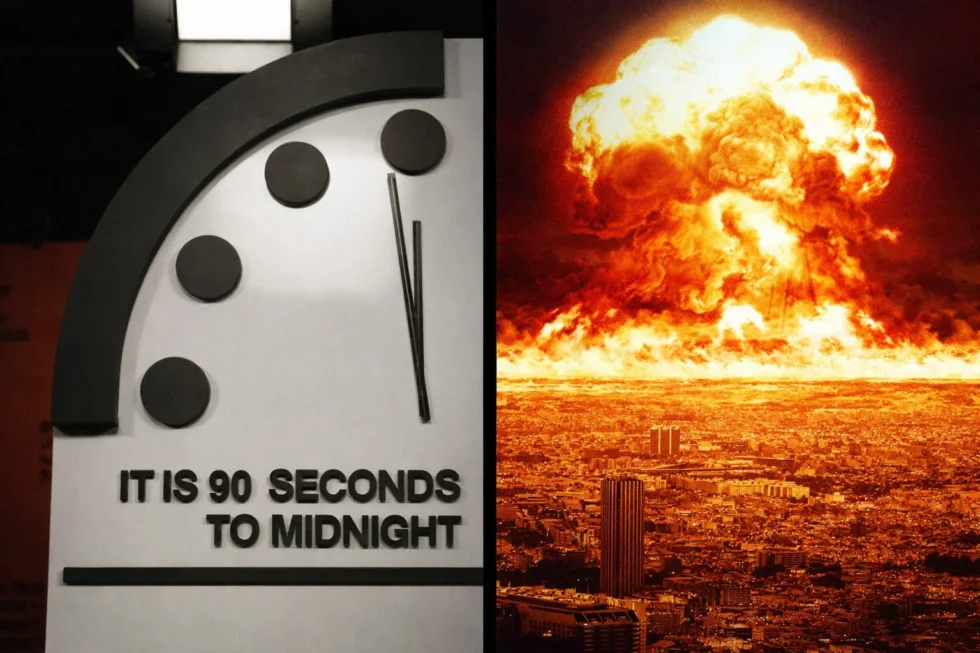
The Doomsday Clock is a symbolic timepiece that represents the likelihood of a global catastrophe threatening humanity. It was created in 1947 by the Bulletin of the Atomic Scientists, whose founding members included renowned physicists Albert Einstein and J. Robert Oppenheimer. Unlike a conventional clock, the Doomsday Clock does not measure real time; instead, its hands indicate how close humanity is to existential danger, including nuclear war, escalating international conflicts, climate change, and the unintended consequences of emerging technologies, reports the editorial team at The WP Times, citing information from the Bulletin of the Atomic Scientists.
In January 2026, the Doomsday Clock’s hands were moved four seconds closer to midnight, now standing at 85 seconds to midnight — the closest ever in the clock’s history. According to the Bulletin, this adjustment reflects a growing convergence of global threats and serves as a stark warning of humanity’s vulnerability. As Rachel Bronson, president and CEO of the Bulletin of the Atomic Scientists, stated:
"The world is facing a perfect storm of crises — nuclear risks, geopolitical tensions, and rapidly advancing technologies that could magnify human error."
The history and significance of the Doomsday Clock
The Doomsday Clock was originally conceived to communicate the dangers of nuclear weapons to the public and policymakers. Its hands are set annually by the Bulletin’s Board of Directors and a panel of experts, including 18 Nobel laureates, who review political, military, technological, and environmental developments.
Over the decades, the clock has reflected major crises:
- 1949: The Soviet Union conducted its first atomic bomb test, moving the hands to three minutes to midnight, signalling the beginning of the nuclear arms race.
- 1953: After the United States and USSR tested thermonuclear weapons, the clock moved to two minutes to midnight, the first time it reached such a high-risk level.
- 2001: Following the September 11 attacks and rising geopolitical instability, the clock advanced to seven minutes to midnight.
- 2018–2022: The clock consistently indicated an extremely high risk, reflecting nuclear tensions, cyber warfare, climate crises, and the beginning of Russia’s invasion of Ukraine.
The clock is not a literal prediction, but a symbolic measure of existential threats, intended to raise awareness and prompt action.
Why 2026 is unprecedented: key factors
The latest adjustment, moving the clock from 89 seconds to 85 seconds to midnight, is driven by multiple overlapping global factors:
- Geopolitical tensions: Increasingly assertive policies by Russia, China, and the United States have raised the possibility of miscalculation and conflict escalation.
- Ongoing wars and regional conflicts: The war in Ukraine and instability across the Middle East have contributed to heightened global risk.
- Nuclear threats: Concerns over potential nuclear weapons use have intensified. The Bulletin noted that “regional conflicts involving nuclear-armed states continue to pose an existential risk.”
- Technological risks: Rapid development of artificial intelligence (AI) and its potential misuse in creating biological or other catastrophic hazards.
- Climate and environmental concerns: While nuclear risk dominates the clock, climate change and fossil fuel dependency remain significant long-term threats.
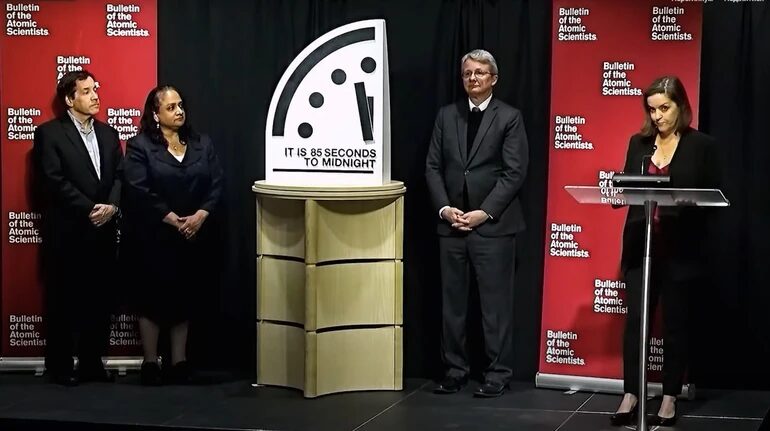
The Bulletin explained in a statement:
"Throughout 2025, both longstanding and emerging threats intensified. This includes not only the escalation of armed conflicts but also the acceleration of AI development and growing climate instability."
Scientific analysis and recommendations
Despite the unprecedented proximity to midnight, scientists stress that humanity still has opportunities to reduce these risks. Some of the key recommendations include:
- Reviving international dialogue on nuclear disarmament: Reducing warheads, enhancing verification mechanisms, and establishing arms control agreements.
- Regulating AI and biotechnology: Preventing the use of AI to design biological weapons or other catastrophic technologies.
- Reducing reliance on fossil fuels: Limiting climate change impacts by transitioning to renewable energy and improving global energy governance.
- Strengthening diplomacy: Engaging nuclear and non-nuclear states to prevent escalation in volatile regions.
As Lawrence Krauss, theoretical physicist and former chair of the Bulletin’s Board of Sponsors, emphasised:
"The Doomsday Clock is a call to action, not a prophecy. Decisions made by governments and societies can still shift the hands away from midnight."
How the Doomsday Clock informs public awareness
The Doomsday Clock serves as a communication tool, raising awareness among policymakers, scientists, and the general public:
- Highlighting existential risks: It signals the proximity of humanity to potential disaster.
- Monitoring policy impact: The clock reflects the consequences of national policies, military actions, and international treaties.
- Assessing technological threats: Experts consider the risks of AI, biotechnology, cyber warfare, and environmental degradation.
- Encouraging international cooperation: The symbolic nature of the clock underscores the importance of diplomacy and joint efforts to mitigate global threats.
Historical parallels and symbolic significance
The clock has historically reacted to crises such as:
- Soviet atomic tests (1949)
- Thermonuclear testing (1953)
- 9/11 attacks (2001)
- Russian-Ukrainian war (2022)
It serves as a reminder that humanity has repeatedly faced moments of extreme danger, and that proactive steps—political, scientific, and technological—can prevent catastrophe.
Practical steps for reducing risks
Even at 85 seconds to midnight, experts suggest concrete actions:
- Strengthen arms control and nuclear non-proliferation treaties.
- Implement AI and biotechnology safeguards.
- Reduce fossil fuel dependence to mitigate climate-related threats.
- Support diplomatic conflict resolution, particularly in high-risk regions.
These steps demonstrate that while the clock indicates danger, it is not inevitable — coordinated global action can still “turn back the hands.”
Read about the life of Westminster and Pimlico district, London and the world. 24/7 news with fresh and useful updates on culture, business, technology and city life: What is Nipah virus? Deadly India outbreak raises UK health concerns