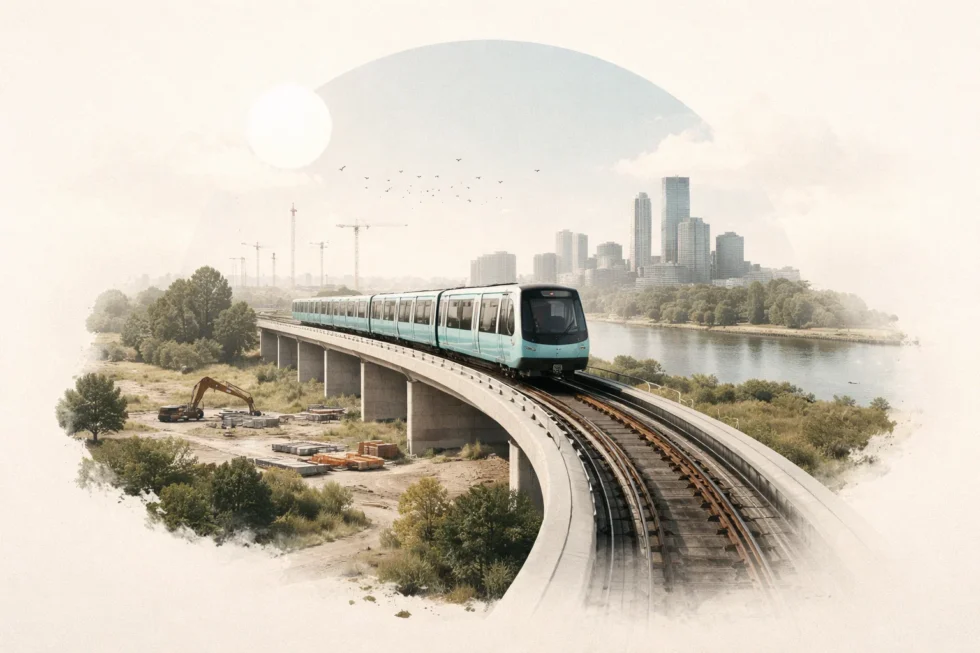
Transport for London has confirmed the full scope, cost and delivery timetable for the long-awaited DLR extension of the Docklands Light Railway into south-east London, providing long-term clarity on a project first proposed more than a decade ago. Newly published tender documents show construction is due to begin in 2028, with passenger services expected to start in 2033, The WP Times reports.
The scheme, first outlined in 2010, is designed to address one of London’s most persistent transport gaps. Despite its size and development potential, Thamesmead remains one of the capital’s largest residential areas without a direct rail or Underground connection. The confirmed timeline marks the first firm delivery commitment after earlier targets of 2026 and 2028 were abandoned.
Route and stations confirmed
Under the approved plans, the Docklands Light Railway will be extended east from its current terminus at Gallions Reach, creating the first direct rail connection into one of London’s least-connected areas. The new section of line will serve two purpose-built stations at Beckton Riverside and Thamesmead, both located within large-scale development zones identified for long-term growth.
TfL says the route has been designed to support thousands of new homes and jobs planned for the area, while also reducing dependence on long bus journeys and private car use. Improved rail access is seen as a prerequisite for unlocking regeneration at scale, particularly in Thamesmead, which currently has no direct Underground or mainline rail service.
Timeline: from construction to opening
Tender documentation issued by Transport for London sets out a seven-year construction programme for the DLR extension. Under the current schedule, preparatory works and main construction are due to begin in 2028, with the line expected to be completed and opened to passengers in 2033.
TfL says the extended timeframe reflects the complexity of the project, which includes the construction of two new stations, new track sections, signalling and control upgrades, power supply enhancements and full operational integration with the existing DLR network, all while maintaining services on live sections of the railway.
Cost and funding structure
The total estimated cost of the extension is £1.62 billion. The majority of the funding will be raised through borrowing by TfL and the Greater London Authority, with no confirmed allocation of direct central government funding at this stage.
The financing structure underlines the continued strain on TfL’s long-term finances. Analysts note that major transport schemes in London are increasingly dependent on borrowing and future revenue projections, rather than upfront Treasury grants, raising questions about how further large-scale infrastructure projects will be funded in the coming decade.
Key facts at a glance
| Category | Details |
|---|---|
| Project | DLR extension to Beckton Riverside and Thamesmead |
| First proposed | 2010 |
| Construction start | 2028 |
| Expected opening | 2033 |
| Total cost | £1.62 billion |
| New stations | 2 |
| Main funders | TfL, Greater London Authority |
| Government funding | Not yet confirmed |
Political and planning context
London Mayor Sadiq Khan has repeatedly framed the DLR extension as a strategic priority for addressing long-standing transport inequality south of the River Thames. The project has been positioned as critical to balancing London’s growth, particularly as large-scale housing development increasingly shifts towards the city’s outer and river-adjacent zones.
At the same time, the project’s prolonged development cycle has exposed structural weaknesses in how major transport schemes are planned and financed in the capital. Repeated delays, shifting delivery targets and the absence of guaranteed central government funding have highlighted the vulnerability of long-term infrastructure projects to political cycles, fiscal constraints and changing national transport priorities. For residents of Thamesmead, the confirmed timeline means the area will wait more than two decades from the scheme’s initial announcement to its completion — a delay that has become emblematic of the challenges facing regeneration-led transport planning in London.
What the extension changes for passengers
Once operational, the extension is expected to significantly reduce journey times between Thamesmead, east London and Canary Wharf, providing the area with its first direct rail-based link into London’s wider employment and commercial centres.
TfL expects the new line to relieve pressure on existing bus routes, which currently handle the majority of commuter demand from Thamesmead and surrounding areas. Faster, more reliable rail services are also expected to improve peak-time resilience, reduce overcrowding on parallel corridors and offer commuters a credible alternative to car-based travel. More broadly, TfL has described the scheme as a transport “enabler”, with benefits extending beyond day-to-day travel to include improved access to jobs, education and services across east and central London.
New DLR trains and operational readiness
The extension will be operated using TfL’s new B23 DLR trains, which began entering service in September 2025 as part of a wider modernisation of the network. The fleet was temporarily withdrawn as a precaution after a braking-system issue was identified during routine checks, a move TfL has stressed was not linked to any safety incident.
The trains are expected to return to service by the end of 2026, well ahead of the extension’s planned opening. Once fully deployed, the B23 units will provide higher passenger capacity, improved step-free access, better energy efficiency and enhanced reliability across the DLR network.
Why the project matters beyond transport
Beyond reducing journey times, the DLR extension is central to long-term regeneration ambitions in south-east London. Improved rail connectivity is widely viewed by planners as a prerequisite for unlocking large-scale housing development, attracting private investment and supporting sustained employment growth.

For Thamesmead, the project represents a structural shift rather than a marginal upgrade — moving the area from the edge of London’s transport network towards full integration with the capital’s rail system. City planners argue that this change is essential if regeneration in the area is to move beyond isolated developments and deliver lasting economic and social impact.
Read about the life of Westminster and Pimlico district, London and the world. 24/7 news with fresh and useful updates on culture, business, technology and city life: When will the A40 Westway close and until when will TfL works last in London